Showing posts with label liveblog. Show all posts

10 September 2014

LiveBlog: Steward Pickett: Evolving Theoretical Frameworks for Urban Ecological Science

Rough notes from the Common Lecture

Steward Pickett
Evolving Theoretical Frameworks for Urban Ecological Science: The Global and Regional Metacity

"City" - downtown, suburbs, commercial, industrial, etc.  but the city encompasses more than just those areas

Old City assumptions include - We have long assumed that city and country are distinct

more after the break

12 February 2014

Anita Bakshi Liveblog

Anita Bakshi
Is green always good? Landscapes of division and silence
(Note: as a live blog on a politically contested territory, I want to apologize in advance for notes that misconstrue Dr. Bakshi's comments with provocative links and comments that are probably unintentional)

In early 20th Century Jerusalem, Charles Robert Ashbee proposed eliminating some of the historic structures to create more enhanced views and green space. In part, this plan was based on his hope to return the city to what he called “the most perfect, medieval enceinte in existence.”

The area has areas called Mewat land, seen as unclaimed. But even village lands are contested, since the land outside of a village wall is seen as essential by the Palestinian village but available or unused by Israel.

Another type of land in these areas is the Peace Forest which is examined more closely in a documentary film called The Village Under the Forest.

Proposals for national parks become contentious for a variety of reasons. One of the examples was the City of David property which can be linked with a larger network of similar lands.

Our sense of connection and movement through connected lands is very different in our region than it is in Israel and Palestine. As such, evaluations of proposals (like the proposed Mount of Olives National Park) have to be considered from different perspectives than just those with which we might approach the situation.

Even neighborhoods, like Walaja, become contested territory.

Landscape as heritage
Mostar Bridge in Bosnia and Herzegovina 
Yad Vashem


20 November 2013

GIS Day Common Lecture Live Blog: Erika Svendson

Visualizing the Social: Understanding and Mapping Urban Environmental Stewardship
Erika Svendsen, Research Social Scientist
People and Their Environments: Social Science Supporting Natural Resource Management and Policy
NYC Urban Field Station, Northern Research Station, US Forest Service

Cultivating more places of places of social meaning - a little green or a lot
Different research types
...Intensive-Extensive + Social-Biophysical
  
Inspired by Prof. Bill Burch at Yale School of Forestry and Environmental Studies
Human Ecosystem Framework (HEF)
Virtuous vs. Viscous Cycles - Disturbance can be useful

Stewards as first responders.- adaptive/polycentric
Gardeners as first responders - urban fiscal crisis 
...Strengthening social cohesion and fostering new forms of governance
Resilience cycles
Giuliani and community gardens

Book/blog: Greening in the Red Zone - this isn't just for wealthy urban enclaves


Joplin Tornado Memorial - USFS still has a forester there, helping the city recover - extending the recovery timeline - already planted over 5000 trees

Nature: As asset and a threat


Stewardship mapping
STEW-MAP Project
Online and mail-in survey
initial n=5861
final n=2517

NYC Oasis map  Mapping stewardship "turf" like it was gang turf

Network analysis identified the individuals/groups that served as nodes within the massive stewardship network in NYC- bridge, broker, and bi-modal governing


Timeless threads and places of Social Meaning
Jamaica Bay neighborhoods after Superstorm Sandy
zone mapping for each of the parks - a new social layer for NYC Parks
found lots of 'mad love' for parks
Example: Frank Charles Memorial Park
Example: Sea Song Memorial

Tree planting helps strengthen democracy

Stewardship is a restorative mechanism, it is a part of our social infrastructure


See also: Stewardship, learning, and memory in disaster resilience (paper)
See also: Integrating grey and green infrastructure to improve the health and well-being of urban populations
And myriad other papers


17 April 2013

LiveBlog: Sub-arctic landscapes

Janike Kampevold Larsen 
Beyond the Nation: Contemporary Challenges for Northern and Arctic Landscapes

Some sloppy notes from a great lecture today:

Current features includes glaciers, oil and gas industries, impassable mountain regions (until after WWII)
The landscapes were captures by Maximillian Carpelan and Johannes Flintoe


An abundance of minerals and metals (like aluminum) has led to an increased exposure to mining which is changing the landscapes of Northern Sweden


View Larger Map

Influences are shared beyond Norway:
Stourhead
Rockefeller State Park

Railing at the falls at Videseter shows how deep the notion of landscape at Stourhead really is

Nedre Oscarshaug
At Bergbotn, Senja, Code architecture's undulating cantilevered bridge

How do we learn how to see?

We also heard some quotes from Friends of the Pleistocene (FOP) Blog

Landskip and Landschaft as competing ideas
Everything is a story

(Our guest speaker never mentioned the Witch Monument in Vardø, but once I stumbled into it I had to link to it as well)


06 February 2013

LiveBlog: Julie Langsam

Not much bloging today, but a few good links because the imagery was so engaging. It was fascinating to hear her boldly show us how she has stripped away context and landscape (2 things we treasure most).

Julie Langsam
Classicism, Romanticism & Modernity: A Painter’s Perspective

13 April 2011

LiveBlog: Jim Welsh

Jim Welsh
Thomas Balsley Associates


...We're Halfway There.  Livin' on a Prayer

Starts with a personal history inspired by The Last Lecture by Randy Pausch

He encourages us to go back and check out their old award-winning projects too.  And then visit, since many of them are in New York City. 

The first project is the Curtis Hixon Waterfront Park in Tampa next to the Kiley Gardens.  Some elements are not for the reasons they seem, like a dog run which is about ensuring that there is a steady presence of eye on the park from sunrise on.  Custom designed site furnishings are a standard tool in their efforts to make a design experience unique.

Main Street Garden Park was one of the first new parks in downtown Dallas in several years. 

They also recently completed the Zen Garden at the Intercontinental Hotel in NYC.

Balsley partnered with Stantec to work on the Heritage Park at Yankee Stadium.  Partnerships like this are pretty important for making special projects work.

Hunter's Point South will be an extension of the Gantry Park project.

The Master Plan for Binghamton University builds on an existing campus that resembles an upsidedown brain in plan view.  Balsley offered design ideas for turning some of the underutilized spaces on campus into more student-friendly and greener spaces.

Ferry Point Park in the West Bronx is being redesigned to include a Jack Nicklaus golf course and turn a contaminated site into a meaningful green space for local residents.  Turning the waterfront into a quality space and integrating environmental features and native grasses.

And then we got into life lessons, but I'll spare Jim from having them on the Internet.

23 February 2011

LiveBlog: Ray Mims on SITES

Ray Mims, US Botanic Garden
Applying the SITES rating System: Lessons from Pilot Projects


One of his favorite quotes:
We abuse land because we regard it as a commodity belonging to us. When we see land as a community to which we belong, we may begin to use it with love and respect."
— Aldo Leopold

He used a photo of three LEED Plantinum buildings, none of which had any trees anywhere around them. He pointed out how different meanings of green can proliferate. We are missing out on, or ignoring, countless free ecosystem services that we should be appreciating. Examples like the Catskills and New Orleans illustrate how important ecosystem functions are.

SITES is up to 165 pilot projects. 65% were grayfield projects while 15% were brownfields and 20% were on greenfields. The pilots worked - they discovered some issues they hadn't thought about. For instance, it changed their treatment of prime farmland and the submittal materials. The goal of using these case studies is to make the Sustainable Sites Initiative as well thought out as possible.

A detailed description of the Bartholdi garden explained how the USBG  is trying to apply the sites criteria themselves, in the shadow of the US Capitol. (I love that fountain)

They've worked to be very open and collaborative so avoid lawsuits like LEED

08 December 2010

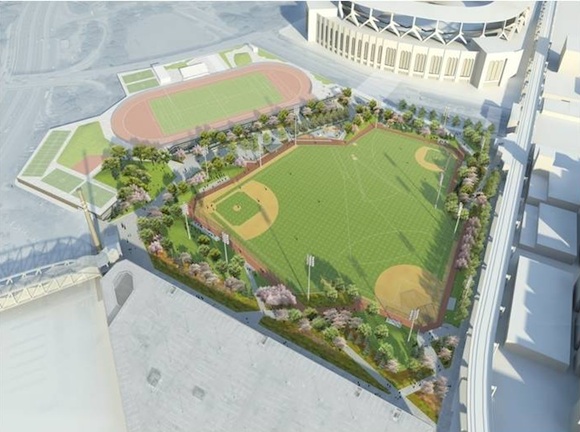
LiveBlog: Yankee Stadium Upland Park Redevelopment

 Yankee Stadium Upland Park Redevelopment

Gary Sorge, FASLA, Stantec
Frank McCue, NYC Parks

Last LiveBlog of the semester.

While one is the client and one is the design firm, they really work as a team.  The project had over 450 submittals to review. 

Mill Pond Park was built on the site of the old Bronx River Market from the 1920s-1970s.  The old Powerhouse has been retrofit with a green roof, hoping to get LEED Gold.

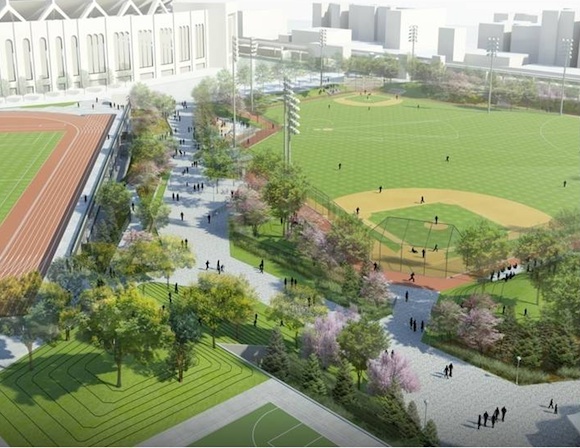
The new park has been built just as it was shown to the community in early renderings. Macomb Dam Park was also overhauled with Heritage Field and Ruppert Plaza.  There are River Avenue Pocket Parks, including small play areas and a $3 million skateboard park.

MetroNorth built a new train station which had to be integrated into these design, too.

Stantec's approach emphasized the park as more than just a collection of ballfields, but a highly accessible park for the broadest possible audiences.  Some pieces of the old frieze (the white arched fencing that is part of the Stadium iconography) were saved for the new Heritage Field.  Layout and grading requirements prevented them from being able to save the location of home plate as the new home plate, where Lou Gehrig gave his famous address. (now it is at 2nd base)  But they did preserve the giant bat.  They are also installing 7 Viewmasters so you can see slides of the old Stadium.  They did preserve the footings of much of the Stadium, burying them under the berms.


Ruppert Plaza is the wide walk you see below.  The mound is above the roof of a parking deck.

The park will also have Yankee quotes and even a Bull Durham quote scattered around on the walls. 

  Work began this past summer.

17 November 2010

Live Blog: Seiko Goto

Designing Gardens for the Healing Mind
Seiko Goto


This post-sabbatical report comes in three acts.  As usual, liveblogging is sloppy, incomplete and inaccurate.
1) Historic research
 (will be in a film with NHK for Japanese next August and then translated into English and brought to US)

WWII Japanese Interment camps
These controversial facilities were located in inaccessible locations with poor living conditions. 
Photos by Ansel Adams only tell part of the story.
The camp was so large that it had 24 dining halls.
Today it is a NPS National Historic Site.

Gardens were one of the key tools for helping the interred make the experience less painful.

David recommends Kenny Helphand's Defiant Gardens

2) Garden Projects
What if the residents of a senior community had an indoor garden in the winter?
Differnet courtyards were identified (some designed by professionals, some note so much), and then residents were asked to visit each - once in the winter and once in the summer - and review their preferences.
Associations with plants from their childhood were important.
The Japanese garden was the most preferred and the herb garden (professionaly designed) was least preferred.  Comments about the herb garden suggested a problem with the ephemeral nature of herbaceous plants.
At a nearby school, she found that primary school kids also preferred Japanese garden designs.

As an alternative to prefernece surveys, she used synthetic and para-synthetic EKG to monitor patient responses to gardens.  Japanese gardens were found to e better, but the lack of trees in herb gardens might have just made them too hot.
Finally, Alzheimer's patients were studied.  EKG, heart rate, medical report and video tape were used to document responses.  Patients started inside and then moved outside.  They heard crickets, and when they went away, noticed that they were missing.  Since these patients' memories aren't supposed to endure that long, it was a notable finding.  Something is linking memory and gardens.

3) Japanese Garden Workshop
Mark R reported on a small group trip to Kyoto where the students got to do hands-on maintenance with a master japanese gardener.
"If a carp can become a dragon, what can you do?"

06 October 2010

Live Blog: Laura Lawson, Rutgers


Dr. Laura Lawson
Chair, Department of Landscape Architecture
Community Gardens: Trend or Fad?

Official Summary:
To some, the recent upsurge in interest to start community gardens, school gardens, and socially-based urban agriculture programs is a reactionary fad that satisfies the impulse to “do something” amid multiple social, economic, and environmental crisis. To others, however, it represents a trend towards more sustainable communities and food systems. Which is it? Acknowledging the many timely benefits associated with such programs, it is also important to frame community gardening in the context of over one hundred years of advocacy and programs.  This presentation will describe the evolution of community gardening from the 1890s to present.  While past phases tended to be opportunistic and temporary responses to social and environmental concerns, today’s programs are increasingly framed as permanent resources to serve individuals and communities. Developing and sustaining gardens that in turn sustain communities requires attention to land tenure, community outreach, and engagement of a wider network of support.

 With the beginning of this fall semester, Dr. Lawson has taken over the leadership of the Department of Landscape Architecture. She has joined us from the University of Illinois, where she was a member of the Landscape Architecture faculty and Director of their East St. Louis Action Research Project.  Laura has been involved in a broad range of landscape architecture practice and teaching.  Her scholarship focuses on community building through landscape design and activism.  We highly recommend her books, especially City Bountiful: A Century of Community Gardening in America (University of California Press, 2005).


 ____________________________________
 Let the liveblog begin...

What are the benefits?
What is our contribution as LAs?
  Turning red squares into green squares
What does it take to sustain an urban garden program?

History
The history goes back to the 1890s
One example is the creation of Vacant Lot Cultivation Associations (1893-1897)
   a response to the depression
Then there was a children's school garden movement (photos)
Vacant lots and backyards became important resources
War gardens of WWI
  A community effort
   then everyone celebrated the end of war by getting away from this
Relief and subsistence gardens (1931-1935)
  Selling food was discouraged - use it as local aid but don't compete with farmers
WWII Victory gardens (1941-1945) were much more notable - but some wondered whether it was efficient
10 days after Pearl Harbor the desire to do more was so great that the government embraced it
  treat it as a lifestyle

  Victory Garden posters
  The response from landscape architecture? "Yes, but with discretion."
Community Garden Movement (1970s-????)


Learning from Successes: Seattle
Seattle is a major success - P-Patch Program
Here is Thistle from above:

View Larger Map

Here is Bradner Gardens P-Patch in StreetView:

View Larger Map

One of the challenges today is that they are still seen as temporary by many people and viewed as a very local use.  (You can drop in and play soccer at the park, but you can't drop in and eat a carrot at a garden, unless you are willing to let Mr McGregor chase you.)

Urban Personalities
Place-based character and sustainability
Why are Chicago's gardens different than other places
_Great organizations, but does the alderman system keep them from coordinating better?  Redundancies occur
_Growing native plants instead of veggies
_NeighborSpace Land Trust

Land availability in Detroit creates a different pattern - 10 month growing season (hot houses, etc.)
Food desert forces more farming than gardening

Important enough that streets get named after this:


View Larger Map

Community + Garden


Here is a nicely maintained community garden in the Boston Fens that we saw on a Fall Field Trip several years ago.  You should join us on the next trip...


We didn't need to ask 3 Landscapes because we did it so recently.

24 February 2010

LiveBlog: Elijah Huge

Elijah Huge, Architect
Contrived Environments

Leads both a student studio (North Studio) and a separate small professional studio (Periphery)
 SplitFrame at Mattebeseck Reserve in CT was a design-build project
The project sequence was influenced by the site and created a viewing deck that allowed visual access to the water while creating a structure that reflected the unique characteristics of the place

Intertidal
In Cape Cod Periphery worked on a comeptition project at Buzzards Bay Village
The centerpiece was a town green that, it was felt, should be more about water than land
They created a series of forms and voids that allowed the tide to create a daily drama as it flowed in and out

Tangshan Earthquake Memorial Park

Bundalow
A bamboo project at the Schuykill Center

Sukkah
His students designed and built a Sukkah at Weslyan
While initially unfamiliar with the details, they were offered some rabbinic code and encouraged to design something that could be erected every year
The final design was a series of arches which blurred the distinction between walls and ceiliing

Part of the goal is to treat architecture as something that isn't clearly defined - none of these projects have doors
The tectonics and materiality finds a commonality with us as landscape architects and designers

04 November 2009

LateBlog: Drs. Frank and Deborah Popper

Due to some technical issues, I was unable to liveblog today's talk. But here is a summary of how it went.

Part I: Dr. Deborah Popper on Great Plains History and the Buffalo Commons

Dr. Popper described the history of the settlement and development of the Great Plains as an agricultural landscape. She talked about about short-grass and mid-grass prairies, Easterners and immigrants. There were always economic cycles of booms and busts that shaped the landscapes. Mix in some dustbowl. With mechanized farming, increased production and an influx of capital the great plains were seen as key to helping feed the world.

Then came the decline and with it came environmental degradation and loss of jobs. In the 1980s debts were called in. Suddenly the thinning population underwent lifestyle changes - itinerant ministers, no afterschool.

This, said Dr. Popper, was a region characterized by variability. Indeed!

In response the Poppers proposed the Buffalo Commons. Their 1987 Planning paper proposing the Buffalo Commons was one of the top 25 papers in 25 years. It was meant as a metaphor but it resonated so well that it stuck. Even the name was more provocative than they may have intended.
Buffalo = animal they had gotten rid of
Commons = Sounds like communism
Tribal groups responded positively. They have higher rates of diabetes and recognized that a shift towards buffalo meat could help.

Still, many communities wondered if they could get back to growing their economies. WHat kind of hazardous waste facility could we attract? How many casinos can we build? Dr. Popper suggested instead that they "Look to the land."


Part 2: Frank Popper on the next Depopulation Crises

Dr. Popper donned his infamous buffalo hat for his portion.

After letting his wife tell one story of regional decline and redempetion, he suggested that we look elsewhere for others - Northern NE, Northern MidWest, Lower Mississippi Delta.

(DT - Double Play! LateBlogging comes with some benefits.)

He asks whether the declining part of big cities like Detroit and Cleveland are really all that different than the Great Plains. Now that drivers on Detroit's Interstate highways are treated to the sight of pheasants, it is becoming eerily similar. And both the plains and the cities are left with aging communities less able to migrate.

3 cities have emerged as trying to be more creative or aggressive in finding new futures for their communities: Youngstown, OH, Braddock, PA and Flint, MI. Youngstown is getting creative about its future and looking into ways to rework ownership patterns. Flint is seeking to buy up vacant land. Braddock's mayor is on the cover of this month's Atlantic Monthly. From Buffalo to St Louis, more and more post-industrial cities are now where the Great Plains was back in the 1980s when the Poppers first proposed the Buffalo Commons.

For so long Western Civilization had embraced the notion that growth was a sign of health. These examples confront us and challenge us to reconsider the notion.

(DT - Another run!)

What will the urban equivalent of the Buffalo Commons look like? What will be the next sites of rapid depopulation? Suburbs? Coastal zones?

07 October 2009

LiveBlog: Ellen Creveling of TNC

Ellen Creveling, Conservation Science Coordinator
The Nature Conservancy, New Jersey Chapter
Conservation Planning at Scale: the Nature Conservancy's statewide approach for New Jersey


Why Plan? It seems obvious but is worth asking. LIimted resources force tagetted efforts and thoughtful strategies.

The primary goal of their ecosystem planning is to ID a system of conservation areas that contain multiple viable examples.

Much of the work is organized by an ecoregional approach
They try to evaluate their targets by by finer and coarse filters
  • what are the large ecological community systems worth saving?
  • what are the key species that get left out?
The target set should be representative and provide redundancy

Target viability means that TNC needs to consider:
  1. size
  2. condition
  3. landscape context
TNC started a statewide look by identifying road-bounded polygons
Matrix and umbrella blocks - 10,000 acres and 75% or more natural - 4250 ac and 75% natural
The went back and looked at polygons of a certain size and asked which had rare or notable species
The looked at high quality watershed lands too

Still, there was a lot of prioritization left to do, but they got the list down to 12 areas around NJ
  • Highest ecological importance - broad systems and specific species
  • Immediate and multiple threats
  • Action could result in success
  • Since that plan was completed, other activities have contributed in other ways
    • Forest assessment
    • Freshwater streams assessment - not all streams are created equal
    Dynamic forces like climate change colmplicate this process quickly too.
    It isn't all preservation. Restoration is in their toolbox, too.

    30 September 2009

    LiveBlog: Eric Sanderson on Mannahatta

    Eric Sanderson
    Mannahatta: A Natural History of New York City
    The Fall 2009 Environmental Planning Lecture

    So right up front we have to acknowledge that today's talk brings with it some extra attention. The Mannahata Project has a highly visible website with data as well as plenty of attention from the NY Times and WNYC's Leonard Lopate Show. Rutgers alum Kate John-Alder recently wrote a review in the Architect's Newspaper. If you want depth, you should start with Kate's review. This is just a LiveBlog...

    MuirWeb and Mannahatta - making the invisible, visible
    Mannahatta, the isle of many hills

    It all started with a map found
    His work at the World Conservation Society (Bronx Zoo) led him to this map that went back before the usual early histories
    . . . . Father Duffy

    NYC was the first megacity - Now there are 18, soon there'll be 27

    1782 or 1783


    Fort Kniphausen - Fort Washington

    What if we could take the streets off and go further back in time.
    Sanderson's team made an historic DEM, added spotty data, and ran a human habitat model
    . . the best places were around Collect Pond, near Chinatown and City Hall
    . . . similarly they could look for Lenape field where they might have grown the three sisters - corn, beans, and squash
    . . . they could model the 55 different ecosystem types that came up as most likely - he thinks of these as being the neighborhoods for plants and animals - more than Yellowstone has on a per acre basis
    Sorry, no PowerPoint comas today. This was an ArcGIS dependent presentation.

    Home Reconstructed
    He enjoys looking for similar landscapes to the original places
    • Hempstead Plains Grassland
    • Coastal Appalachian Oak-Pine Forest
    • Rocky Headwater Stream
    • High and Low Salt Marsh
    The Lenape were written about by Penn - today we think about 3-600 people lived on the island.

    Animals were plentiful
    • Beavers were probably o all 66 miles of streams
    • Heath hens
    • Deer and maybe elk
    • Wolves
    • Black bear
    WCS looked at habitat conditions based on four characteristics
    • Food
    • Water
    • Shelter
    • Reproductive resources
    And they started recognizing the networks that were present in these habitat and species relationships - it led them to the MuirWeb
    It features a density of relationships that make it robust, dynamic and resilience
    The MuirWebs are named for John Muir (a real shaper) who said:
    "When we try to pick out anything by itself, we find it hitched to everything else in the Universe."

    With Markley Boyer he then illustrated the best estimation of how it looked.

    The old and new are both pretty special. Can it last for another 400 years?


    As his epilogue, he points out how humans need more than Food, Water, Shelter, Reproductive resources, we also need Meaning. But have we spent so much time worrying about Meaning that we have neglected the others?
    What if we brought back the streetcars and added greenroofs? Can we think regionally again?
    The #1 agricultural county in the US used to be Queens. Can it come back?

    What would it look like then?


    View Larger Map

    15 April 2009

    Liveblog: Stu Appel - Greetings from Dubai

    Stu Appel - Wells Appel

    Greetings from Dubai: Design, Environment and Impressions of a New Middle East

    Rather than talk about his own work, Mr. Appel talked about the larger context of this important place.
    We are all temporary stewards and we try to learn lessons from the past. But here is a place with no lessons from the past, no history, no grounding to identify what is important. The Bedouin history is limited, there was a little pearl industry and a small port city.

    Dubai
    3:1 Male:Female ratio
    83% of the city residents are expatriates – they can’t own property
    Home to the iconic Burj Al-Arab hotel and the tallest building ever, the Burj Dubai
    In 2006 the population had grown to about 1.4 million (over 1 million men)
    The Palm Islands will have 4000 villas, 1000 water homes, 5000 apartments


    View Larger Map

    Other notable features of the city included the Mall of the Emirates, with its indoor ski slope, and the district of Dubailand. Stu described Dubailand as Orlando times 2.5.

    The world financial crisis has impacted the place as well, with hundreds of billions in construction that has halted.


    Qatar
    45 minutes by plane from Dubai, but a very different approach
    Doha is taking down its embassies to create green space along the water
    Less than half a million residents, more expats than not
    Has protected older places and created other quality spaces - Souk marketplace
    It is a place of contrasts - Fishing ships cross in front of modern structures
    The heat still requires better indoor spaces like at the Sidra Medical and Reserach Centre

    They are not immune to the dramatic - check out this video of their island complex called The Pearl...


    The environmental impact may not get discussed as much, but the opportunity to participate in some of these unparalleled experiences is a trade off that some designers won't make. And the cultural conflicts are tough, so guides have emerged. But this is an important place and different people and groups are dealing with it in different ways - ULI has a new magazine called Urban Land Middle East.

    Summary: Not a travelogue, not a design presentation, but a serious and thoughtful discussion about this emerging world center.

    11 March 2009

    Liveblog: Annette Voigt on Landscape Conservation

    Annette Voigt Technische Universität München Dept. of Landscape Ecology
    Nature Conversation in Germany – Problems and Perspectives

    Today's talk explored questions about the meaning of nature in a place like Germany, where there remains an active dialogue about whether conservation should be favoring natural or cultural landscapes, especially since 19th century agricultural landscapes are treasured by much of the public. This process is pursued to preserve the Germany of the past:
    • Heimatschutz = Homeland conservation
    Ecologists are less positioned to address the meaning of nature and simply rely on concepts like wilderness and ecosystems as subjective constructs as a convenience.

    As an example she described the wilderness development area at Koenigsbrucker Heide in Saxony. Her
    dissertation abstract is available to help you digest some of these concepts.

    (I know little about these ideas, but it looks like this might be an interesting read, too)

    11 February 2009

    Live Blog: Potential for LEED-ND to Curb Sprawl in NJ

    Exploring the Potential for LEED-ND to Curb Sprawl in New Jersey
    The Spring 2009 Environmental Geomatics Lecture
    John Hasse, PhD
    Rowan University

    Part I: Patterns of Land Development in NJ
    How do you know sprawl when you see it?
    One person's sprawl is another person's American Dream.
    Most densely populated state
    Still increasing population, but the rate is slowing down a little
    Does that mean that development is slowing down?
    Using Google Earth, Dr. Hasse illustrated land use change patterns and showed that new development in a 16 year period was equal to the total land area of Bergen, Hudson, Passaic and Essex Counties combined.

    He projects that in August 2008 we crossed the line where forest was the largest land use in NJ, to where Urban is now the largest!

    The basic numbers on loss of forests and wetlands and gains in development are on the CRSSA Landscape Change web page.


    He encouraged students to go to the NJ State Atlas website to get some other ways to look at the landscapes of New Jersey.


    Part II: Can LEED-ND help with NJ Sprawl?

    LEED-ND is the USGNC's new LEED measure for Neighborhood Development. While LEED has been around for buildings (like the Comcast building in Philly - the world's tallest green building) it is pretty new for developments. It includes firm requirements, like not building on wetlands, and some things you can do to get points, like affordable rental housing. It also requires at least 7 houses per acre and rewards transit, energy efficient buildings.

    Dr. Hasse used Rowan Boulevard in Glassboro as a case study. This is a redevelopment of a deteriorating town center driven by the school, meant to help the town. Technically it would be ineligible because of an existing stream. But he proceeded to explore some other measures. The site avoided T&E species habitat, had more than 55% of front doors within a walking distance of a bus stop, connected to a bike path, and had dwelling units close to schools.

    28 January 2009

    Live Blog: Tom Woltz on Desiging the Frame

    “Designing the Frame: landscape architecture as a tool in the ecological conservation, education & sustainable architecture.”
    Thomas Woltz, ASLA
    Nelson Byrd Woltz

    Holly Nelson described him as "Practicing what he preaches"
    Interesting to visit a program situated amidst other professions like ecologists and plant scientists. Here are some projects that he spoke about:
    • The Dell - Stormwater management project at UVA
    An aesthetic solution as well as a functional solution.

    He refocused on bringing out natural beauty on a series of farm projects. One was called Tupelo Farm. It was recently described in the New York Times:

    At Tupelo Farm, an estate near Charlottesville, Mr. Woltz drew on the region’s geology, agricultural traditions and plants — both native and imported — in designing the garden, a project that he has been working on since 2000. Locally quarried fieldstone walls retain the heat of the springtime sun and establish curving terraces for a peach orchard, a gesture at Albemarle County’s history as one of the state’s largest producer of peaches in the 19th century. Nearby, on a smooth flagstone terrace, a group of half-buried boulders has the same geological composition and similarly mounded shapes as the Blue Ridge Mountains that loom over the farmland.

    While each farm is different, one of them was intended as a life-long design project, evolving slowly over time. The ethics of water quality management, native grasses, and green design have been so successful that 6 neighbors have also hired the firm to expand their efforts to 2,000 acres.

    He also showed us a Charlottesville Urban Farm which helped turn open land in the city into a more productive and more community-oriented landscape.

    Finally we looked at Nick's Head Station in New Zealand. It was a controversial site, with many locals initially opposing its purchase by an outsider. Not only is it the place that Cooke first saw, but it is also the place that the Maori first saw (and they found the fossilized remains of a Moa here). However, their designs for conservation of this significant site have helped. Their They have planted 250,000 trees so far, but aren't done yet. But the tree planting is only part of the design process. They've begun actively attracting rare birds with both habitat and recorded calls. But they worked to design the naturalized forms on the site in a way that reveals the human hand. Even areas of crops are formed in more structured ways than you might expect elsewhere. He closed with a few thoughts about the cultural connectivity that is becoming with the site too.


    View Larger Map

    21 January 2009

    Live Blog: Networked Ecologies: Infra-Architecture

    Mason White
    University of Toronto
    Lateral Architecture
    InfraNet Lab
    "Networked Ecologies: Infra-Architecture"

    Since he is used to talking to architects, this is a refreshing opportunity to explore this topic without having to first educate his audience on the different nature of the landscape.

    Four figures have provided guidance for this presentation:
    In thinking about infrastructure - somewhere in the mix there is an immense amount of science, but also an opportunity for an immense amount of design

    The networks of food, economics, aeroponics, hydroponics and infrastructure are all about SYSTEMS.

    One student project was from Scotland looking at seaweed agriculture. How is it moved? How is it stored? The design looked at a net system with a drying tower and seed farm on the land. The multiple public lives it could have include a nighttime use as a lighthouse.

    Another project looked at the possibility of merging speculative office space with sustainable agriculture/greenhouse space.

    Both have great graphics. Be sure to look closer.

    In Reykjavik they looked at turning runways into greenways for production, civic/ecology, and recreations.

    Their final project was a metis garden inspired by the map that changed the world and brought in soil samples from throughout Canada.

    03 December 2008

    Live Blog: Joel Flagler (brief)

    Today's liveblog was cut VERY short by technical problems and some of this is from memory...

    The 2008 Landscape Industry Lecture

    Taking Stock: The True Value of Horticultural Therapy

    by Joel Flagler

    Flagler has been at Rutgers for 21 years - he is a Cook grad and got his masters at the Yale School of Forestry and Environmental Studies.

    The only ag extension agent with a teaching appointment - Rutgers is one of four Universities in USA that offer a degree in horticultural therapy

    Our language is filled with many horticultural references – a reflection of how we integrate values into the dialogue.

    Horticultural therapy is used in at least 3 different ways:

    * Vocational
    * Therapetic
    * Social

    There are myriad benefits including building self-esteem, enhanced motor skills, psycho-emotional healing, job skills, etc.

    An exciting example in Bergen County is Health Barn USA. He promises we'll hear more about it soon.

    (The above photo shows people shopping for some happy healthy improvements at Ag Field Day)