06 May 2021

Slow TV

 Celebrate finishing that exam or paper by turning on the Great Moose Migration on Twitch. This is a live feed from northern Sweden with 27 different cameras streaming the migration. The area has a major river crossing but they also hang out nearby. Cranes, grouse, foxes, and beavers make cameos. The streaming site has a counter in the lower left, a daily "best of" show and a behind the scenes doc as well.


03 May 2021

Books revisited

 [slightly updated reprint]

Q. I have some extra time this summer/semester/winter and would like to read an extra book or two. Can you suggest anything good?

A. It depends on your interest.

A) An easy avenue to consider as a start would be to get some recent issues of Landscape Architecture Magazine which is published by the American Society of Landscape Architecture and is meant as their semi-official portrayal of the state of the profession.

B) For environmental planning students I frequently recommend the following (although some are recommended as examples of trends that I may or may not fully endorse):

Ian McHarg's Design With Nature and A Quest for Life.

Anything written by Wendell Berry. My favorite was Home Economics, but that was a while ago.

Duany, Plater-Zyberk, and Speck's Suburban Nation: The Rise of Sprawl and the Decline of the American Dream.

James Howard Kunstler's Geography of Nowhere: The Rise and Decline of America's Man-Made Landscape.

Oh, what the heck. Maybe you should just pick from Planetizen's Top 20 Planning Books list for this stuff. (Or their latest, the Best of 2020)

C) For those who are trying to move up from entry level students to serious students of landscape architecture, here is an edited version of the list Dr. Shearer prepared for some our past design students:
There are several books by John R. Stilgoe that are well worth reading. He is an historian, not a designer, and holds a joint appointment between the Department of Landscape Architecture at the Harvard Graduate School of Design and the Visual & Environmental Studies Department of the Faculty of Arts and Sciences. Also worth mentioning, he writes a bi-monthly column in the Sunday Boston Globe--South Shore Edition. You can find these by searching his name on Google News.
John Stilgoe, Common Landscapes of North America. His first major work, this book examines how North America has been intentionally shaped from the colonial era through the early nineteenth century by non-designers. Topics include measures taken by government--such as the Ordering of Towns which was penned before the Puritans stepped off the Arabella, the Spanish Law of the Indies, and the Jefferson-era Northwest Ordinance; by farmers--how northerners made fences to keep things in vs. how southerners made fences to keep things out and why barns are red; and by what might be considered visionary industrialists--such as the people who funded the Pennsylvania Turnpike and the Erie Canal. As one might expect, this book is chock full of historical facts, but its real strength is that demonstrates how "traditional" practices for shaping the landscape are not conventions to be followed uncritically. Instead, they are based on a complex combination of ideals and practicalities. At a minimum, this book would complement your landscape history class in that it describes the "non-art" shaping of the environment. But separate from that potential, I think this book would be of interest to everyone, regardless of whether you are in the landscape architecture, landscape industry, or environmental planning & management programs.

John Stilgoe, Outside Lies Magic. Relatively short and very approachable, this book was written for a broad audience and intended to get everyone to go outside, look around, and think about the implications of what they see. For example, how does the US Post Office organize space and how, in turn, do we--in part--live by that organization?

John Stilgoe, Landscape and Images. This book is a compilation of some of JRS' articles and essays. Topics include the role of photography in shaping our understanding of the landscape (for better and worse), the specter of hobgoblins in suburbia, and bikinis. This book came out last year through the University of Virginia Press and I do not know if it is available as a paperback yet.

Simon Schama, Landscape and Memory. Schama is another historian, but unlike Stilgoe does not focus on the environment. (For example, a previous book was on Dutch painting and he has recently been compiling a multivolume history of the Britain.) As a result of his range, he is not as insightful on particular points about landscape change, but his breadth makes connections that a more specialized mind might miss. Some of the places described in Landscape and Memory will be familiar to you from your landscape history class; others--like Mount Rushmore--you will know from elsewhere. What I think is useful about this book is its organization: Rather than go through a discussion of these sites by time or by location, it is arranged in three parts by material: wood, water, and rock. This perspective can help you re-think not only what you learned in your history class, but how you might apply design themes based on materials in studio.

William Cronan, Natures Metropolis. If you are looking for patterns in this list, Cronan is also an historian. If he has a fault, it would be that he occasionally sentimentalizes some activities associated with shaping the environment. That particular problem is not so evident in this history of Chicago in which he describes how the idea (the promise?) of "progress," natural resources, and technology combined to create a new kind of urban condition. I recommend this book not because I think everyone should know about America's second city, but because it lays out, in clear language, how possibilities can be combined to create something bigger than most people can imagine. Whether or not such things should be built is another question, but it is happening at a rapid clip in China as you read. Admittedly, this book will be of more obvious interest to those in the environmental planning & management program, but it could help everyone think about the built environment.

J. Nicholas Entrikin, The Betweenness of Place: Towards a Geography of Modernity. This book is not an easy read: most graduate students need to keep a very good dictionary at hand, and you will want to (or need to) pause and think about what is expressed after each and every page. In essence, Entrikin tries to synthesize two opposing ways we understand the creation of regions. On the one side, there is the German "science of space" view which holds that law-like forces of change operate universally over time. On the other side is the French, "description of place" view which holds that regions emerge from entirely idiosyncratic opportunities and decisions. If you can get through it, it will help you to understand arguments of geographic limitation-determinism.

Gaston Bachelard, The Poetics of Space. If you pick up Kevin Lynch and Gary Hack's Site Planning, you will be able to start applying what you read very quickly; It's just that kind of book. The Poetics of Space is the opposite in term of easy application, but it is arguably as important. You do not "use" this book. Instead, you live with it, and as you do it infuses your own ideas and makes them richer. Most of the points are made in terms of architecture—and indeed, this book is read by just about every architect at some point in his or her education—but do not let that get in the way of you reading it. (Stilgoe thought it important enough that he wrote an introduction to one of the more recent editions.)
Edward T. Hall, The Hidden Dimension. Hall is an anthropologist who writes on a variety of issues that frequently go unnoticed in daily life because they are so ingrained in a culture. In this book he examines what might be considered the dynamics of personal space and indirectly, what designers might do to influence how social places are designed.

Niall Kirkwood, The Art of Landscape Detail and Weathering and Durability in Landscape Architecture. Kirkwood now deals with bioremediation and other technologies for brown field sites, but his first book and follow-up were careful studies of construction details. On the surface, they are about what combinations of material and forms work, what do not work, and why. However, their underlying premise is that for site scale design to be successful, the ideas of the larger scheme should be expressed in the thoughtful execution of the smallest elements. Admittedly, most books on building details are hopelessly dull and this text might suffer a certain lack of glamour. But if you want to further explore how a curb or a flight of steps might matter and, moreover, how thinking about these things might contribute to a richer design process, then these books are worth a look. Also of note, when I last looked, they were quite expensive.

James Corner [Editor], Recovering Landscape: Essays in Contemporary Landscape Architecture. Corner was the Chair of the Landscape Architecture Department at the University of Pennsylvania. Some of the essays in this collection are difficult to read, but if you are interested in wrestling with big ideas, it is a good place to start.
Giuliana Bruno, Atlas of Emotion: Journeys in Art, Architecture, and Film. Another disclaimer: I was GB's teaching fellow for several years. There is "smart," there is "really smart," and there is "scary smart"—so smart that you are glad the person uses their mind for good and not to rule the planet for their own enrichment. Giuliana Bruno is scary smart. This book is about the relationship between seeing and traveling, about the "motion" in emotion. That topic alone makes it engaging, but what I think is even more important about this book is the way it brings together different arts.

Malcolm McCullough, Abstracting Craft: The Practiced Digital Hand. During pin-ups and reviews we have talked about how the making of drawings and models is a matter of craft—of knowing about the qualities of materials and how they can be shaped for a certain effect. Very soon you will be making representations with a computer in addition to with a lead holder and chipboard and you might be wondering, is there such a thing as "digital craft"? After all, most AutoCad plots look as if they could have been made by anyone any time. McCullough, who was trained as an architect and urban planner, thinks that digital craft does exist, even if the ideas of craft are not discussed or taught in a computer lab. This book places digital media within a larger context of visual arts. It will not teach you how to make the most of the Photoshop magic wand tool, but it will introduce you to a way of thinking about your efforts with keyboard and mouse that will lead to better works.

Douglas Cooper, Drawings and Perceiving: Life Drawings for Students of Architecture and Design. Cooper teaches at Carnegie Mellon and this book might be considered a translation or adaptation of the well known The Natural Way to Draw by Kimon Nicholaides for designers. The instructions and exercises are quite good.

Robert W. Gill, Basic Rendering. This book is all about black and white rendering. Its strength is its discussion of how light behaves on the objects around us. It will help you to become a master of stippling.

A lesson in moving sand

NJ.com has posted a helpful article about the beach replenishment that is necessary to get the Jersey Shore ready for summer. While it focuses on the current work in Avalon, it provides a quick lesson in a variety of practices and terms including back passing, scarping,and borrow and fill areas. 


02 April 2021

29 March 2021

The Barcelona grid

Today is a great day to learn a little more about the 19th Century planner, Ildefons Cerdà. A graduate student at Bloustein called him the The True Founder of Comprehensive Planning. While best known for the Cerda grid, his larger ensanche and regional planning ideas are all important too.

Now Barcelona is staying at the forefront of innovation and expanding on his ideas with the Superblock.


Here is one of the intersections that has been transformed from a car-centered traffic spot into a pedestrian-friendly urban plaza.

15 March 2021

Old Postcards

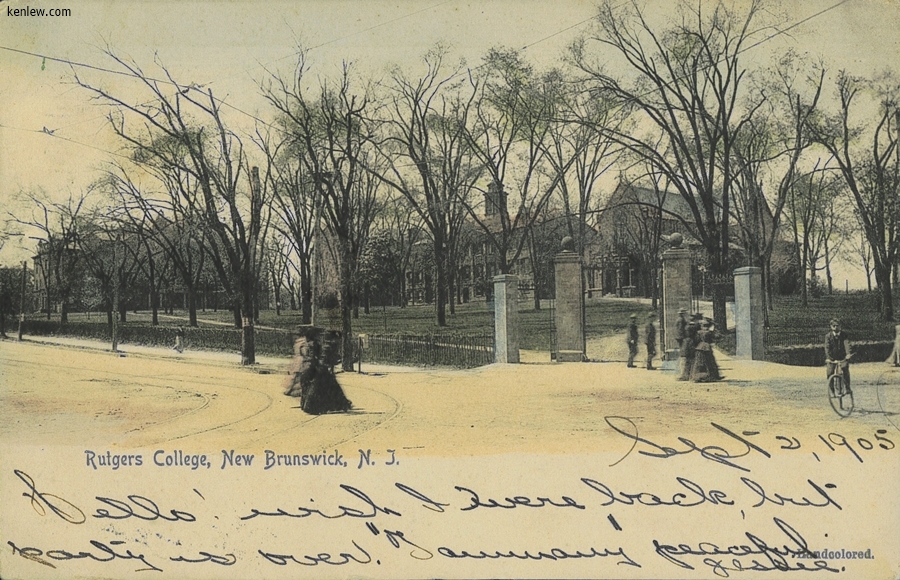
 Spring Break might normally be a time to send postcards back to your friends in New Brunswick. This year, things are different, so it is a good time to look at postcards FROM New Brunswick.

Ken Lew has posted historic postcards from all around the campuses including these of the Old Queens campus entrance, Balantine's Gymnasium, and the always charming Commons.

He also has scanned a 1977 pictorial summary of New Brunswick history from the First Savings and Loan Association. It includes a late 1800s photo of the steamer, New Brunswick, a women's suffrage march at George and Albany, and the great flood of 1920.


09 March 2021

In Jackson Heights

As a parallel to the Monrovia pieces, here are some Jackson Heights bits.

I think this is one of the shopping centers that is discussed in the movie:


Peter Bradshaw's review of the film for The Guardian talks about some of the grassroots discussions about redevelopment of the neighborhood. After talking up the diversity of the neighborhood, he describes the tension:

But all this is under threat. Jackson Heights' very identity could be slipping away. Rather like west London, it is being on the point of being gentrified and yuppified to within an inch of its life. Now that Manhattan and Brooklyn are costly and fashionable, the white-collar commuting classes are zeroing in on Jackson Heights, attracted by the charming community spirit that the modest locals have built up over decades - and pricing them out. Local businesses are also being threatened by a scheme called the Business Improvement District or BID which forces business owners to pay an additional tax to support the surrounding infrastructure. Poorer businesses below a certain threshold theoretically need not pay – but they find themselves under pressure to sell up by the bigger corporations moving in and the freeholders are putting their rents up.

The concerns about gentrification and the development of the BID were enough to stop it, eventually.


Manohla Dargis' review of In Jackson Heights talks about how it captures a complex place, "Each person and storefront sign carries a story, opens another world, from “Articulos Católicos” to “Himalayan Driving School” and “Whole Baby Goat.”"


08 March 2021

Monrovia, Indiana

Aside from the Wikipedia entry, here are some other materials on the cinematic little town:
The public library on Street View does not yet seem to have the benches (as of July 2018).


When the film was released, NPR said on Monrovia, Indiana that "Monrovia, Indiana lopes along pleasingly, if a bit too casually, with nothing more dramatic than Homestead resident complaining about the fire hydrants that serve a strictly ornamental purpose in his neighborhood." In November 2020 there was a fire in Homestead which made the hydrants seem pretty important.

The Census lists it as only 1504 people, with the average home value of $77,000. But the home home for sale on Zillow is listed at $299,484.

01 March 2021

Learn about native plant gardens

The snow is melting and spring is 20 days away. Are you ready to prepare your garden fro something new?

As part of the Rutgers Environmental Stewards program, the Earth Day, Every Day webinar series will be presenting Starting a Native Plant Garden. The presentation is next Monday (March 8):

New to native plant gardening? Not sure which native plants will thrive where you live? Angela Monaghan, Master Gardener Coordinator for Middlesex County, taught us how to start native plants from seed back in the fall (EarthDay2020 is the recording password). Angela had so much fun with us that she's BACK to help you plan your new native plant habitat. She'll cover garden site assessment, finding the best native plants for your area, and how to provide resources for pollinators and other beneficial creatures in your garden.
You do need to register so go to Earth Day, Every Day.

22 February 2021

Native Plant Society of NJ

What should be here? In New Jersey the Native Plant Society has tried to make some helpful lists of what should be here and what should not. Particularly helpful are the spreadsheets for each county with the species lists that are also coded for plant types, habitat types, and wetlands identification types.


If you don't live in New Jersey, maybe you could try the BONAP's Customized Geographic Database that allows you to build and share your own floristic database for any place in the US. Or, you could just check out some of the lists near you.


08 February 2021

Finding Equal Ground

These might be difficult times in some ways, but this is also a golden age of accessibility to great lectures. Landscape architecture fans should enjoy a talk that LSU is hosting late this afternoon (6ET/5CT) by EDSA Principal, Kona Gray.

Kona A. Gray, FASLA, PLA, EDSA Principal, will give a virtual lecture titled, “Exploration – The Pursuit of Finding Equal Ground” on February 8, 2021 via Zoom.

07 February 2021

Kwate Talk on Thursday

 A great chance to see a talk by a Rutgers professor on a notional streaming outlet, hosted by the National Library of Medicine History of Medicine.

Savages cry easily and are afraid of the dark: What It Means to Talk about Race and African American health

05 February 2021

A sign of the tides

As flooding becomes more common in some New Jersey coastal towns, flood gauges are getting reset so that more of them work together. Cook alum Joe Martucci reports that the gauges in Ship Bottom, Tuckerton, Absecon, South Dennis, Avalon and Stone Harbor are now calibrated with those in AC and Sandy Hook. Not only does it provide more widely consistent reports, but it also is forward looking:

“The new calculations will take into account the continued effects of sea level rise,” Iovino said.

According to a Rutgers University report released in 2019, sea levels rose an average of 1.5 feet along the New Jersey coast from 1911 to 2019, compared with the global average of 0.6 feet.

03 February 2021

Planning Board meetings

Better than TV...

  New Brunswick has a meeting of its Planning Board on Monday February 8.

  Franklin Township has a virtual meeting on February 17.

  Sayreville Planning Board has a meeting on the 17th as well.

The agendas for the meetings include a link to the WebEx or Zoom meeting.


01 February 2021

Samoan Circles

 While we are talking about different ways to facilitate public discourse, this description of the Samoan Circle helps show that there are alternatives. This is a specific method, since the Samoan Circle is a leaderless meeting.

31 January 2021

Night Walk in Marseilles

Our wanderlust is unsated during this pandemic. Travel videos seem to be getting more viewing than normal. But technology can let us go even deeper. 

YouTube has leveraged their Street View technology to create an atmospheric virtual walking tour of the Cours Julien neighborhood in Marseilles. Instead of regular Street View, the tour makes the neighborhood feel a little more authentic by using nighttime imagery and providing narration by a couple urban storytellers. Check out Google's Promenade Nocturne. Talk a virtual walk, watch some videos, and just wish you could walk even more.


29 January 2021

Friday Night Music

I don't know why there aren't more rock songs about trees. This isn't a good way to learn ecology, its just a song. And it doesn't end well for the trees. But it is a song about trees and that is better than listing our some planning boards to watch.


"But the oaks can't help their feelings

If they like the way they're made
And they wonder why the maples
Can't be happy in their shade"

28 January 2021

Esri Map Gallery

 Looking for a little map inspiration? The Esri Map Gallery has many different maps for various purposes. Some are heavy on methodology and process, like this Access Impact Mapping poster from the Trust for Public Lands. Others are historic or complex. It is all great just for exploring and enjoying some beautiful maps.


24 January 2021

Threats to GPS

 The Sunday NY Times has a guest column by Kate Murphy that explains why we need to update, strengthen and supplement our GPS network. She mentions attacks and interference. And, since we land planes with GPS, you should care. But she didn't mention the FCC as a potential threat, as they are handing over some of those public airwaves to private interests.

As a guest column, she also didn't have space to talk about supplements to GNSS, like RTK networks.

21 January 2021

New book by Simon Winchester

 My current stack of books threatens to kill me if it topples, but I want to add one more to the stack. Simon Winchester has a new book out that is distracting me. His previous books includes The Map that Changed the World and Krakatoa. That alone would be enough. But PlaNetizen's review of his new book, Land: How the Hunger for Ownership Shaped the Modern World, has me ready to skip a few in the stack to get to this.  

Don't get me wrong, the review doesn't seem exactly like an endorsement. But the book sounds like it tried to help readers get to a new place, intellectually, in thinking about how we make decisions about land. The reviewer, Josh Stephens, offers this:

For urban planners working on local issues, with local people, Winchester implicitly begs for a reconsideration of the relationship between land and influence. Even if we agree that a homeowner's property is his castle, is the homeowner necessarily entitled to weigh in on, much less decide on, what happens on adjacent properties? And, of course, Winchester reminds us that even a home that is deeded and duly paid for was, initially, stolen from people who had essentially no concept of land ownership (and not enough firepower to defend their land).
Our world is changing. And, while this anglo-centric book might not present the final word on the matter, it sounds like a well-researched, well-written exploration of alternative ways to think about the land under our feet, under our homes, and under the communities that we are planning and designing for.


But (sigh) why did I need to read about this just as the new semester starts?

15 January 2021

Wish list item

This is an installment in my list of simple things I want to do when we can do things again


Walk to the Zimmerli and see The Good Shepherd by Henry Tanner, "the first African-American painter to gain international acclaim."


14 December 2020

Mapping out the Scottish Gritter Spreaders

Where is Spready Mercury? What is For Your Ice Only? To help answer those questions, Scotland has created a live web map called the Trunk Road Gritter Tracker, that tracks their ice trucks with those entertaining names.


10 December 2020

Paper: Evidence That Changes in Community Food Environments Lead to Changes in Children’s Weight

Excited to announce that capping more than 10 years of collaborative research, the Journal of the Academy of Nutrition and Dietetics has published our paper, Evidence That Changes in Community Food Environments Lead to Changes in Children’s Weight: Results from a Longitudinal Prospective Cohort Study. A project with a long timeline deserves a long title, right? A special thanks to all of our collaborators and staff along the way.


30 November 2020

Geohealth job in Europe

It is amazing to watch in real-time as geohealth continues its expansion from a small niche to a regular specialty. One more bit of evidence is this announcement of a post-doctoral position at the University of Twente, which mostly skips past the posturing and definitions and, instead, moves right into the specifics. And, like every conversation about human health these days, the description begins with COVID and then moves on to other areas.


11 November 2020

COVID and design readings

Some pieces on redesigning our environment due to COVID-19


22 October 2020

Let it flood?

Walter Hood's proposal to let the monuments around the Tidal Basin slowly get inundated is remarkable: 

"Let the waters be free," writes Walter Hood in his proposal. "It could start with living in a wetland rather than draining it." Hood, whose Hood Design Studio is based in Oakland, Calif., also calls for "a prophetic aesthetic ... that is really telling the truth about a place."

And the image from Field Operations, in NPR's Landscape Architects Unveil Plans To Save The National Mall's Tidal Basin, is downright haunting.


12 October 2020

Tomorrow: Understanding and Managing the Risk of COVID-19

SEBS Virtual Science Cafe: Don Schaffner presents “Understanding and Managing the Risk of COVID-19” 

Dr. Schaffner, distinguished professor and extension specialist in food science, will present his experiences working with the general public and the news media during the COVID-19 pandemic, with a focus on helping people to understand the risks posed by SARS-CoV-2 and how to minimize them.

The conversation is on Tuesday, October 13, 2020 at 11:30am, but advance registration is required.


08 October 2020

CIP Codes

 In case it comes up, here are the CIP Codes for a few of our programs:

B.S. Landscape Architecture 040601
B.S. Environmental Planning and Design 040401
M.L.A. Landscape Architecture 040601

06 October 2020

Exploring the National Parks

As part of the National Park Service guide to its parks, it has curated topic guides to the websites. For a topic, like Civil Rights, they provide a brief overview of the topic and then give the visitor link to a variety of parks where they could learn more about the topic.


Sample Topics

Civil Rights

Industry

Literature and poetry 

Presidential sites

Explorers and Exploration


Sample Features

Homes

Grasslands and Prairies

Waterfalls and Gorges 

Monuments, Memorials and Statues


Of course, some topics are too general to have a list associated with them. For instance, there is a fabulous guide to Cultural Landscapes without a list. And the guide to Natural Sounds is unexpected and remarkable.


01 October 2020

One of the NPS' most popular events

 This week is a popular time for the National Park Service; it is Fat Bear Week. There will be lots of news coverage (CBS, WaPoSmithsonian), plenty of voting, and a spike in searches on Katmai and Fat Bear. This is really a science awareness program to show people how Katmai National Park's amazing bears fatten up before the onset of the harsh Alaskan winter. So, watch some videos and vote for the fat ones.


24 September 2020

Dialect Map

Aschmann's map of North American English Dialects, Based on Pronunciation Patterns is an enormous labor of love. The accompanying information about individual spoken traits adds details that enrich the maps. But my favorite part may be the close-up map of New Orleans that shows more distinct dialects inside those levees than in the entrety of the American West. I have been a sucker for this sort of stuff for years, including the old Joshua Katz maps and the Harvard dialect surveys.


17 September 2020

Crowdsourced neighborhood mapping

Maps Mania undertook the exercise of mapping out a London neighborhood (or neighbourhood) using crowdsourced input to determine the boundaries. The neighborhood they mapped, London's West End, is a particularly undefined area and the submitted results show it. But, when combined, the final result seems a somewhat plausible. And the idea behind it remains pretty interesting.

15 September 2020

Subpar Reviewers

 Amber Share turns horrifically bad one-star reviews of our National Parks into art that she calls, Subpar Parks.The art work is beautiful. And, as sophisticated commentary on attitudes to the parks, the reviews she has chosen are masterful.


03 September 2020

Knowledge


Knowing is not enough, we must apply. 

Willing is not enough we must do.

- Goethe


31 August 2020

Maping the potential sports spread of coronavirus

This new feature from ESPN hits the trifecta of COVID-19, sports, and mapping. It uses maps to show the spatial reach of a single college football game. And, by extension, it shows how far and how many places could be touched by the COVID spread from that single game. Their examples are from Tuscaloosa, Lincoln, and Los Angeles.

The maps are fascinating and really make the story.

24 August 2020