Students in landscape architecture, environmental planning and environmental geomatics have all asked me recently about whether and how they should develop a portfolio. Fortunately, the Medium has posted a thoughtful essay by Rachel Berger on The Death of the Design Portfolio. To me, the take home message is that while the design portfolio is changing, you need to find the right way to share (let's be honest, to show off) your work such that it highlights your abilities but also says something about who you are. There isn't a single answer for all of these students, or even for all of the students of each career path.
23 September 2019


12 September 2019
Clean water protections

Wide coverage is being given to today's rollback of clean water protections. But Politico warns that this is simply a preface to a much bigger rollback to follow:
And it clears the way for the Environmental Protection Agency to finish a follow-up regulation in the coming months that could leave most of the nation’s wetlands without any federal safeguards. (emphasis added)At a time when cities like Newark and Flint have water crises, it is interesting to see the regulations becoming more lax.
10 September 2019
Cholera map in 3d
Almost every conversation about public health and mapping includes a reference to John Snow's famous cholera map. (Not that John Snow) And generally the sites and slides and posters all use a similar reproduction of the original map. But I was pleasantly surprised when I discovered one group that produced a 3-d version of the map, and did it in a way that made the visualization meaningful.
h/t Robin Hawkes' Spatial Awareness Newsletter
h/t Robin Hawkes' Spatial Awareness Newsletter
09 September 2019
04 September 2019
VGI for protesters
Here is an interesting example of VGI. In support of protesters in Hong Kong, a small group of volunteers are making real-time maps showing locations for riot police and water cannons. By building on crowdsourcing, the map is updated quickly as the situation changes. Like many VGI projects, it sounds like a bit of mixed methods:
Out on the frontlines are “runners” dressed as regular passersby so as not to attract too much unwanted attention. Working with pen and paper on a clipboard, or through an illustrator app on an iPad, the runners mark up a blank map with the latest updates. The so-called “integrator” in the control room then assembles the updates, adding additional information from live-streams and news sources, to collate all available information at that moment into a single map, which is then published online and sent out via Telegram.One of the technical barriers is that, with so many protesters gathered so densely, mobile phone data capacities can be poor. QUartz reports that the protesters at the edge of the crowds are being encouraged to download the latest map and then airdrop it for easy access by those in the middle.
26 August 2019
GIS job in Delaware
New Castle County, Delaware is searching for a GIS technician. The description asks for:
At least five (5) years' experience in drafting, planning, GIS or related work at the level of Geographic Information Systems Specialist and completion of a standard high school course or GED certificate program, supplemented by four years of college with major course work in geography, planning or a related field; experience operating a Geographic Information System or computer Aided Drafting program; experience in Python, XML, javascript or other programming/scripting language a plus; familiarity with ArcGIS Online and Portal for ArcGIS; GISP Certification a plus or an equivalent combination of experience, education or training directly related to the required knowledge, skills and abilities.
20 August 2019
19 August 2019
Growing negative views of college
The Pew Research Center reports that between 2015 and 2019 colleges and universities have seen their popularity drop from a 63% positive viewpoint to 50%. This is something about which all of us in the higher education community should be aware and concerned.
16 August 2019
The Cult of the Fantasy Pedestrian
Strong Towns has a post by Daniel Herriges talking about what he calls the Fantasy Pedestrian.
Designing streets for the Fantasy Pedestrian is really, really easy, because their behavior is 100 percent predictable in every circumstance. Just lay out the rules. But designing streets for real people, who take shortcuts and do spontaneous and expedient and sometimes even foolhardy things, requires more critical thought.Of course, since cities preference the car, the designs really disadvantage the pedestrians who cross where and when it is inconvenient. Their justification of not being more accommodating, he argues, requires pretending to believe in fictional orderly pedestrians.
15 August 2019
Next generation of DC landscapes
For us in New Jersey, Washington DC is close enough to visit regularly. Plus, the ASLA headquartered there, it is a great place for landscape architects to show off. ASLA's The Dirt has a nicely illustrated summary by Ian Dillon that describes several new stops on your update design tour of the District. In reality, it is the latest award winners, so they aren't all built works, yet. But it is worth marking your maps and keeping them in mind on future trips along I-95.
13 August 2019
Landscape architecture's answer to the Pritzker?
Landscape architecture is creating a major design award that is meant to be the LA equivalent to the architecture's Pritzker.
12 August 2019
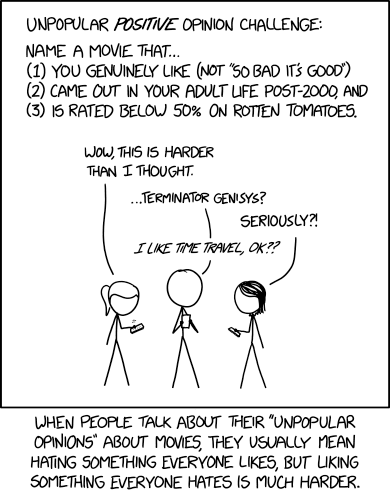
Unpopular Positive Opinions
As usual, XKCD says something immediately funny, but also a tiny bit profound.
09 August 2019
IPCC report
The IPCC has issued a new report on the role of land use in climate change. Every major news outlet will have their own summary or analysis (The Atlantic, Ars Technica, WSJ). But a good place to watch a conversation about it will be Real Climate. Some of the commenters will have been at the meeting or will already be reading the report.
Is land use part of the problem or part of the solution?
Is land use part of the problem or part of the solution?
Friday Fotos: Wyoming
Well, only one place in Wyoming: Devil's Tower National Monument. It was established as the first national monument in the us in 1906.


05 August 2019
Land management
The recent headline in the Salt Lake Tribune just about says it all, "William Perry Pendley, opponent of nation’s public lands, is picked to oversee them as acting head of BLM."
He argued in a 2016 National Review article that the "Founding Fathers intended all lands owned by the federal government to be sold."Readers interested in public lands will probably be watching this story unfold for a while.After all, this puts him in charge of about 250 million acres. By my rough math, that is an area larger than all of Texas and New Mexico combined.
02 August 2019
Friday Fotos: South Dakota
Some landscapes from South Dakota to remind you that it is richer landscape than some might lead you to believe.


31 July 2019
Breezewood
CityLab posted a piece by Amanda Kolson Hurley that presents a little extra background on the famous Burtinsky photo of Breezewood. She tries to argue that Breezewood, PA is a remarkably unique place. In a sense I agree, since places are all unique. The specifics of the development, the adjacent hill, But I disagree in that the famous photo of Breezewood really captures a sense of place that is not unique (see US 11 just a few miles away in Carlisle, PA). You don't have to agree completely to enjoy this piece.
29 July 2019
Emotional response to teaching and research
A new paper by Stupnisky, Hall, Pekrun is summarized by Inside Higher Ed. The paper takes a deeper look at the emotions of faculty engaged in teaching and research and presents findings that suggest that paying attention to the emotional state of faculty could help the university improve outcomes. For example, the article, "Professors Have Feelings, Too," suggests that tenure-track faculty might have negative feelings about research that are caused more by the tenure process than by research. Also, the paper talks about ways that collegiality is impacted by research emotions:
In terms of implications for institutions, Stupnisky found that perceived collegiality correlated with both teaching and research emotions, and perceived balance correlated specifically with research emotions. Collegiality was also a significant, direct predictor of control and value and an indirect predictor of success in both the teaching and research domains via faculty emotions.As universities continue to evolve, this could be a valuable element to making new faculty more successful and better adjusted.
26 July 2019


Subscribe to:
Posts (Atom)


