The new green wall at Prudential in Newark is making national landscape architectural news.
Showing posts with label Green Design. Show all posts
Showing posts with label Green Design. Show all posts
04 August 2015


24 October 2012
Green Team blog
The Metropolis Green Team has a great blog post from RU LA alum Zeina Zahalan. She critiques instant landscapes and talks about alternative approaches.
(I'd like to think that the absurd amount of writing that the climate change studio required was part of what propelled her into high visibility writing. But talent and hard work are probably more to blame.)
(I'd like to think that the absurd amount of writing that the climate change studio required was part of what propelled her into high visibility writing. But talent and hard work are probably more to blame.)
23 October 2012
Greenest cities infographics
Fast Company has some fascinating infographics to help you sort out which cities are the greenest in the world.
02 August 2011
Solar Decathlon is moving ahead
With several folks from Environmental Planning and Design participating, it is great to see that the solar decathlon project is moving ahead. The Star-Ledger just wrote up the project, with photos of the concrete solar house being constructed, and there is both a video walk-through and a Facebook page so you can learn more.
05 July 2011
Very, very small green roofs
The DIRT shows how Philly is trying out very small green roofs. And Philly has a website to sow off more too.
09 March 2011
LiveBlog: Sustainable in a Material World
Meg Calkins, Ball State
Editor of the forthcoming Sustainable Sites Handbook to be published in October 2011 by John Wiley and Sons. Author of Materials for Sustainable Sites (described by L+U as a "must read")was published in October 2008.
For an aluminum rail in Indianapolis she breaks down all of the environmental impacts of that rail.
Millennium Ecosystem Assessment (2005) concluded that ecosystem resources are critical to support life on earth. And that society has caused irreversible damages.
More than 90% of the materials that goes into the average US product is waste before it reaches the users. 80% is molecular waste that goes into the air or water, etc. But if you consider closed materials and resource loops, "true waste does not exist". Good green design recognizes that and makes use of it as a guiding principle.
 The first case study is the High Line. The heavy reliance on cement is a good starting point. We can often reduce it. Sometimes we can use substitutes like fly ash, slag, and natural pozzolans like calcined shale. Another concern are the woods used. If they were rainforest materials they are not renewed as well as others. Certified wood would be better - this can include accounting for the chain of custody. Plastic lumber is a much harder sell, but if you use it make sure you avoid PVCs. For materials like stainless steel and aluminum, we should be considering the level of embodied energy.
 If we are going to make progress on this front, we need to make a minor or less radical shift on projects like this.
 But we need a major shift in materials that we need to seek out as well.
The 2nd case study is at the Queens Botanical Garden. One innovation was rammed earth structures, which can be used anywhere. It is high-labor, low-cost and low-impact. Don't confuse it with Compressed Earth block (CEB). The radical shift in materials is needed to "close the loop".
Alternate materials can include gabions with concrete or stone rubble from on-site. Stabilized soil pavement requires binders, whether they are plant-based (agave, pine resin, seed oils), and polymer binders can help us stop using so much paving. Natural barriers can replace fencing.
Ecobalancing - life-cycle flow of resources that balances inputs and outputs to support vital whole systems.
Finally an example was provided using an interdisciplinary student project from outside Muncie. One included a 5ac demonstration site for a family, because 5ac is the footprint of a single family. The designs also included selective harvesting of a forest on site, permaculture areas, strawbale construction (currently not legal in the US) and AlgaeWheel technology. Even an incremental shift in construction methods will require proving the reliability of these techniques and showing people the benefits.
Editor of the forthcoming Sustainable Sites Handbook to be published in October 2011 by John Wiley and Sons. Author of Materials for Sustainable Sites (described by L+U as a "must read")was published in October 2008.
For an aluminum rail in Indianapolis she breaks down all of the environmental impacts of that rail.
Millennium Ecosystem Assessment (2005) concluded that ecosystem resources are critical to support life on earth. And that society has caused irreversible damages.
More than 90% of the materials that goes into the average US product is waste before it reaches the users. 80% is molecular waste that goes into the air or water, etc. But if you consider closed materials and resource loops, "true waste does not exist". Good green design recognizes that and makes use of it as a guiding principle.


The 2nd case study is at the Queens Botanical Garden. One innovation was rammed earth structures, which can be used anywhere. It is high-labor, low-cost and low-impact. Don't confuse it with Compressed Earth block (CEB). The radical shift in materials is needed to "close the loop".
Alternate materials can include gabions with concrete or stone rubble from on-site. Stabilized soil pavement requires binders, whether they are plant-based (agave, pine resin, seed oils), and polymer binders can help us stop using so much paving. Natural barriers can replace fencing.
Ecobalancing - life-cycle flow of resources that balances inputs and outputs to support vital whole systems.
Finally an example was provided using an interdisciplinary student project from outside Muncie. One included a 5ac demonstration site for a family, because 5ac is the footprint of a single family. The designs also included selective harvesting of a forest on site, permaculture areas, strawbale construction (currently not legal in the US) and AlgaeWheel technology. Even an incremental shift in construction methods will require proving the reliability of these techniques and showing people the benefits.
19 July 2010
A sustainability design challenge
An interesting challenge that is popping up more and more is the ability to elegantly integrate some of the less elegant elements of sustainability in the working landscapes of daily life. One example of this was highlighted (indirectly) in the NY Times blog this week: solar panels. The video shows one way people are starting to integrate them into parking lots, but the truth is that as panel prices drop there will be plenty of other interesting alternatives to solar farms that will create visual and aesthetic challenges for designers.
07 July 2010
08 April 2010
Is LEED what we need?
Political blogger Matt Yglesias has sparked an interesting comment thread on LEED standards.
02 November 2009
A very large green roof
The Target Center in Minneapolis has a new green roof designed (in part) by the landscape architects at the Kestrel Design Group. Retrofitting is hard. But, as EcoStructre reports, retrofitting a roof into the 5th largest green roof in the country is extra challenging.
22 September 2009
The Dirt on ASLA
In case you didn't go to Chicago, The Dirt is recapping some of the more notable presentations at this year's ASLA. Presentations covered include a look at changing cities in a climate change world, the economics of the London Olympics, and the green streets program from Vancouver.
01 June 2009
Getting Green at MCC
It looks like there will soon be a LEED Silver building nearby at Middlesex County College, designed by DMR Architects. Today's Home News and Tribune looks at multiple efforts on the MCC campus to promote more sustainable activties, including courses for green-collar workers and working 4-day work weeks during the summer to save energy. The article quotes the Sierra Club's omnipresent Jeff Tittel as saying that this will be an important economic area of growth: "We expect in New Jersey over the next 10 years 150,000 jobs in the clean energy sector alone.''

04 May 2009
06 March 2009
The Green Energy Education Act
ASLA has posted an interesting legislative action item:
I'll even try to add a widget for tracking this.
Congressman Mike McCaul (TX) has re-introduced legislation aimed at preparing the next wave of design and construction professionals to improve the energy efficiency and productivity of our nation's buildings.
H.R. 957, The Green Energy Education Act, would require the Department of Energy (DOE) to partner with the National Science Foundation to award grants to university programs related to the design and construction of high performance buildings. The legislation specifically states that in awarding grants, DOE should give priority to university programs in design, architecture, landscape architecture, and city, regional, or urban planning. The legislation would improve the ability of engineers, architects, landscape architects, and planners to cooperate on the incorporation of advanced energy technologies during the design and construction of buildings.
During the last Congress, ASLA worked with Congressman McCaul to include "landscape architecture" in a similar bill that unanimously passed the House of Representatives. After learning how landscape architectural techniques, including sustainable site planning and development, contribute to the high performance of buildings, Congressman McCaul offered an amendment to include landscape architecture in the bill. Fortunately, the version recently introduced by Congressman McCaul does include language regarding landscape architects.
The legislation has been referred to the House Committee on Science and Technology.
18 December 2008
Majora Carter
The NY Times calls her the green power broker and talk about the fact that some environmentalists might not appreciate the fame she is getting.
29 November 2008
Greenbuild Conference in Boston
C-Net has posted photos from the recent Greenbuild Conference in Boston, so you can see the latest in windmills, green drywall, and lighting systems.
09 October 2008
EPA student design competition
We are always looking for a good student competition. Here is the request for applications for a great one:
6th Annual P3 Awards: A National Student Design Competition for Sustainability Focusing on People, Prosperity and the Planet
6th Annual P3 Awards: A National Student Design Competition for Sustainability Focusing on People, Prosperity and the Planet
01 October 2008
Live Blog: Kurt Culbertson of Design Workshop
Live blogging the common lectures is back! This is a fast moving discussion and this post will be pretty disjointed.
Kurt Culbertson, FASLA began his Beyond Green lecture with a description of Design Workshop and its history.
Founders Joe Porter and Don Ensign - Gave them a sense of courage – try not to take themselves too seriously
Early projects started at the Outer Banks of NC and led them to Jim Rouse.
An important turning point was a proposal for Owl Creek in Snowmass CO that wasn’t successful.
The resort work has been an important foundation for their growth - The Village at Ribbon Creek
In a 29 year career, he has worked as a sub-consultant to an architect only twice: LA is not the stuff around the bottom of the building!
4 years before the founding of the US Green Building Council, DW was working on similar guidelines for a community in NM. More recently they have worked at planned sustainable communities like Rancho Viejo in Santa Fe.
Les Wexner’s yard in Columbus, OH helped them model how they could grow as a firm taking on smaller residential and larger planning projects simultaneously.
Last year he worked on 4 residences where the average budget was $ 3.5 million.
The discussion turned toward his vision for sustainability.
Social Justice was a serious priority.
At a new project in Salt Lake City they will have NO buried storm drains. – The runoff rate had to match the pre-European settlement conditions.
Agricultural urbanism is another tool for exploring the real impact of the community. He came up with a calorie budget (21 billion calories per year) which suggested that a 5,000 acre community needed a rather unrealistic 35,000 acre farm area. Still, forcing the community to address food as an issue helps with the environmental impact.
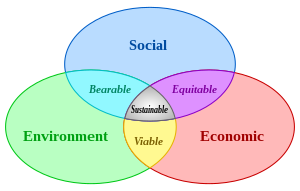
Quite importantly, DW has worked to add art to the usual environment, economics and community diagram (http://upload.wikimedia.org/wikipedia/commons/thumb/7/70/Sustainable_development.svg/300px-Sustainable_development.svg.png).
One of his heroes is Sam Mockbee whose Rural Studio was one of the inspiration for the DW Foundation. They also use a housing trust to help employees.
If you subscribe to one magazine in life, he says make it The Economist. They ranked quality of life in the US as 13th in the world.
What constitutes success in this process? Is it just something beautiful? Is it a project that includes affordable housing, like the Gates Rubber Factory? Starting in Bolivia they began exploring how to make appropriate housing that can grow. They are now looking at places like Nigeria to see if it works there.
What gets measured, gets done. - Tom Peters
LEED Standards have helped establish metrics for green issues. DW has developed a broader set of metrics for community success. Jones and Jones has developed their Intrinsic Values Index. The reflection and consideration of the impact may be an emerging trend. We'll see.
He described the career path as 3 years to stop hurting yourself and 15 years to get competent.
DT sez: Sorry if it is sloppy - it was a wild ride.
27 September 2008
Eco-Cities: Urban Planning for the Future: Scientific American
The current issue of Scientific American includes a feature on Eco-Cities called Eco-Cities: Urban Planning for the Future. One of the example is a proposal for Treasure Island.
25 September 2008
Renzo Piano's California Academy of Science
 Renzo Piano's new building just opened this week in San Francisco's Golden Gate Park. Treehugger offered a preview a few months back. And now the NY Times has posted a review and slideshow. No single photo tells the story. (The above photo is from Wikicommons)
Subscribe to:
Posts (Atom)