The Land and Water Conservation Fund is under threat, which means that some of the more important natural lands in the US are also at risk. This would be a good time to read the ASLA policy brief on the Land and Water Conservation Fund. The 2023 update was set to include over $7 million for New Jersey, but the latest Senate proposal cuts the nationwide funding by $100 million. Keep an eye on the policy as it moves forward.
Showing posts with label ASLA. Show all posts
Showing posts with label ASLA. Show all posts
05 September 2023


19 September 2013
Guerrilla Wayfinding
One of ASLA's top student Communications Awards this year went to an NC State student for his ingenious project, Guerrilla Wayfinding. Be sure to check it out and way to go, Matt Tomasulo!
24 September 2012
Remembering Stu Appel

When he was nominated by the NJ ASLA to become an ASLA Fellow, the summary of their statement was this:
"Stuart Appel was nominated by the New Jersey Chapter for his design contributions to the profession and his commitment to teaching and mentoring. The senior principal of Wells Appel, he has created a body of work that reflects a profound understanding of context, culture, and natural systems. Concentrated in the mid-Atlantic region, his work has earned scores of national and regional design awards. His commitment to scholarship and mentorship has remained a stalwart of his practice, evidenced through his teaching at Temple University, the University of Pennsylvania, and Rutgers University. Appel earned his bachelor of environmental studies in 1978 and bachelor of landscape architecture in 1979 from the State University of New York–Syracuse and an MBA from LaSalle University in 1990."
Places and Spaces has written about Stu before. He offered us some great insight into work in Dubai and Qatar (not that our notes reflect on the quality of the lecture). And we recorded his answer when he was asked to name his 3 favorite examples of landscape architecture that he'd ever visited:
1) Piazza San Marco, Venice
2) Villa Montefiore in Tuscany
3) Yosemite Park
Most importantly he was loved and respected and just a great person to be around.
11 July 2012
Heat waves aside, summertime is often a dry time. But drought conditions are supposed to be exceptions to the regular patterns of dry weather. But with 56% of the country currently shown in drought (below, from the US Drought Monitor at Nebraska) and with climate scientists anticipating significant dust bowl effects, it is worth asking whether the ASLA is doing enough on water efficiency. They give awards to projects that demonstrate innovative and sensitive responses and provide general guidelines, but many members continue to design water-intensive landscapes. How much should we lead and how much must we follow?

06 July 2011
And a fine fellow he will be...
Proud Rutgers alum Bob Snieckus is making us proud. ASLA has announced that he will become a fellow this fall. Despite his important work serving the nation in DC, Bob has been a regular participant in all sorts of activities on campus as a Cook alum and LA alum. Check out his bio from the Fellow announcement:
Robert E. Snieckus, ASLAWho's next?
USDA Natural Resources Conservation Service
Washington, D.C.
Robert Snieckus was nominated by the Potomac Chapter in the Leadership/Management Category. Throughout his career, he has showcased the creative problem-solving acumen of landscape architects to the many multi-discipline professionals in the agencies in which he has worked. Be it gravel pit stabilization, a flood detention basin, or the USDA building on the National Mall, he has consistently introduced long-term, visionary aesthetic solutions. His creativity and enthusiasm are as astonishing as he is unique. Despite his administrative responsibilities, he still leads design teams in the execution of creative and sustainable solutions to very difficult land and water management problems all across the country. Perhaps the most challenging and rewarding was the landscape regeneration plan he implemented following the eruption of Mount St. Helens. His BLA is from Rutgers University.
02 February 2011
Mixed economic news for LA Firms
It is hard to tell which way is up in the latest quarterly report from the ASLA. Billable hours are down but more firms are looking to hire.
13 September 2010
ASLA makeup: Majora Carter
If you missed Majora Carter's ASLA Keynote, you might watch this short video of her TED talk from 2006.
12 September 2010
ASLA makeup: Richard Jackson
If you missed ASLA this year, you can still see a few of the speakers. One of the keynotes was public health expert Richard Jackson who talked about the connection between the way our communities are designed and the health of our next generation. While this isn't the same speech, it includes similar material.
30 August 2010
Go See DC: Portrait Gallery
(NOTE: This is a re-purposed post from the past as part of the ongoing Go See DC series.)
Just a few blocks from the student hotel is the Foster + Partners new Kogod Courtyard at the National Portrait Gallery. They keep late hours, are free, and are well worth the stop, even if only for 15 or 30 minutes.
 On the floor of the courtyard is this "fountain" which just has water sheeting across the granite. The drains on are the left side of the photo. (Mapped)
 While there I saw their newest addition, the iconic but controversial portrait of Obama by Shepard Fairey.


Just a few blocks from the student hotel is the Foster + Partners new Kogod Courtyard at the National Portrait Gallery. They keep late hours, are free, and are well worth the stop, even if only for 15 or 30 minutes.
 On the floor of the courtyard is this "fountain" which just has water sheeting across the granite. The drains on are the left side of the photo. (Mapped)
 While there I saw their newest addition, the iconic but controversial portrait of Obama by Shepard Fairey.

29 August 2010
Go See DC: Olin's NGA Sculpture Garden
(NOTE: This is a re-purposed posting from the past to get you excited about going to DC this fall.)
Sadly, after digging through disks and folders, I can't find many of the dozens and dozens of photos I have taken at this elegant design. Just steps off of America's front yard is this sculpture garden which provides one of the great spots for resting during an active day in DC. At its center is this massive, yet simple fountain. The garden uses a generous array of plant material to soften it while it sits between the large institutional buildings that contain it on three sides. And it uses classic forms and materials allowing the sculpture to take much of the credit here.


Sadly, after digging through disks and folders, I can't find many of the dozens and dozens of photos I have taken at this elegant design. Just steps off of America's front yard is this sculpture garden which provides one of the great spots for resting during an active day in DC. At its center is this massive, yet simple fountain. The garden uses a generous array of plant material to soften it while it sits between the large institutional buildings that contain it on three sides. And it uses classic forms and materials allowing the sculpture to take much of the credit here.


28 August 2010
Go See DC: Washington Monument
(NOTE: This is a re-purposed post celebrating our upcoming Fall Field Trip to DC)
As part of a larger effort to solidify the security of the nation's monuments and critical buildings, Olin Partnership was hired to develop an attractive security enhancement for the Washington Monument. The result was an award-winning plan that completely hides its primary role as security enhancement, while enhancing the visitors' experience climbing up the hill.

One of the primary elements in the plan is a low series of stone walls which, while new, look like they could almost be original if only they had a light patina or bit of weathering. These walls and some retractable bollards, shape the rounded path systems as it encircles the plaza at the top of the hill.
The Bing Bird's Eye offers a great look at the hilltop plaza around the Monument. At ground level, it is easier to overlook the organization of the plaza, but the photo shows how the paving and benches subtly emphasize or reinforce the effect of the obelisk in. The rings of paving are part of Olin's more recent treatment of the site. These forms are elegant and universal, although it is easy enough to link them with more symbolic traditions by pointing out how the rings form a circumpunct (sometimes associated with the symbol for the greek letter Theta) around the point of the monument itself. Check the older air photos and you get a hint that it was pretty different before the remake.

View Larger Map

(BTW, when you look at the Mall in the 1949 historic Aerial, there is a large building West if the Monument. Anyone know what that is? A temporary WWII building? A temporary office building while something new was being built elsewhere?)
Finally, I find the benches at the top to be absolutely wonderful. Their shape makes them great for people who need to collapse on them after a death march down the Mall (sorry about that, alums!). The curve lets soda and rain roll off, and the cross-sections look very much like those Olin designed for Columbus Circle. But they also are large enough that many complete strangers can share them simultaneously without ever feeling like their personal space has been violated.
You can look at the plaza in isolation, but the Monument is something larger than that. Looking across from Lincoln to Washington, we like to talk about them together as reminders of the Birth and Redemption of the nation.

It is a big hill, but worth the climb. Olin helped make it a much more pleasant climb. Although the view from down here is pretty good too.
 It even adds to its neighbors...

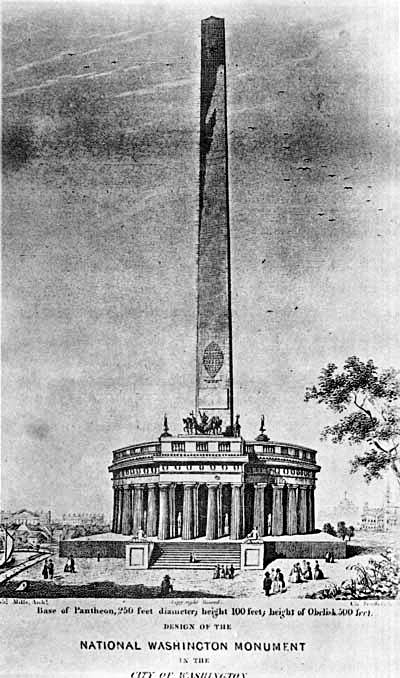
It is a shame that Olin couldn't help finish the project as it was originally planned:
On October 21, at 6:30pm, Laurie Olin delivered the Steve Strom Memorial Lecture at the Douglass Campus Center. Don't miss this year's Lecture, to be announced soon.
As part of a larger effort to solidify the security of the nation's monuments and critical buildings, Olin Partnership was hired to develop an attractive security enhancement for the Washington Monument. The result was an award-winning plan that completely hides its primary role as security enhancement, while enhancing the visitors' experience climbing up the hill.
One of the primary elements in the plan is a low series of stone walls which, while new, look like they could almost be original if only they had a light patina or bit of weathering. These walls and some retractable bollards, shape the rounded path systems as it encircles the plaza at the top of the hill.
The Bing Bird's Eye offers a great look at the hilltop plaza around the Monument. At ground level, it is easier to overlook the organization of the plaza, but the photo shows how the paving and benches subtly emphasize or reinforce the effect of the obelisk in. The rings of paving are part of Olin's more recent treatment of the site. These forms are elegant and universal, although it is easy enough to link them with more symbolic traditions by pointing out how the rings form a circumpunct (sometimes associated with the symbol for the greek letter Theta) around the point of the monument itself. Check the older air photos and you get a hint that it was pretty different before the remake.
View Larger Map
(BTW, when you look at the Mall in the 1949 historic Aerial, there is a large building West if the Monument. Anyone know what that is? A temporary WWII building? A temporary office building while something new was being built elsewhere?)
Finally, I find the benches at the top to be absolutely wonderful. Their shape makes them great for people who need to collapse on them after a death march down the Mall (sorry about that, alums!). The curve lets soda and rain roll off, and the cross-sections look very much like those Olin designed for Columbus Circle. But they also are large enough that many complete strangers can share them simultaneously without ever feeling like their personal space has been violated.
You can look at the plaza in isolation, but the Monument is something larger than that. Looking across from Lincoln to Washington, we like to talk about them together as reminders of the Birth and Redemption of the nation.
It is a big hill, but worth the climb. Olin helped make it a much more pleasant climb. Although the view from down here is pretty good too.
It even adds to its neighbors...It is a shame that Olin couldn't help finish the project as it was originally planned:
On October 21, at 6:30pm, Laurie Olin delivered the Steve Strom Memorial Lecture at the Douglass Campus Center. Don't miss this year's Lecture, to be announced soon.
26 August 2010
Go See DC: Best of the 2007 Fall Field Trip
A few of my favorite photos from the 2007 DC Fall Field Trip...RE-purposed from an older post, naturally.


25 August 2010
Go See DC: VIsualizing Washington DC
Although we've written about it before, it bears mentioning again. The University of Maryland-Baltimore County's Imaging Resource Center has built a resource to help imagine what Washington used to look like. The Visualizing Historic Washington project was made for a PBS show on Latrobe, but also helps us visualize how this estuary turned planned city slowly came to be the traffic-snarled mess of diagonals that it is today.
23 August 2010
Go See DC: Pentagon 9/11 Memorial
(NOTE: This is re-purposed from an old post to celebrate out upcoming DC trip.)
The 9-11 Memorial at the Pentagon is open 24/7 which makes dusk an interesting time for a visit.


 Regrettably, the last lines of Witold Rybczynski's Slate piece on the memorial rang very true. Some of trees are already failing and a few light bulbs were temporarily out. Hopefully these can be addressed, because this is an important memorial at an important place. Reading reviews like this and then visiting the place in person is an important design experience for students. The Fall Field Trip is a great time to try it - just take the Metro to the Pentagon stop.


The 9-11 Memorial at the Pentagon is open 24/7 which makes dusk an interesting time for a visit.


 Regrettably, the last lines of Witold Rybczynski's Slate piece on the memorial rang very true. Some of trees are already failing and a few light bulbs were temporarily out. Hopefully these can be addressed, because this is an important memorial at an important place. Reading reviews like this and then visiting the place in person is an important design experience for students. The Fall Field Trip is a great time to try it - just take the Metro to the Pentagon stop.

02 August 2010
Big Loss for LA Education
On Saturday July 31st, Landscape Architecture lost one of its most durable leaders in education, Robert 'Doc" Reich, FASLA. As founder of LSU's LA program in 1946, and a teacher there until quite recently, "Doc" spent decades building and shaping the profession in Louisiana and throughout the South. He won the ASLA Award and Dot Carpenter Award, and had the School of Landscape Architecture named after him.
Many programs have notable leaders who grew them in the post-WWII era and helped shape the ASLA as it solidified the profession, but "Doc" really stood out as one of the special members of that group. The loyalty he got from LSU grads was remarkable and their financial support of his program helped make it one of the largest in the country.
Many programs have notable leaders who grew them in the post-WWII era and helped shape the ASLA as it solidified the profession, but "Doc" really stood out as one of the special members of that group. The loyalty he got from LSU grads was remarkable and their financial support of his program helped make it one of the largest in the country.
27 April 2010
The 2010 Margaret Cekada Memorial Lecture
The 2010 Margaret Cekada Memorial Lecture
Shane Coen, Coen + Partners
2010 Cekada Memorial Lecture
Thursday, April 29th at 6:30
Cook Student Center
- Westminster Presbyterian Church Fellowship Courtyard and Memorial Columbarium, Minneapolis, MN
- Speckman House Landscape, Highland Park, St. Paul, MN
24 January 2010
Sea Level Rise talk at NJASLA
In lieu of handouts...
Advanced Geomatics website
Reading Assignments:
This weekend's flooding news from Upper Villas
More Cape May and Sea Level Rise info
The NY Times reports on the finding that we just finished the hottest decade on record.
Advanced Geomatics website
Reading Assignments:
- Living by the Rules of the Sea. David Bush, Orrin Pilkey, and William Neal. Duke University Press, 1996
- The Rising Sea by Orrin Pilkey and Rob Young, 2009
- "How High Will Seas Rise? Get Ready for Seven Feet" in E360 (e360.yale.edu) (14 Jan 2010) Rob Young and Orrin Pilkey, 2010
This weekend's flooding news from Upper Villas
More Cape May and Sea Level Rise info
The NY Times reports on the finding that we just finished the hottest decade on record.
30 October 2009
Friday Photos: Boston Children's Museum
Michael Van Valkenburgh Associates received an ASLA 2008 Design Honor Award for their work at the Boston Children's Museum calling it "a great example of placemaking." It is clear that our group had more complex feelings about it. Maybe it was the weather. Maybe it was the walk. Maybe it was the design. We'll try again in 3 years.


 The big heavy milk bottle wasn't as easy to drop in as might first appear. Here's a comment from the ASLA awards announcement:


The big heavy milk bottle wasn't as easy to drop in as might first appear. Here's a comment from the ASLA awards announcement:"Throughout the project, construction techniques were employed to address the need for durability on a constantly shifting site. Expanded polystyrene foam (Geofoam) was used as fill below the finished plaza to offset the weight of the new landscape and to prevent further settlement. Steel piles driven into the native bedrock were installed to support heavier elements like the marble boulders and the Milk Bottle. A waterproof liner system was developed to contain the roots of the willow trees while keeping the saline ground water from contaminating the planting soils."
22 September 2009
The Dirt on ASLA
In case you didn't go to Chicago, The Dirt is recapping some of the more notable presentations at this year's ASLA. Presentations covered include a look at changing cities in a climate change world, the economics of the London Olympics, and the green streets program from Vancouver.
18 September 2009
Bill Thompson leaving LAM
While I am disappointed that I couldn't get Bill Thompson to add Lat Long coordinates to the project credits in LAM, his parting from Landscape Architecture Magazine will be sadly noted. For 20 years it has been a steady and popular representation of the profession. Although, back before his time, the graphics used to be pretty memorable.
Subscribe to:
Posts (Atom)


