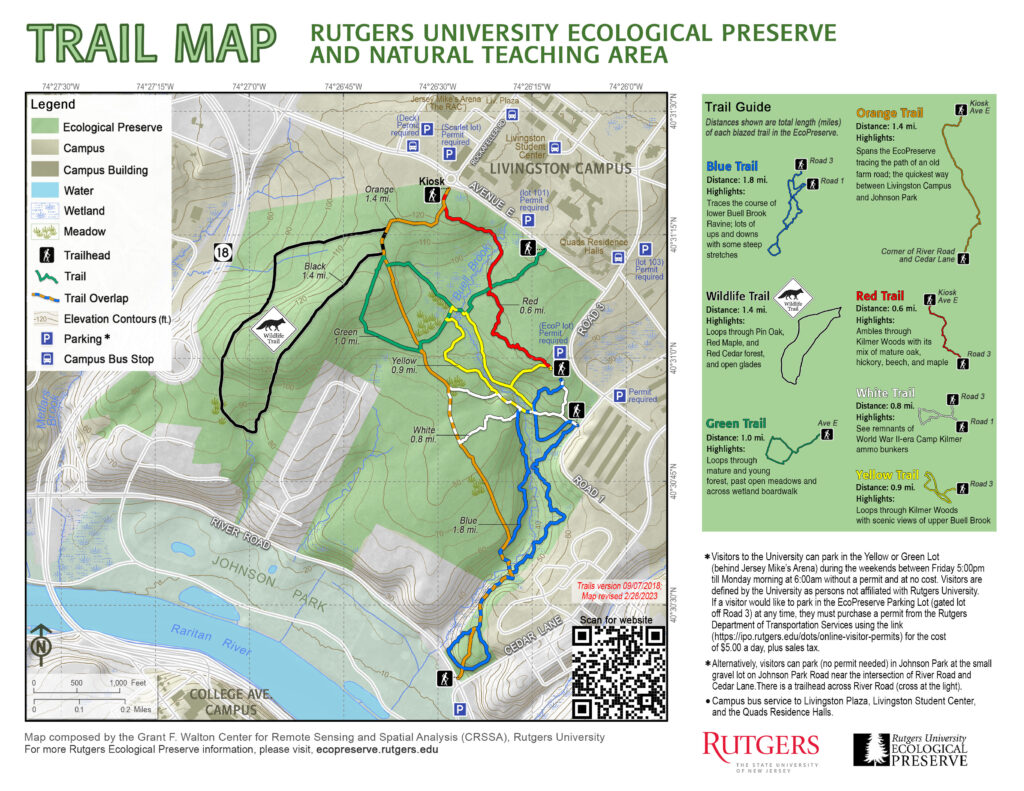
A special thanks goes out to Mike Siegel and the Rutgers Cartography Lab. This is a great resource for students and for pros. A national resource is the Libre Map Project, but it is a bit harder for first time users.
Comments and news about Environmental Planning and Design. Intended for all audiences including students and alumni of the Rutgers major of Environmental Planning and Design.


Many bird species are in decline. The Washington post article is beautifully illustrated. It isn't good news, but it is worth reading as the details help is understand it better.
The article includes a tool that lets you map out the increase or decrease of a species. If you need good news, look up the map for Bald Eagles. But many common species are shown in decline.
An incredible lesson in life-long learning from one of our landscape architecture students.
How do you replace something that is irreplaceable? That is the struggle facing a community in northern England where vandals cut down a landmark 300-year old tree along Hadrian's Wall. The Sycamore Gap Tree was a solitary tree in an historic space, so it leaves a visible hole. Should they build a memorial to mark the spot? Plant a replacement tree? Install an artificial (presumably artistic) facsimile?
Atlas Obscura posted an emotional piece about a sculpture in northern Sweden. The piece shows a real person, so he was especially touched when it was found after a theft.
Excited to see that the idea of sponge cities has gotten Peking's Yu Kongjian recognized with the Oberlander Award. It is a well deserved honor for a transformational idea and an international leader in landscape architecture.
The Land and Water Conservation Fund is under threat, which means that some of the more important natural lands in the US are also at risk. This would be a good time to read the ASLA policy brief on the Land and Water Conservation Fund. The 2023 update was set to include over $7 million for New Jersey, but the latest Senate proposal cuts the nationwide funding by $100 million. Keep an eye on the policy as it moves forward.
New Jersey has a new Inland Flood Rule that is the first in the US to account for changes in precipitation due to climate change. The recent extreme weather suggests that this cutting edge, first of its kind change may already have been overdue.
Q. I have some extra time this summer/semester/winter and would like to read an extra book or two. Can you suggest anything good?
It depends on your interest.
A) For trying to get a sense for Landscape Architecture as a profession:
An interesting book to read and explore (that is often used at universities in the landscape discovery classes) is John O. Simmonds' Landscape Architecture. It is fairly easy to read, can often be acquired as a used book (especially online) and is intersting for folks in and out of the profession.
Another avenue to consider would be to get some recent issues of Landscape Architecture Magazine which is published by the American Society of Landscape Architecture and is meant as their semi-official portrayal of the state of the profession.
B) For environmental planning students I frequently recommend the following (although some are recommended as examples of trends that I may or may not fully endorse):
Ian McHarg's Design With Nature and A Quest for Life.
Anything written by Wendell Berry. My favorite was Home Economics, but he has lots to choose from.
Duany, PLater-Zyberk, and Speck's Suburban Nation: The Rise of Sprawl and the Decline of the American Dream.
James Howard Kunstler's Geography of Nowhere: The Rise and Decline of America's Man-Made Landscape.
Oh, what the heck. Maybe you should just pick from Planetizen's Top 20 Planning Books list for this stuff.
C) For those who are trying to move up from entry level students to serious students of landscape architecture, Dr. Allan Shearer has prepared this for his design students:
A few people have asked me for a list of books that might be of use to a landscape architecture education. Below is a starter-list which, I think, should offer something to everyone. I have not looked which of these are on the shelf of RU libraries, but all could be borrowed by way of interlibrary loan services. Similarly, I am not sure how many of these will be for sale at Borders or Barnes and Noble's, but everything should be available through Amazon or Alibris (a great site for used books).
There are several books by John R. Stilgoe that are well worth reading. He is an historian, not a designer, and holds a joint appointment between the Department of Landscape Architecture at the Harvard Graduate School of Design and the Visual & Environmental Studies Department of the Faculty of Arts and Sciences. Before mentioning the books, I should give a couple disclaimers: First, he will be speaking here next spring, so you might want to take the opportunity to get a sense of who he is, what interests him, etc. The topic has not been set, but he might very well ask you if you see the arrow in the FedEx sign. Second, JRS was my dissertation advisor (and J.B. Jackson, author of The Necessity for Ruins, was his). And no, I am not required to be a shill for his books. Also worth mentioning, he writes a bi-monthly column in the Sunday Boston Globe--South Shore Edition. You can find these by searching his name on Google News.
John Stilgoe, Common Landscapes of North America. His first major work, this book examines how North America has been intentionally shaped from the colonial era through the early nineteenth century by non-designers. Topics include measures taken by government--such as the Ordering of Towns which was penned before the Puritans stepped off the Arabella, the Spanish Law of the Indies, and the Jefferson-era Northwest Ordinance; by farmers--how northerners made fences to keep things in vs. how southerners made fences to keep things out and why barns are red; and by what might be considered visionary industrialists--such as the people who funded the Pennsylvania Turnpike and the Erie Canal. As one might expect, this book is chock full of historical facts, but its real strength is that demonstrates how "traditional" practices for shaping the landscape are not conventions to be followed uncritically. Instead, they are based on a complex combination of ideals and practicalities. At a minimum, this book would complement your landscape history class in that it describes the "non-art" shaping of the environment. But separate from that potential, I think this book would be of interest to everyone, regardless of whether you are in the landscape architecture, landscape industry, or environmental planning & management programs.
John Stilgoe, Outside Lies Magic. Relatively short and very approachable, this book was written for a broad audience and intended to get everyone to go outside, look around, and think about the implications of what they see. For example, how does the US Post Office organize space and how, in turn, do we--in part--live by that organization?
John Stilgoe, Landscape and Images. This book is a compilation of some of JRS' articles and essays. Topics include the role of photography in shaping our understanding of the landscape (for better and worse), the specter of hobgoblins in suburbia, and bikinis. This book came out last year through the University of Virginia Press and I do not know if it is available as a paperback yet.
Simon Schama, Landscape and Memory. Schama is another historian, but unlike Stilgoe does not focus on the environment. (For example, a previous book was on Dutch painting and he has recently been compiling a multivolume history of the Britain.) As a result of his range, he is not as insightful on particular points about landscape change, but his breadth makes connections that a more specialized mind might miss. Some of the places described in Landscape and Memory will be familiar to you from your landscape history class; others--like Mount Rushmore--you will know from elsewhere. What I think is useful about this book is its organization: Rather than go through a discussion of these sites by time or by location, it is arranged in three parts by material: wood, water, and rock. This perspective can help you re-think not only what you learned in your history class, but how you might apply design themes based on materials in studio.
William Cronan, Natures Metropolis. If you are looking for patterns in this list, Cronan is also an historian. If he has a fault, it would be that he occasionally sentimentalizes some activities associated with shaping the environment. That particular problem is not so evident in this history of Chicago in which he describes how the idea (the promise?) of "progress," natural resources, and technology combined to create a new kind of urban condition. I recommend this book not because I think everyone should know about America's second city, but because it lays out, in clear language, how possibilities can be combined to create something bigger than most people can imagine. Whether or not such things should be built is another question, but it is happening at a rapid clip in China as you read. Admittedly, this book will be of more obvious interest to those in the environmental planning & management program, but it could help everyone think about the built environment.
J. Nicholas Entrikin, The Betweenness of Place: Towards a Geography of Modernity. This book is not an easy read: most graduate students need to keep a very good dictionary at hand, and you will want to (or need to) pause and think about what is expressed after each and every page. In essence, Entrikin tries to synthesize two opposing ways we understand the creation of regions. On the one side, there is the German "science of space" view which holds that law-like forces of change operate universally over time. On the other side is the French, "description of place" view which holds that regions emerge from entirely idiosyncratic opportunities and decisions. If you can get through it, it will help you to understand arguments of geographic limitation-determinism.
Gaston Bachelard, The Poetics of Space. If you pick up Kevin Lynch and Gary Hack's Site Planning, you will be able to start applying what you read very quickly; It's just that kind of book. The Poetics of Space is the opposite in term of easy application, but it is arguably as important. You do not "use" this book. Instead, you live with it, and as you do it infuses your own ideas and makes them richer. Most of the points are made in terms of architecture—and indeed, this book is read by just about every architect at some point in his or her education—but do not let that get in the way of you reading it. (Stilgoe thought it important enough that he wrote an introduction to one of the more recent editions.)
Edward T. Hall, The Hidden Dimension. Hall is an anthropologist who writes on a variety of issues that frequently go unnoticed in daily life because they are so ingrained in a culture. In this book he examines what might be considered the dynamics of personal space and indirectly, what designers might do to influence how social places are designed.
Niall Kirkwood, The Art of Landscape Detail and Weathering and Durability in Landscape Architecture. Kirkwood now deals with bioremediation and other technologies for brown field sites, but his first book and follow-up were careful studies of construction details. On the surface, they are about what combinations of material and forms work, what do not work, and why. However, their underlying premise is that for site scale design to be successful, the ideas of the larger scheme should be expressed in the thoughtful execution of the smallest elements. Admittedly, most books on building details are hopelessly dull and this text might suffer a certain lack of glamour. But if you want to further explore how a curb or a flight of steps might matter and, moreover, how thinking about these things might contribute to a richer design process, then these books are worth a look. Also of note, when I last looked, they were quite expensive.
James Corner [Editor], Recovering Landscape: Essays in Contemporary Landscape Architecture. Corner is the Chair of the Landscape Architecture Department at the University of Pennsylvania. Some of the essays in this collection are difficult to read, but if you are interested in wrestling with big ideas, it is a good place to start.
Giuliana Bruno, Atlas of Emotion: Journeys in Art, Architecture, and Film. Another disclaimer: I was GB's teaching fellow for several years. There is "smart," there is "really smart," and there is "scary smart"—so smart that you are glad the person uses their mind for good and not to rule the planet for their own enrichment. Giuliana Bruno is scary smart. This book is about the relationship between seeing and traveling, about the "motion" in emotion. That topic alone makes it engaging, but what I think is even more important about this book is the way it brings together different arts.
Malcolm McCullough, Abstracting Craft: The Practiced Digital Hand. During pin-ups and reviews we have talked about how the making of drawings and models is a matter of craft—of knowing about the qualities of materials and how they can be shaped for a certain effect. Very soon you will be making representations with a computer in addition to with a lead holder and chipboard and you might be wondering, is there such a thing as "digital craft"? After all, most AutoCad plots look as if they could have been made by anyone any time. McCullough, who was trained as an architect and urban planner, thinks that digital craft does exist, even if the ideas of craft are not discussed or taught in a computer lab. This book places digital media within a larger context of visual arts. It will not teach you how to make the most of the Photoshop magic wand tool, but it will introduce you to a way of thinking about your efforts with keyboard and mouse that will lead to better works.
Douglas Cooper, Drawings and Perceiving: Life Drawings for Students of Architecture and Design. Cooper teaches at Carnegie Mellon and this book might be considered a translation or adaptation of the well known The Natural Way to Draw by Kimon Nicholaides for designers. The instructions and exercises are quite good.
Robert W. Gill, Basic Rendering. This book is all about black and white rendering. Its strength is its discussion of how light behaves on the objects around us. It will help you to become a master of stippling.
While the good weather lasts, you should get out.
Heather Fenyk from the Lower Raritan Watershed Partnership saw these critters from New Brunswick's Boyd Park.
There has long been a recognition of the linkages between video games and GIS (insert old reference). For those interested, Esri is hosting a free zoom session on Tuesday that peeks into that crossover:
Topic: Bridging the World of 3D GIS and Game Engines: Unity and Unreal Engine
Date: Tuesday, April 11, 2023
Time: 10:00 am PDT | 1:00 pm EDT
Where: https://esri.zoom.us/j/778857623 [esri.zoom.us]
Description: In recent years, many industries and organizations have pursued next generation 3D GIS solutions by leveraging game engines for high-end graphics capabilities and extended reality (XR) experiences. Join us to discuss game engines in GIS, focusing on integration of ArcGIS technology with the two market-leading game engines, Unity and Epic’s Unreal Engine.
Presenter: Rex Hansen, Principal Product Manager, ArcGIS Runtime and Maps SDKs, Esri
The presenter also wrote an ArcUser article in 2021 that gives a hint of how this might look.
The GMP for Kalaupapa NHP provides a meaningful peek into this incredible park. At first glance it is less about a single document and more of a record of an ongoing set of processes. While there is a GMP that is the official plan, the processes suggest that this is a dynamic plan and a park that is influenced by its context.
In case the GMP isn't your thing, here is video with a few glimpses:
Check out the internship opportunities at the NJ DEP. (Scroll down to the Spark section)
Luc Anselin is giving the Waldo Tobler lecture on TOBLER'S LAW AND THE CHALLENGE OF IDENTIFYING LOCAL MULTIVARIATE CLUSTERS at the Austrian Academy of Sciences. Long trip, but the lecture is being streamed. Wednesday March 15 at what I think will Noon EDT. (Don't trust my daylight time trans-atlantic time zone conversion)
NASA's Earth Observatory celebrated Fat Tuesday with images of some Louisiana wetlands around Mardi Gras Pass. They detail the changing characteristics of the waterways in a meaningful way.
Since New Orleans will be in the news today (Happy Mardi Gras) maybe it is a good day to share the New Orleans Reforestation Plan. The plan frames a pilot approach that includes specific plans for a few different neighborhoods. While the plan is specific to the Crescent City, some of the ideas could inform work elsewhere.
The latest issue of Landscape Architecture Magazine presents an innovative marsh planting technology/design intended for the wetlands at the ancestral home of the Atakapa Ishak/Chawasha peoples.
not not anyone needed another reason, but, landscape architects will have a new excuse for a day at the beach when James Corner's new Ganesvoort Peninsula debuts this summer.
Could the Supreme Court decision regarding Sackett v. EPA leave Louisiana's wetlands unprotected? NOLA.com explains their concerns.
About 12 hours ago, Turkey had a 7.5 (or 7.8?) magnitude eatherquake. The USGS already has some interactive maps of the earthquake in Turkey. This contour map of impact shows how much it shook distant areas. Zoom out to see that there are areas of Georgia and Iraq, hundreds of miles away, that felt it as a 3.5.
The USGS also has a page called, "Did You Feel It?" where people can share "Felt Reports." A little bit of citizen science.
As part of an ongoing focus on biodiversity and cities, the McHarg Institute has created an interim report on its Hot Spot Cities.
The Babbitt Center for Land and Water Policy has updated their online overview of the Colorado River. By itself it is a pretty amazing storymap. But the story of the Colorado River is exceptional. The watershed of the river is vast and it impacts so many critical issues.
What can we do? The Lincoln Land Institute has a Water Smart video that gives some first ideas.
The printed map version is pretty amazing too.
WLA says that Mapping and BIM are hot trends for 2023, while Map Happenings just posted a piece declaring that geospatial data is stuck in the year 1955.
World Landscape Architect identified what they see as the top trends for 2023. They include a few fairly obvious trends like the changing climate and biodiversity but also mapping (mapping!) and education. I sear, I did not write this list.
Are you ready for what this year might bring?
Callery pears are now illegal in Ohio.
Does New Jersey need a law to control invasive species? Tom Gilbert of the NJCF says we do.
The Wikipedia entry for Phil Lewis isn't great, but has some helpful details. His 1964 resource map of Wisconsin was a remarkable step.
Looking for something new to read? The UPenn Ian McHarg Center shares ideas and news through a blog that it calls Ian McBlog. It captures current thinking from a variety of voices and may well push readers in some new directions. Take a look.
With extensive flooding in California this winter, people are asking whether there is a way to capture some of the stormwater and use it to replenish the groundwater and reservoirs that are desperately low. While at first it sounds like an engineering problem, Politico presents it as a political or policy problem. After all, the state might have to fix the existing water infrastructure before it can add a newer water capture and movement system:
The pumps, aqueducts and reservoirs California relies on are “outdated and vulnerable to climate change” and limit the amount of water that can be stored during winter storms, acknowledged the director of the Department of Water Resources, Karla Nemeth.
One of the local experts suggested to Politico that it was the start of a "new era" for California, by which it sounds like there is going to have to be an entirely new model for thinking about water.
ASLA's The Dirt reviewed 2022 and listed their 10 most read posts of last year. The list includes an impressive variety of landscape architecture and planning stories. Personally, I really like the look at Yosemite's influence on Olmsted. But there is something there for sports fans and a reflection on Superstorm Sandy for those of us in New Jersey and New York.
For years we have been investigating urban childhood obesity, walking, the food environment and the physical activity environment. Short version: It turns out there are lots of factors that play a role.
This week we are celebrating the start to school by emphasizing our recent finding, led by Robin DeWeese, that if children start walking to school early in life they are most likely to still be walking to school later in their academic career.
The original paper is in Preventive Medicine Reports
Rutgers Today has a strong summary
Futurity picked it up
NJ 101.5 also covered the work (but the 63 smartest breeds is pretty interesting too)
Earth.com too
In the end it was in 120 news outlets. News in the digital era is a whole new thing.
In the 1980s, Cape May County birders counted 90,000 red knots visiting their beaches during the spring migration. Last year it was 6,800 and this year it was 12,000.
This week, the NJCF's Jay Watson looks at changes in New Jersey's red knots and horseshoe crabs.
(Note: CRSSA has been helping track them for years)
Nevada's new turf-removal law is a remarkable step towards sustaining the water supply for that desert state.
The NY Times writes, "The authority estimates there are about 3,900 acres of grass to be removed, which could yield savings of up to 9.5 billion gallons of water annually, or about 10 percent of the region’s allocation from the Colorado."
[slightly updated reprint]
The design world knows:
The final doesn't always end up looking like the renderings.
But how do you know if you don't check back? Daily Dose of Architecture helps you do that.
This Vox piece, Why we still don’t yet know how bad climate migration will get, helps explain some climate migration uncertainty without seeming mysterious. Primarily a response to the latest IPCC report, the article helps explain different ways that climate change could force migration. Included in this is the simple appreciation for how difficult it is for many people, directly in harms way, to move.
Ecologists are tracking the movement of several of New Jersey's Bald Eagles. Posted on a cool site called Eagle Trax, the ecologists share some animated maps showing their GPS tracking of these majestic raptors.
Two of the eagles, Duke and Pedro, have very NJ-centric interests. And the tracks let you see when the eagles travelled and when they hunkered down. So I can see that Duke (who was born at Duke Farms) is currently working the some lakes along the Delaware River between Yardley and Trenton. These aren't just local trips - one of the eagles has gotten pretty far up into Canada.
Check it out.
(h/t H Fenyk)
Jason Kottke posted recently on knowing more about where you are at. As he acknowledges, it isn't a new idea.
But, if you want to answer it, could you? Do you have the resources to look up the soil where you are? To map the water movement around you? What resources would you need?
Water quantity is easy to monitor with river gauges. The USGS has plenty of these online.
But how do we know about water quality? Water quality monitoring is work and this resource from Hudson River Park gives some insight. After explaining the work it also reports that "Hudson River Park’s water quality supported indirect contact for recreation 286 out of the past 366 days."
But for a large watershed, it might not just be a single point or a single level of accomplishment. Massachusetts's Charles River Watershed Association uses a report card system for reporting on 39 sampling sites throughout their watershed.
Since it is continuously changing, Orange County, Florida maintains a Water Quality Dashboard. An amazing interface, but not something that every community has enough data to populate.


Sea Isle City has installed a live cam to help the general public observe coastal flooding on neighborhood streets. While a coastal storm can cause flooding, keep an eye on the tide charts for sunny day flooding.
Prepping for a lecture that includes a few minutes on Phil Lewis and found this nice memorial note from a few years back as well as an older appearance he made in the NY Times. Incredible contributions.
You can save this one for a snow day. Someone has built a Wikipedia History game. As a public participatory experience, there is a Github site for improving the game by reporting bad histories.
“There is a possibility that the court can write an opinion,” says Michael Burger, executive director of the Sabin Center for Climate Change Law at Columbia University, “that really reflects a core challenge to the fundamental basis of the regulatory state — for the ways in which our federal bureaucracy or federal agencies have evolved and operate.” In other words, if the Supreme Court applies the most conservative interpretation of the constitutional challenge, it could entirely knock out the system by which we protect air and water in the U.S. — not to mention scores of other federal laws.Assuming that the oral arguments really happen, the news will be interesting to read the next day. Watchers will keep a particularly close eye on the comments and questions from Justice Gorsuch whose mother had a difficult time as EPA Administrator.
Found this uncomfortably remarkable bridge in Carrilho da Graça's project list. Makes Covilhã, Portugal seem worth a visit.
What: a global event celebrating science maps and macroscopes
Who: artists, scientists, visual storytellers from eight countries
When: Sat, Dec 11, noon EST - Sun, Dec 12, noon EST
Where: https://24hoursciencemap.info
Background: https://scimaps.org
The interdisciplinary Ph.D. program in Geospatial Analytics at the Center for Geospatial Analytics (geospatial.ncsu.edu) at North Carolina State University is now accepting applications for Fall 2022 enrollment. We expect to admit a cohort of twelve students, all with fully funded graduate research assistantships with $25,000 salary, benefits, and tuition support, renewable for up to four years.
The application deadline is February 1, 2022.
The Center for Geospatial Analytics at NC State is an internationally recognized hub for interdisciplinary data scientists pushing the boundaries of spatial data science to advance discovery and inform real-world decision-making. Ph.D. students receive multidisciplinary advising and the opportunity to work with over thirty faculty fellows with diverse expertise from a dozen departments across NC State.
Faculty at the Center develop and apply innovative techniques to advance new research frontiers (geospatial.ncsu.edu/research). For example, we develop new ways of gathering and processing large datasets, forecasting future conditions based on "what-if" scenarios, and putting forecasts into the hands of the people who need them most to collaboratively explore alternative futures of planning and change. Our work involves deep collaboration with government, industry, and community partners to address interdisciplinary environmental and societal challenges.
Applicants are encouraged to reach out to faculty with similar research interests but are not required to secure an advisor prior to admission. Students with quantitative and computational backgrounds in geography, informatics, or remote sensing are strongly encouraged to apply. We welcome applicants interested in pushing the boundaries of geospatial analytics and technology from a variety of perspectives, including design, cognitive science, natural resources and the environment, computer science, engineering, social and behavioral sciences, and more. We are especially committed to increasing the representation of students that have been historically excluded from participation in U.S. higher education.
Additional details and complete application instructions are available at go.ncsu.edu/geospatial-phd. Interested students are encouraged to contact Rachel Kasten, Graduate Services Coordinator (rachelkasten@ncsu.edu or 919-515-2800), with any questions.
Landscape Architecture Magazine has a great feature (Sept 21) on a map that is changing how we read the changing issues for a major watershed.
A team of five has produced a remarkably rich, peer-reviewed map of the Colorado River Basin and the the changing conditions threatening its future. Produced by the Babbit Center of the Lincoln Land Institute, this is an information-filled explanation of an incredibly complex landscape.
Government Technology has posted data-rich story that shows how open records requests are becoming more complicated. But at the end, it seems to lack a celebration that of this as representing more open government. I appreciate that many of the readers of GovTech are open records officials who are overworked. But is the lack of emphasis on transparency meant to indicate that these datasets and videos are not helping democracy?
The Daily Dose of Architecture has a thoughtful piece reflecting on the temporary wonders built for festivals and biennales. While the exposure of emerging designers is great, Andreea Cutieru points out that there is an added value in the "opportunity to enact architectural lines of inquiry that wouldn't otherwise find an expression in everyday architecture." I know that I find exploring ephemeral art and architecture to be its own special experience. It focuses the memory and the senses, knowing that there will not be an opportunity to repeat this experience.