Since New Orleans will be in the news today (Happy Mardi Gras) maybe it is a good day to share the New Orleans Reforestation Plan. The plan frames a pilot approach that includes specific plans for a few different neighborhoods. While the plan is specific to the Crescent City, some of the ideas could inform work elsewhere.
Showing posts with label Louisiana. Show all posts
Showing posts with label Louisiana. Show all posts
21 February 2023


14 February 2023
Adaptive design
The latest issue of Landscape Architecture Magazine presents an innovative marsh planting technology/design intended for the wetlands at the ancestral home of the Atakapa Ishak/Chawasha peoples.
20 June 2019
04 May 2019
Louisiana storm surge maps
The new interactive storm surge risk maps recently released by the National Hurricane Center show a Category 5 hurricane could push at least 9 feet of water into Baton Rouge. But I am more worried about the rapidly growing areas Ascension Parish which get wet in even the mildest scenarios.


26 April 2018
Tabasco Sauce vs. Coastal Erosion
When I saw the headline "Tabasco Sauce Is in a Battle For Its Very Survival" I had to click through, since I've been to Avery Island where still they make Edmund McIlhenny's unique hot sauce. I had suspected that it was going to be a story about trade wars or an unexpected increase in the cost of vinegar. Instead, it was a story about coastal erosion.
After the usual background about hurricanes and Louisiana losing several football fields of land every day, the article suggests that a new strategy is underway. Tabasco is putting together a team of landowners to fight against coastal erosion:
And if you ever get down there, tour the factory and the "island". The place should be a UNESCO World Heritage Site.
[Mapped]
After the usual background about hurricanes and Louisiana losing several football fields of land every day, the article suggests that a new strategy is underway. Tabasco is putting together a team of landowners to fight against coastal erosion:
“We were competing against each other for these multi million dollar coastal restoration projects to go on our own property,” Moertl explains. “So we came up with the idea of forming an alliance. Let’s erase our property boundaries, and let’s work together, pool our resources and our expertise, and see if we can’t go after this with a more regional approach.”The story is absolutely worth a full read.
“The property boundaries are artificial,” says Osborn. “If your neighbor’s land starts eroding, so will yours.”
And if you ever get down there, tour the factory and the "island". The place should be a UNESCO World Heritage Site.
[Mapped]
31 August 2015


30 September 2014
Southern Louisiana
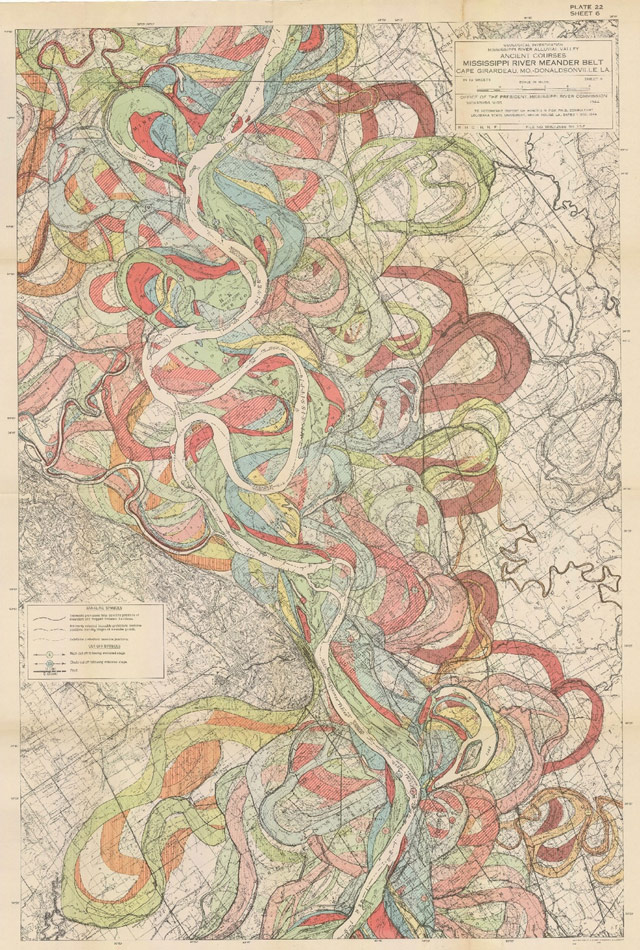
The Mississippi River used to change its course with remarkable regularity. Captured by the Corps of Engineers in the map above (one of Bill Rankin's 5 favorite maps) the dynamic river was important to the renourishment of the wetlands of Southern Louisiana.
It has changed so much that Brett Anderson writes in The Medium that logos using the state outline need to be changed if they are to be honest. (Lagniappe: The article includes a trip to Esri)
27 September 2013
The ground is swalloing up this landscape
The NY Times reports on a sinkhole that is opening up in Southern Louisiana and sucking down the landscape with it. You can watch some of it as it happens:
This isn't the first time that part of Louisiana was sucked into the Earth. Visitors to Jefferson Island can see where a salt dome was dissolved and created a massive whirlpool. The History Channel explains:
This isn't the first time that part of Louisiana was sucked into the Earth. Visitors to Jefferson Island can see where a salt dome was dissolved and created a massive whirlpool. The History Channel explains:
25 February 2013


05 September 2012
Invasive species problem
Even when an invasive species experiences a significant die off, it can still be a problem. The latest example is from Louisiana where Hurricane has left piles of dead nutria (15-20 pounds each) on the beach. Students from my environmental planning will already be familiar with my stories about these very large rodents that have been wreaking havoc on the marshes of Louisiana since the earliest days of the Tobasco empire.
NBCNews.com reports that the clean up isn't as easy as you might think:
"As they're picking them up, they're busting open," Hancock County Supervisor David Yarborough told the Biloxi-Gulfport Sun Herald. A federal contractor with experience in hazardous waste has been brought in, but even a handful of its workers had quit Sunday morning, the Sun Herald reported.Welcome back.
17 May 2011
Flood map
ESRI has created a dynamic map of flooding impacts along the Lower Mississippi River. I am afraid that pretty soon you will have to zoom in on Louisiana to see the points clearly.
02 August 2010
Big Loss for LA Education
On Saturday July 31st, Landscape Architecture lost one of its most durable leaders in education, Robert 'Doc" Reich, FASLA. As founder of LSU's LA program in 1946, and a teacher there until quite recently, "Doc" spent decades building and shaping the profession in Louisiana and throughout the South. He won the ASLA Award and Dot Carpenter Award, and had the School of Landscape Architecture named after him.
Many programs have notable leaders who grew them in the post-WWII era and helped shape the ASLA as it solidified the profession, but "Doc" really stood out as one of the special members of that group. The loyalty he got from LSU grads was remarkable and their financial support of his program helped make it one of the largest in the country.
Many programs have notable leaders who grew them in the post-WWII era and helped shape the ASLA as it solidified the profession, but "Doc" really stood out as one of the special members of that group. The loyalty he got from LSU grads was remarkable and their financial support of his program helped make it one of the largest in the country.
20 December 2009
openHouse photos
I had written previously about openHouse: A collaboration between Francis A. Bitonti (FADarch) and Brian Osborn (BOTH) at the AIA DesCours exhibition in New Orleans.
These post-installation photos come from Rutgers' Brian Osborne:


The project was forced to work through challenging weather conditions. As you can see, it performed admirably.
These post-installation photos come from Rutgers' Brian Osborne:


The project was forced to work through challenging weather conditions. As you can see, it performed admirably.
10 December 2009
Hard work in the Big Easy
One of our instructors, Brian Osborn, is in NOLA this week participating in DesCours, a great week-long architecture and art event. His project, with partner Francis Bitonti, is one of the finalists in the competition.
You can check out all of the work through video tours available (theirs is below). Last night was the official opening, so pictures and awards information should continue to get posted for a few days.
You can check out all of the work through video tours available (theirs is below). Last night was the official opening, so pictures and awards information should continue to get posted for a few days.
11 November 2009
When will NOLA go under again?

This past summer the Christian Science Monitor had an Environment feature on sea level rise in New Orleans and other areas along the lower Mississippi. Louisiana has long struggled in its ongiong battle with the Gulf of Mexico, but this could get really ugly. The researchers they interview project that by 2100 Louisiana could lose more than 5,000 square miles (note: 1 sq mi = 640 acres). Of course, since it is already below sea level, their projections don't look good for New Orleans either.


13 April 2009
Another Katrina casualty?
LSU (Geaux Tigers!) has a hurricane expert on staff who PBS says warned officials of the potential for disaster in a Katrina-like event:

"A slow-moving Category 3 hurricane or larger will flood the city. There will be between 17 and 20 feet of standing water, and New Orleans as we now know it will no longer exist."The Times-Picayune reports that he has been fired and the resulting letters are interesting.
—Ivor van Heerden, October 29, 2004
04 November 2008
Sad policy
 Thing about the complex nature of responses to Katrina is that they seem to be very effective at making the sadness of the overall situation linger. The Chronicle reports on how the New Orleans campus of Southern University, a historically black college or university (HBCU), is having a hard time getting FEMA to help them out. One of the problems is that they let students move back into a damaged building which FEMA sees as evidence that it isn't so bad.
(The photo is fromNOLA's French Quarter, far from the campus. But I wasn't sure when I would get to use it if I didn't pull it out today.)
23 October 2008
Katrina Memorial in the Lower Ninth Ward
Some memorials rely on the fanciest and most expensive materials to show the seriousness of their intent. This memorial may have succeeded in using cheaper pavers in a way that achieved just that - something more elegant would have looked like a well-funded token, while this looks a bit more like a less well-funded work of heart. It obviously has a lot more polish than the makeshift memorials that popped up after the storm. It is designed by David Lee, FAIA and sits right at the bottom of the bridge as you enter the Lower Ninth Ward.


 I read somewhere that the blue columns represented the different levels of water during the storm.
 Since it is situated in the middle of a street, it is more of a piece on a pedastal than a place to visit and contemplate. But since it is still surrounded by one of the most devastated urban places in the US, there are plenty of other places nearby to dwell on the negative. This colorful offering tries to do something different than some other memorials.

This stone, which looks a lot like a cemetery headstone, seemed a little out of place. But it also quickly turned a colorful plaza into a serious space.
 What do you think? Does it strike you as having the impact of a Vietnam Memorial or a WWII? Should it? What is being memorialized here?
I read somewhere that the blue columns represented the different levels of water during the storm.Since it is situated in the middle of a street, it is more of a piece on a pedastal than a place to visit and contemplate. But since it is still surrounded by one of the most devastated urban places in the US, there are plenty of other places nearby to dwell on the negative. This colorful offering tries to do something different than some other memorials.This stone, which looks a lot like a cemetery headstone, seemed a little out of place. But it also quickly turned a colorful plaza into a serious space.
What do you think? Does it strike you as having the impact of a Vietnam Memorial or a WWII? Should it? What is being memorialized here?
16 October 2008
Brad Pitt's houses in NOLA
The Lower 9th Ward has some new houses being built by Brad Pitt's Make It Right Foundation.


 The solar panels and materials scream sustainability, but the long levee wall in the background of this photo says something different to me.

The solar panels and materials scream sustainability, but the long levee wall in the background of this photo says something different to me.
15 October 2008
Not a good one for the rankings
Well, it was a rough weekend for my schools - LSU lost to Florida, Rutgers lost to Cincy, UK lost to South Carolina, and UW lost to Penn St. The Sagarin rankings actually rewarded Rutgers.

I sought comfort in the newly painted scoreboard at Tiger Stadium. It reminds us that they are the only team to have won 2 BCS National Championships.

We are also reminded that they play in an old dorm. That is how Huey Long got the funds to expand the stadium back in the 1930s. It is too good to be made up.

I sought comfort in the newly painted scoreboard at Tiger Stadium. It reminds us that they are the only team to have won 2 BCS National Championships.
We are also reminded that they play in an old dorm. That is how Huey Long got the funds to expand the stadium back in the 1930s. It is too good to be made up.
Subscribe to:
Posts (Atom)


