A warm sunny day might seem like a good time for sneaking to the shore and walking on the beach. But 2 oceanfront homeowners in Brick say they can't walk to the beach because the state built a wall between their houses and the Atlantic Ocean.
Showing posts with label hurricane sandy. Show all posts
Showing posts with label hurricane sandy. Show all posts
16 March 2016


08 February 2016
Hoboken's plan
The NY Times takes a longer look at Hoboken's engineered approach to resiliency. At its heart, the plan uses structures that work like floodwalls. But in Hoboken, that has turned out to be so controversial that Mayor Dawn Zimmer has developed an alternative vocabulary. The Times says that, "Instead, she is careful to use less provocative terms, such as a
“flood-protection measure,” and emphasizes that a wall could double as
an “amenity,” such as a bench or planter, that would fit into the urban
landscape."
In Fundamentals, we just finished talking about some participatory planning methods. The article highlights the difficulty that those present. But it might also demonstrate the value of choosing the right ones.
Meanwhile, this morning's high tide has Jersey Shore towns under water. Keep an eye on the photos getting reposted by the Twitter account @JSHurricaneNews.
In Fundamentals, we just finished talking about some participatory planning methods. The article highlights the difficulty that those present. But it might also demonstrate the value of choosing the right ones.
Meanwhile, this morning's high tide has Jersey Shore towns under water. Keep an eye on the photos getting reposted by the Twitter account @JSHurricaneNews.
05 February 2016
Staten Island resiliency changes
NY1 reports that since Superstorm Sandy, New York CIty's Build it Back program has elevated 25 homes in Staten Island above the floodplain. But these elevated homes change the feeling of the neighborhood fairly dramatically.
NY1 writes that "the problem is, while some are raising their homes so they can get cheaper flood insurance, others are choosing not to." But there is also the simpler problem that it changes the street into an unintended canyon that the designs don't address. We are going to see more of this near our shores, especially in urban neighborhoods, with designers starting to propose some interest solutions.
The Rutgers LA Housing Studio taught by Kate Higgins took a look at how resiliency-driven design decisions could change a neighborhood at the shore. Check out the video.
NY1 writes that "the problem is, while some are raising their homes so they can get cheaper flood insurance, others are choosing not to." But there is also the simpler problem that it changes the street into an unintended canyon that the designs don't address. We are going to see more of this near our shores, especially in urban neighborhoods, with designers starting to propose some interest solutions.
The Rutgers LA Housing Studio taught by Kate Higgins took a look at how resiliency-driven design decisions could change a neighborhood at the shore. Check out the video.
29 October 2014
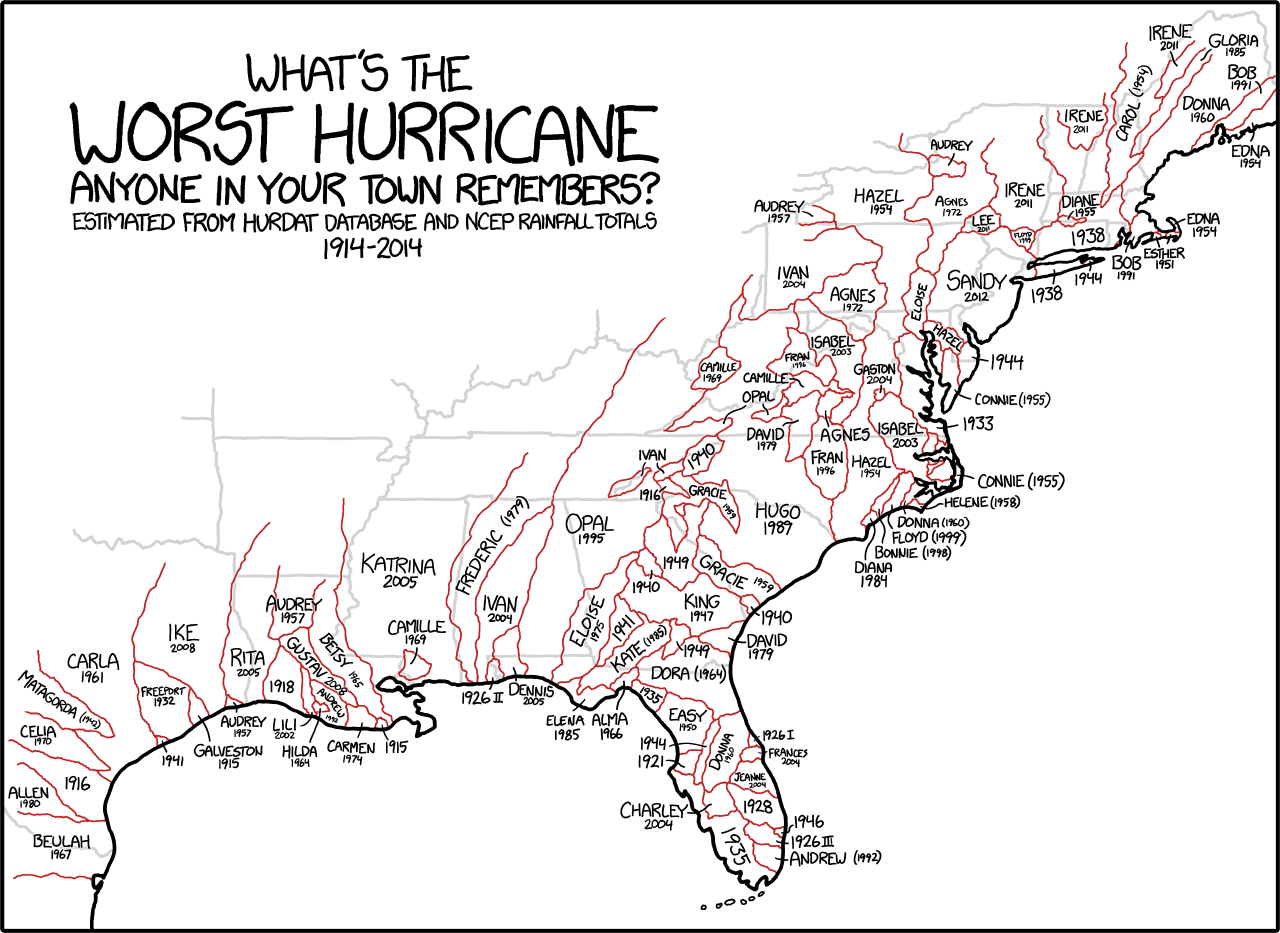
Which hurricanes are most remembered
05 June 2014
More Sandy victims
The Star-Ledger also reports that nearly 50 homes damaged by Superstorm Sandy have been bought out and will soon be demolished.
04 June 2014
One more victim of Sandy
Out on Sandy Hook the Sea Gulls' Nest is going to stay permanently closed, reports the Star-Ledger. But the Park Service, which owns the building, isn't in a rush to fix up the building just so it can get damaged again. Instead, the article suggests that resilience is their new watchword:
"We will continue to use food trucks because at this point it’s a more resilient way to deliver food services," she said.
13 May 2014
09 April 2014
Just trying to tell the story
Regular readers of Places and Spaces will already know that we ran a series of studios last fall investigating different issues in the clean up and rebuilding after Hurricane Sandy. Together we called the studios, Rebuilding for Resiliency: New Jersey Shore, and were fortunate to have a great videographer following along throughout the process.
From the very beginning of the semester until the final presentations, Will Atwater trailed all four classes on multiple trips to the Jersey Shore and captured the explorations and discoveries along the way. In a pretty amazing job of editing, he distilled all of that video down to six short, elegant summaries of the process. Of course, as a good videographer, you never see Atwater, but you can see his diligent work throughout.
For students in Fundamentals, consider how this is part of Steiner's Chapter 8 where he talks about the importance of creating an informed and energized public. These student plans won't get built. But a public watching the videos and thinking about 5-year and 20-year plans for these areas might respond differently to the next round of public hearings whether they are held by towns or FEMA or NJ Future.
From the very beginning of the semester until the final presentations, Will Atwater trailed all four classes on multiple trips to the Jersey Shore and captured the explorations and discoveries along the way. In a pretty amazing job of editing, he distilled all of that video down to six short, elegant summaries of the process. Of course, as a good videographer, you never see Atwater, but you can see his diligent work throughout.
For students in Fundamentals, consider how this is part of Steiner's Chapter 8 where he talks about the importance of creating an informed and energized public. These student plans won't get built. But a public watching the videos and thinking about 5-year and 20-year plans for these areas might respond differently to the next round of public hearings whether they are held by towns or FEMA or NJ Future.
16 March 2014
Blue Acres home demolished
"It's one down, 1,299 to go." NJ Spotlight reports that the first of the Sandy-devastated homes purchased under the Blue Acres has been demolished. This is a small but significant step towards getting residents out of the most floodprone areas.

Photo note: This is not the house in the story, but another victim of Sandy (and Sandy contractors).
Photo note: This is not the house in the story, but another victim of Sandy (and Sandy contractors).
17 January 2014
Rebuild by Design for NJ
The Star-Ledger looks at four of the post-Sandy designs from the Rebuild by Design competition. As the day goes on the comments could become revealing. The designs aren't finalized yet, so the this is a set of preview images. Still worth a peek.
07 January 2014
Not fans of FEMA

NJ Spotlight has posted a profile of the leader of Stop FEMA Now, George Kasimos. The group is described as "an online group of residents opposed to the the new requirements to elevate their homes in accordance with the FEMA flood maps or else pay dramatically higher flood insurance premiums."
Kasimos moved into a lagoon community because he wanted to live close to the water, describing it to NJ Spotlight as living "the American dream." But the storm has changed all of that. While he thinks insurance has gotten too high, he is reported as conceding that people who live in flood-prone areas should pay more for flood insurance than people who don't. It remains unclear how much he thinks that people should pay for flood insurance if they don't need it.
In an area sometimes considered more politically conservative, it will be interesting to see how Stop FEMA Now fares as the call for the government to build protective sand dunes and subsidize insurance, potentially at a rate of tens of thousands of dollars per house per year. Meanwhile, outside groups on the right are upset at the scale of government dependency that flood insurance is creating.
The politics of the shore remain confused/confusing/jumbled/fascinating. Undertones of populism continue to bubble up on both sides of the aisle. We see is sometimes characterized as government-favoring liberals wanting less government support for home owners while some of their more conservative neighbors are suddenly hoping that government can step in to preserve their way of life.
There will be some who will see all of this as competing hypocrisy or self-serving political movements. But whatever it looks like to you, it looks to me like something that is going to remain interesting for quite some time.
07 November 2013
Rising Waters exhibition
The Museum of New York City has opened an exhibition of photography from Superstorm Sandy called Rising Waters. The photos are both eerie and, photographically, beautiful. Digital Photography Review has posted some images online that incredibly powerful. But I imagine that seeing them on a wall, printed pretty large, could be much more emotional.
04 October 2013
Lingering problems
We've been talking about the lingering impacts of Sandy. Last month, Ocean County Planner Dave McKeon said that 26,000 residents are still displaced.
26 September 2013
06 September 2013
Build-a-dune
NatGeo writes about how to build a sand dune to protect from the next big storm. Their version is simple and cheap.
05 September 2013
Yesterday's NY Times took a closer look at how neighbors are pressuring other neighbors at the shore to allow dunes to be built. Will the owners of duneless beachfront homes become pariahs? This story makes it seem like they already are.
03 September 2013
Web resources for Sandy recovery studios
NJ Flood Mapper from Rutgers CRSSA and JCNERR
WNYC's Flood Mapping
State of NJ Storm Response Materials
Sandy Resources from ArcGIS.com
FEMA's Check your Home has aerial snapshots
Other items mentioned
SLOSH Models
SLAMM Model
PlanNYC report: A Stronger, More Resilient New York
FEMA Map Service Center
FEMA Acronym guide
Climate Change Research at Rutgers
FEMA Resource Guide
BFE Look up
Stronger than the Storm
Are FIRM maps political?
Maritime industry impacts


WNYC's Flood Mapping
State of NJ Storm Response Materials
Sandy Resources from ArcGIS.com
FEMA's Check your Home has aerial snapshots
Other items mentioned
SLOSH Models
SLAMM Model
PlanNYC report: A Stronger, More Resilient New York
FEMA Map Service Center
FEMA Acronym guide
Climate Change Research at Rutgers
FEMA Resource Guide
BFE Look up
Stronger than the Storm
Are FIRM maps political?
Maritime industry impacts


02 September 2013
Beach replenishment and rebuilding dunes
This fall my studio will be looking at Sandy recovery further inland, but we need to remain aware of the beaches as front lines for storms coming in off the Atlantic. The Bergen Record offered a diagram of some expensive beach replenishment work that the US Army Corps of Engineers has undertaken. At a distance this sometimes seems linked to the construction of sand dunes that Christie has visibly (or audibly) pushed for. But, writes Bill Wolfe, much of the beach replenishment is of the type that won't provide protection, but will help expend plenty of Federal funds.
As we start this studio, it would be worth looking at these distinctions. They represent a larger lesson. Whether it is raising houses, or razing houses, or restoring marshes or hardening open space, not all improvements are improvements. We are going to race through the semester, trying to digest lots of information and sort out better approaches and solutions.
As we start this studio, it would be worth looking at these distinctions. They represent a larger lesson. Whether it is raising houses, or razing houses, or restoring marshes or hardening open space, not all improvements are improvements. We are going to race through the semester, trying to digest lots of information and sort out better approaches and solutions.
25 August 2013
Macro and micro recovery
Sandy recovery has to be looked at from both a micro and macro perspective. This story is just a micro story, but it might be an indicator of the quality of available workers overall.
23 August 2013
Sandy made some beaches bigger
The Press of Atlantic City reports that Sandy actually helped replenish some beaches in New Jersey. These are strong and complex forces.
Subscribe to:
Posts (Atom)


