27 June 2007
Mobius Transformations
A couple guys at UMinn posted a short, beautiful video that looks at 3-dimensional mobius transformations which are strongly related to the ways we begin to think about spherical map projections.


Full-page Puzzles
Every so often, the New York Times turns over its op-ed page (that's different than the editorial page) to the folks who write puzzles. They create a giant op-art piece that weaves together a series of puzzles wrapped around a theme and that all combine to solve some final puzzle piece. Last year they published a really nice baseball puzzle during the World Series. It is nice to see that they are keeping an archive available online so that these puzzles continue to be enjoyed for years to come.
26 June 2007
Historic Tunnel in Elizabeth
 The Elizabeth Historic Society has found a secret tunnel that they think carries important links to the past. Paul Mattingly reported recently that the tunnel was probably used for smuggling of both goods and people, from the Elizabeth River up to the Belger-Ogden Mansion. While the details are preliminary, it is a pretty exciting find. I can't wait to see it.
23 June 2007
Forests and Natural Lands
Today's NYTimes features a commentary by Timothy Egan who decries recent policies governing the nation's forests and natural lands. The commentary, called "This Land Was My Land," makes specific mention of the poor condition of areas around Mount Hood, Oregon. But it also ventures into some comparisons between the current administration and those who inititated the programs:
It looks like the forestry equivalent of a neighborhood crack house.In the Pinchot woods, you see the George W. Bush public lands legacy. If you want to drill, or cut trees, or open a gas line — the place is yours. Most everything else has been trashed or left to bleed to death.
21 June 2007

15 June 2007
14 June 2007
State GDPs
So, you've probably heard someone say that California has the 7th largest economy in the world. Another way to look at it is to say that its GDP is the same as France.
Texas has a GDP as large as Canada. But what about the other
50 states? Strange Maps has a map where the states are renamed by countries with similar GDP. Very cool.
Texas has a GDP as large as Canada. But what about the other
50 states? Strange Maps has a map where the states are renamed by countries with similar GDP. Very cool.
10 June 2007


09 June 2007
Street View
By now you may have noticed Google Map's new Street View tool which lets you see things at the street level. But did you realize that it has already introduced a new level of sluething to Google Map? There is now an effort to look at the street view images and identify when they were taken.
UPDATE: There is also an active discussion about the privacy concerns of street level spying. And someone spotted E.T. in NJ.
UPDATE: There is also an active discussion about the privacy concerns of street level spying. And someone spotted E.T. in NJ.
01 June 2007


30 May 2007
GIS Job
GIS MANAGER
New Jersey Conservation Foundation (www.njconservation.org), one of the nation’s most effective land conservation organizations, seeks a dynamic individual to manage our Geographic Information System (GIS) and offer technical support for NJCF departments and Garden State Greenways implementation. The applicant should have 2-3 years GIS experience, and should be proficient in cartographic modeling, database development and management. Excellent interpersonal, organization and communications skills with strong team orientation are required. Please send a resume & salary requirements to Maria Hauser, NJCF, 170 Longview Rd., Far Hills, NJ 07931; e-mail to maria@njconservation.org; or fax to (908) 234-1189.
29 May 2007
Bouncing back
 The impacts from Katrina are still slowing be repaired, but this is promising news. The NY Times reports that the bridge connecting Bay St Louis is finally reopening. While it was disheartening to see it so far from complete when I visited in November, it is reassuring and hopeful to see how quickly the finished it. But it is just one piece in a very complex puzzle.
Mayor Favre is still living in a trailer, and the old City Hall downtown is
still empty. He has moved municipal functions to a former utility company
building on the highway. Downtown, on a deserted street, an injunction scrawled
on a vacant frame house — “Please respect our loss. Do not enter” — seems
superfluous, as there is nobody around to read it.
28 May 2007
Memorial Day
 For Memorial Day you could go back and listen to some of Kenny Helphand's NPR interview on Defiant Gardens.
Or you could read about the controversy over memorializing Katrina in New Orleans.
Or you could just look at some memorial photos.


27 May 2007
Historic district in Princeton
(NOTE: Summertime has already meant shorter posts and periods of silence. Expect much more of the same until late August)
While the 1950s produced some incredible examples of modern architecture, Princeton is talking about turning a somewhat less exceptional 1950s neighborhood into an historic district. In isn't that Clover Lane is a reco historic treasure, but no one wants the McMansions that are pushing into this neighborhood built on prime real estate in one of America's most prestigious communities.
The Times reports:
While the 1950s produced some incredible examples of modern architecture, Princeton is talking about turning a somewhat less exceptional 1950s neighborhood into an historic district. In isn't that Clover Lane is a reco historic treasure, but no one wants the McMansions that are pushing into this neighborhood built on prime real estate in one of America's most prestigious communities.
The Times reports:
The proposed historic district "is representative of the many residential subdivisions constructed during the postwar building boom from 1945 to the late 1950s," according to a report that Metuchen-based historic preservation consultant ARCH¯ Inc. completed in February for the township under a $5,000 contract that likely will be amended.
"Its greatest significance is due to the fact that it is one of the few extant examples of Modern style subdivisions in the Princeton area and New Jersey," the report states.
The modern designs usually included clean lines, structural simplicity and lots of glass to connect the interior with the outdoors. Interior walls were kept to a minimum so living areas would flow into one another and to give the little houses the feel of a larger space, according to the ARCH¯ report. Other distinctive elements present in the Deer Path and Clover Lane houses include trapezoidal windows and butterfly roofs that slant upward toward the edges rather than peaking in the middle.
But the interesting idea comes near the end where the article mentions that other most neighborhoods haven't discovered how historic district status can be used as an anti-teardown tool. Yet.
26 May 2007
Earth Spiral


ON a recent outing to the Meadowlands, we saw this art installation. I didn't have time to take good photos because the boys were busy looking for snakes (preferably pythons), so I wasn't going to post them. But then I found the artist's web site and I think her main photo is worth a peek. This looks like the major public installation of this sort by Elaine Lorenz, but I hope it isn't her last.
25 May 2007
FAQ: Transferring into RU LA
Q. I am currently at a County College but am preparing to transfer to Rutgers next year for Landscape Architecture. What can I do to make the most of my time here?
FIRST, as you consider what classes to take, you should know how Rutgers sees them. Using http://njtransfer.org/ you can look up the exact equivalency between Cook/SEBS and your specific County College.
SECOND, you also need to be very aware of the required courses for the major. These are posted online at:
http://catalogs.rutgers.edu/generated/nb-ug-0507/pg21061.html
Here are my favorites. These three classes fulfill both major requirements AND college requirements (thus getting your more bang for the buck) and are often available at county colleges:
01:119:103 Principles of Biology (4)
01:460:101 Introductory Geology I: Physical (3)
01:640:115 Precalculus College Mathematics (4)
Other SEBS requirements can be found online at: http://www.cookcollege.rutgers.edu/core/2003/
Of these I would encourage you to focus first on the communications (i.e. English), and put off the humanities until last (since History of LA counts as one of these classes). A careful investment of your time should help fulfill many of these requirements before you leave County College.
Regardless of how much time you put in at county college, you will probably need to put in 3 full years here, beginning with a fall semester. Our program is sequenced in a way that generally requires 6 consecutive semesters of design studios.
FINALLY, you should know that we use a limited enrollment process. After the first fall semester of landscape architecture classes, students submit materials from the landscape architecture studio as part of a portfolio. The limited enrollment process limits the number of students taking most further landscape architecture classes.
24 May 2007
23 May 2007
Isfahan
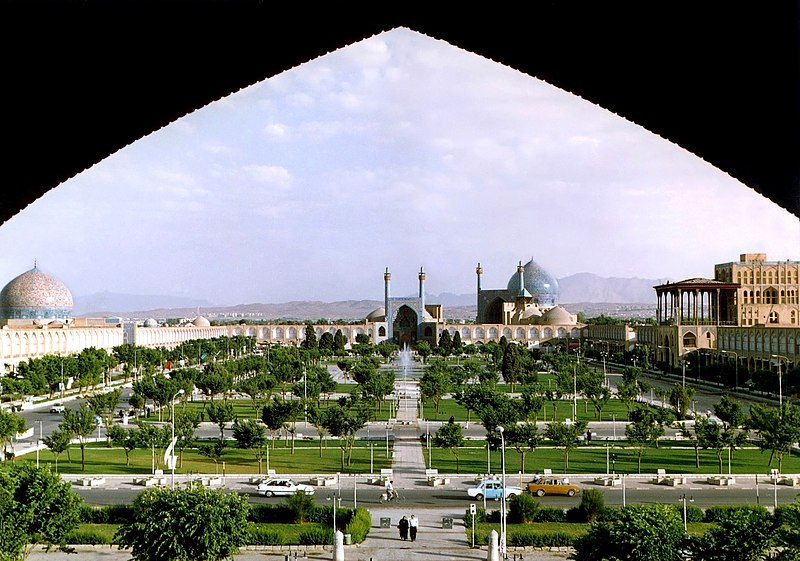 Since yesterday's post about Persian gardens, I have been thinking about the great photos of Isfahan online. I realized that I definitely should be including it on my life list of places I want to visit someday. It is a World Heritage site. PPS has Isfahan's grand Imam Square highlighted on their list of 60 of the World's Great Places. The city, as a whole, is described as both historic and beautiful. One post I found described it as the most beautiful city in the world. I won't know until I see it (which will probably be a while).
I have also added it to my maps.
22 May 2007
Persian splendor
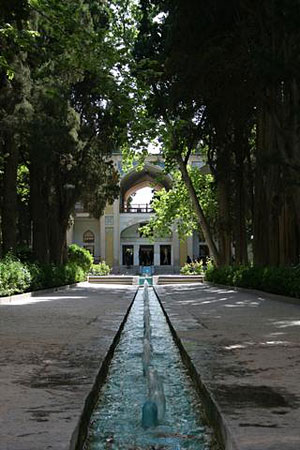 Writing in Slate, Constance Casey has posted a lovely piece describing what one editor has headlined "Gardens in the Axis of Evil." She just spent much of April in Iran and has written about the gardens she saw. Some of the gardens are quiet and reflective places, like the Bagh-i Fin garden in Kashan Slate's picture above captures it nicely). But other examples are on a grand scale that is hard to imagine, like the ancient garden city of Isfahan. Althought the article includes a photo from Isfahan, her writing doesn't tell about her time there.
Anyone who was watched some of the recent Iranian films like Children of Heaven or Baran or The Color of Paradise (!) may not be as surprised by the beauty of some of the photos and experiences. But it is great to hear that this amazing experiences are accesible, even if under limited terms in some cases.
21 May 2007
Gas prices are reducing driving
According to USA Today, Americans have started to change their behavior because of gas prices.
Although 70% have consolidated errands to save gas, only 10% have changed jobs to shorten their commute. If gas breaks $4 per gallon, 33% say they will change cars to one that gets better mileage.
James Howard Kunstler thinks that the decline of oil production and our continued addiction to it will go beyond a crisis and be a major social upheaval. But even a mild reaction should help home values in walkable towns like Highland Park and Metuchen but would seem more likely to create problems for sprawling suburban towns like South Brunswick. And, as usual, in many places it would hurt the poor more and faster than anyone else.
Although 70% have consolidated errands to save gas, only 10% have changed jobs to shorten their commute. If gas breaks $4 per gallon, 33% say they will change cars to one that gets better mileage.
James Howard Kunstler thinks that the decline of oil production and our continued addiction to it will go beyond a crisis and be a major social upheaval. But even a mild reaction should help home values in walkable towns like Highland Park and Metuchen but would seem more likely to create problems for sprawling suburban towns like South Brunswick. And, as usual, in many places it would hurt the poor more and faster than anyone else.
19 May 2007
Opposite side of the world
 When the kids try to dig a hole straight down through the Earth, where are they headed? Strange Maps has posted a great map of all of the land on Earth that has land on the exact opposite side of the planet.
Here is the Google Map of our opposite place. You might even call it an antipode.
International Student Competition
International Student Competition Closing date : 31st July 2007
Competition Brief
This competition is sponsored by the International Federation of Landscape Architects (IFLA) , and is directed by Institute of Landscape Architects Malaysian ( ILAM ).
The Objective of this competition is to encourage and recognize superior student environmental design work that addresses and attempts to find solutions for the various issues and challenges that face future generations and the landscape architecture discipline in making the world a better place to live in.
The competition invites submissions from teams of students in Landscape Architecture programs or other allied disciplines.
Theme
Follow the theme of the IFLA World Congress 2007: EDEN-ing the Earth
The participants can submit the entry related to these sub themes:
Landscape and Parks as Natural Resources
Biodiversity and landscape Planning
Sustainable in Landscape Planning and Design
Disaster management and Landscape Architecture
Cultural Landscape in the Era of Globalization
However, the prize will only be given to overall winner. No prize will be given according to the sub themes.
Awards
1st Prize $3,500 US and certificate (IFLA Prize)
2nd Prize $2,500 US and certificate (IFLA Zvi Miller Prize)
3rd Prize $1,000 US and certificate (Merit Award-ILAM)
44th IFLA2007 International Student Competition
Kuala Lumpur & Putrajaya, Malaysia
Submission and Enquiry :
Dr. Osman Mohd Tahir, AILA
44th IFLA World Congress 2007, Student Design Competition
Department of Landscape Architecture, Faculty of Design and Architecture,
Universiti Putra Malaysia, 43400UPM, Serdang, Selangor, Malaysia
Tel no : (60)3-89464092; Fax no: (60)3-89464005 ; e-mail : osman_mtahir@yahoo.com; enquiry@ifla2007.com
Competition Brief
This competition is sponsored by the International Federation of Landscape Architects (IFLA) , and is directed by Institute of Landscape Architects Malaysian ( ILAM ).
The Objective of this competition is to encourage and recognize superior student environmental design work that addresses and attempts to find solutions for the various issues and challenges that face future generations and the landscape architecture discipline in making the world a better place to live in.
The competition invites submissions from teams of students in Landscape Architecture programs or other allied disciplines.
Theme
Follow the theme of the IFLA World Congress 2007: EDEN-ing the Earth
The participants can submit the entry related to these sub themes:
Landscape and Parks as Natural Resources
Biodiversity and landscape Planning
Sustainable in Landscape Planning and Design
Disaster management and Landscape Architecture
Cultural Landscape in the Era of Globalization
However, the prize will only be given to overall winner. No prize will be given according to the sub themes.
Awards
1st Prize $3,500 US and certificate (IFLA Prize)
2nd Prize $2,500 US and certificate (IFLA Zvi Miller Prize)
3rd Prize $1,000 US and certificate (Merit Award-ILAM)
44th IFLA2007 International Student Competition
Kuala Lumpur & Putrajaya, Malaysia
Submission and Enquiry :
Dr. Osman Mohd Tahir, AILA
44th IFLA World Congress 2007, Student Design Competition
Department of Landscape Architecture, Faculty of Design and Architecture,
Universiti Putra Malaysia, 43400UPM, Serdang, Selangor, Malaysia
Tel no : (60)3-89464092; Fax no: (60)3-89464005 ; e-mail : osman_mtahir@yahoo.com; enquiry@ifla2007.com
Locked churches
Someone is going around England to see if church doors are locked. And then they are creating a massive report on it including graphs by diocese and maps of counties.
18 May 2007
Ecological design issues
 Yesterday, at a doctoral exam, we got pretty engaged in a discussion about whether people can "get" designed interpretations of natural landscapes. One committee member even seemed willing to concede the public's inability to see the aesthetic beauty of more natural landscapes. The candidate had been citing Joan Nassauer's work which encouraged visible interventions (like a rectalinear flower planting inside an otherwise natural-looking forest). And I wondered if we should just keep presenting the very ecological design that we could create and help them learn to appreciation it.
 It turns out that if were keeping up with my reading I would see a parallel discussion in a recent issue of LA Magazine that looks at one of my favorite examples of ecological design. Crosby Arboretum, in Picayune, Mississippi gets featured as a place where visitors have slowly changed from confused to appreciative. Where the experiences used to be like this:
“Excuse me, can you tell me where the arboretum is?” she asked.
“You are standing in it,” I replied.
Now they are getting visitors who understand the experience and maybe willbe pushing them harder to do exciting things. It isn't just Crosby; the article mentioned Darrel Morrison's Lady Bird Johnson Wildflower Center. Ecological design is changing the way people perceive natural landscape.
17 May 2007
The most cramped apartment in NYC

In a most unusual art piece, 6 people are spending 20 days living together in a 2-dimensional space called Flatland. They built a living environment wedged between two glass walls that are just far enough apart to squeeze in a human being. All six people and their very large hamster cage are currently on display at the Sculpture Center in Queens.
16 May 2007
Job: GIS Project Manager
POSTITION ANNOUNCEMENT: GIS Project Manager
The National Center for Neighborhood & Brownfields Redevelopment at the E.J. Bloustein School of Planning & Public Policy is actively involved in three major areas: Land use planning and impact analysis for the state, county and regional government agencies, using its Spatial Land & Impact Model (SLIM); Neighborhood/community level revitalization programs; and Partnering with a consortium of universities in advising the U.S. Department of Energy on the cleanup and reuse of the nation’s former nuclear weapons facilities.
The GIS Project Manager would be actively involved in using SLIM and other spatial and spreadsheet software to prepare a variety of land use and impact analyses under existing contracts, and to promote the greater involvement of the Center in similar work in areas such as wastewater management planning, development of smart growth county and regional plans, and environmental and other impacts studies across the state. Because of the nature of the Center’s work, the individual should also have a good understanding of environmental and other issues surrounding the redevelopment and reuse of old industrial and commercial properties (brownfields/grayfields).
Interested parties should contact Henry Mayer, Ph.D.
Executive Director
National Center for Neighborhood & Brownfields Redevelopment
E.J. Bloustein School
The National Center for Neighborhood & Brownfields Redevelopment at the E.J. Bloustein School of Planning & Public Policy is actively involved in three major areas: Land use planning and impact analysis for the state, county and regional government agencies, using its Spatial Land & Impact Model (SLIM); Neighborhood/community level revitalization programs; and Partnering with a consortium of universities in advising the U.S. Department of Energy on the cleanup and reuse of the nation’s former nuclear weapons facilities.
The GIS Project Manager would be actively involved in using SLIM and other spatial and spreadsheet software to prepare a variety of land use and impact analyses under existing contracts, and to promote the greater involvement of the Center in similar work in areas such as wastewater management planning, development of smart growth county and regional plans, and environmental and other impacts studies across the state. Because of the nature of the Center’s work, the individual should also have a good understanding of environmental and other issues surrounding the redevelopment and reuse of old industrial and commercial properties (brownfields/grayfields).
Interested parties should contact Henry Mayer, Ph.D.
Executive Director
National Center for Neighborhood & Brownfields Redevelopment
E.J. Bloustein School
15 May 2007
14 May 2007
Crissy Field

 Someone pointed out that my life list entries were antiquated sites thus far. Indeed. Let's fix that.
Designed by Hargreaves and Associates, Crissy Field was an ASLA Design Award winner back in 2002 and has become a Bay-area destination and a symbol of civic resuse of land. Originally the site was an airfield, but now this park has become an all-in-one sort of place. It is a beach and a windsurfing spot and a place for gatherings and a front yard for San Francisco. And, while the ASLA only gave it a Merit award, it was included in MoMA's prestigious Groundswell exhibit.
12 May 2007
Life list: Temple of Karnak
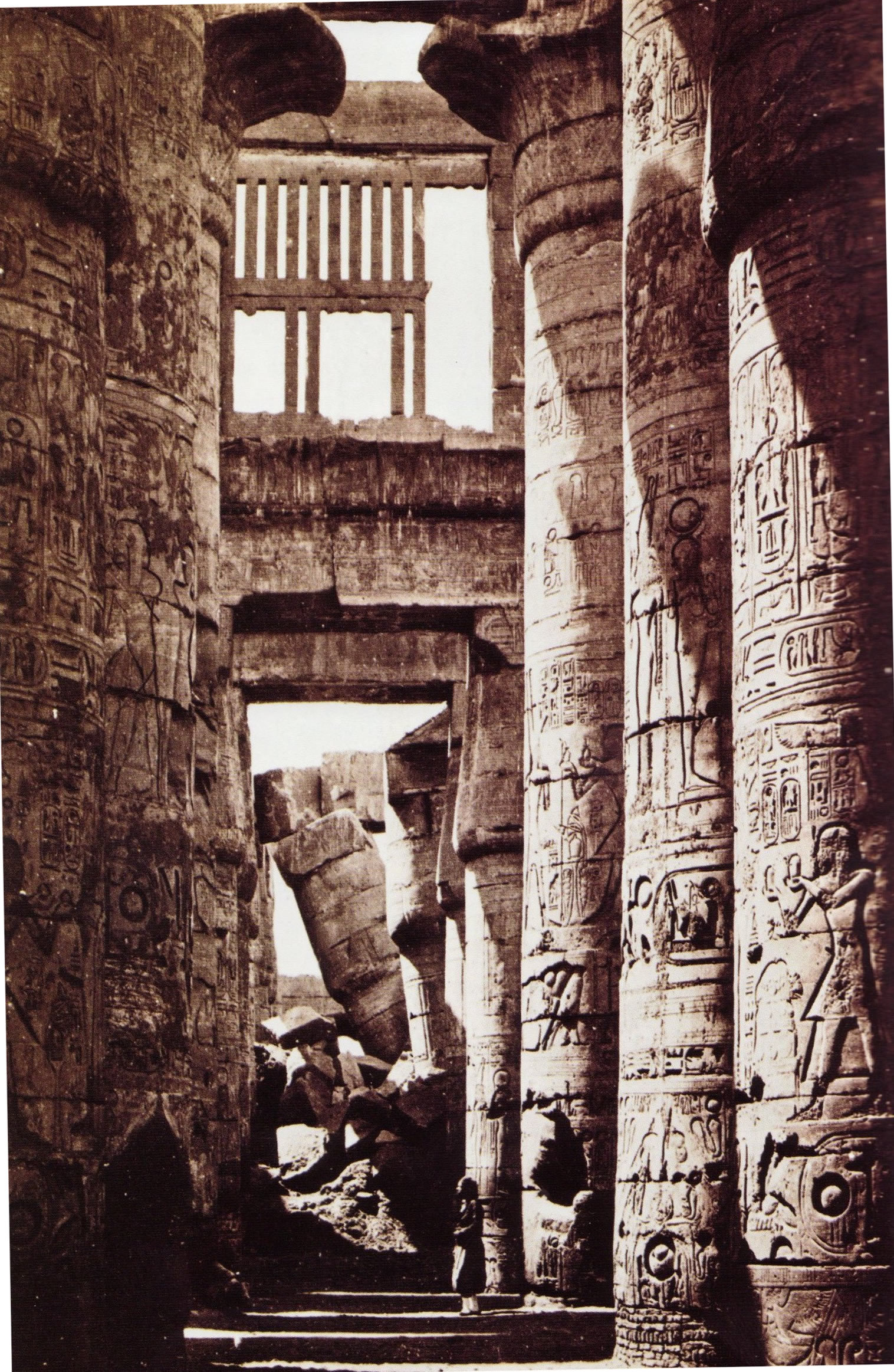 I don't know why, but I have been thinking about Egypt some lately. In particular, the Temple of Karnak. It is definitely a place I hope to visit someday, but I don't imagine making it there for some time to come. Still, I found these photos to be quite distracting. The Wikipedia entry has some good photos, too. Few of the photos online seem to capture the scale but the air photos begin to.
Landscape Wiki
While I have been saddened by the quiet demise of the old Virtual Library of Landscape Architecture at the University of Toronto, I have been more surprised by the lack of a replacement. Landscape Architecture is a field filled with energetic people and I was waiting to see something pop up and fill that niche. Maybe there have been some already, but this Landscape Wiki is the first real collaborative effort I have seen in some time...
http://www.collaborativelandscape.org/
This is a strong collaborative effort that emphasizes open source and open dialogue. With over 100 case studies already included, it seem like it has a robust base. But the real test will be how it handles some heavy traffic and a few early controversies.
http://www.collaborativelandscape.org/
This is a strong collaborative effort that emphasizes open source and open dialogue. With over 100 case studies already included, it seem like it has a robust base. But the real test will be how it handles some heavy traffic and a few early controversies.
11 May 2007
firmitas, utilitas, venustas
 Today's speaker mentioned (ever so briefly) the writings of Vitruvius. His book, De architectura, serves as a foundation of design theory readings. Translated as Ten Books on Architecture, the book is available online at Project Gutenburg and well worth the time to read. One of the more famous sections explains three fundamental qualities of architecture: durabilty, utility, and beauty.
2. All these must be built with due reference to durability, convenience, and beauty. Durability will be assured when foundations are carried down to the solid ground and materials wisely and liberally selected; convenience, when the arrangement of the apartments is faultless and presents no hindrance to use, and when each class of
building is assigned to its suitable and appropriate exposure; and beauty, when the appearance of the work is pleasing and in good taste, and when its members are in due proportion according to correct principles of symmetry.
10 May 2007
 It is no secret that I love old aeromaps. The rich detail, the impressive accuracy and the elegant presentation all combine to present a wonderful learning tool. The Library of Congress keeps a sizable collection of these in its American Memory collection online.
The aeromap above was drawn by C. R. Parsons and published by Currier & Ives. It shows Washington DC circa 1880. If you use their tools to let you zoom in, you can see the Washington Monument still under construction. If you wander up the Mall, you can see how much it has been transformed.

09 May 2007
9/11 Memorials in NJ
As we continue cataloguing sites around the state I have stumbled into multiple resrouces on 9/11 memorials in the Garden State. Being directly across the river from New York, we were directly impacted in multiple ways and the monuments attempt to maintain that connection. An article in City Journal included a photo from the monument at Eagle Rock where the view of the towers used to be a prominent feature. New Jersey has plans online for the State's memorial in LIberty State Park. And pictures are popping up of the controversial sculptural element in Bayonne's.
And as an interesting resource, the Bergen Record has created an interactive map tool focusing on the memorials throughout North Jersey.
And as an interesting resource, the Bergen Record has created an interactive map tool focusing on the memorials throughout North Jersey.
the 5 second rule
Everyone knows that when you are eating with kids and some food gets dropped on the floor, you can't eat the food off the floor...unless you invoke the 5 second rule.
Today's NYTimes examines this emerging area of serious public health research. The landmark research in this field was conducted by Jillian Clarke in 2003. But, like so many scholars, her contributions were not immediately recognized. It was not until 2004 that she received her due, as a winner of Harvard's Ig Noble Award. Her work showed how most clean, dry floors were safe surfaces from which to retrieve fallen food.
Then there was a quiet period in which the scholarly community digested the meaning of this research.
Now, researchers at Clemson University have advanced the ball with a more detailed study on the rule and its implications. As the Times reports:
Today's NYTimes examines this emerging area of serious public health research. The landmark research in this field was conducted by Jillian Clarke in 2003. But, like so many scholars, her contributions were not immediately recognized. It was not until 2004 that she received her due, as a winner of Harvard's Ig Noble Award. Her work showed how most clean, dry floors were safe surfaces from which to retrieve fallen food.
Then there was a quiet period in which the scholarly community digested the meaning of this research.
Now, researchers at Clemson University have advanced the ball with a more detailed study on the rule and its implications. As the Times reports:
Accompanied by six graphs, two tables and equations whose terms include “bologna” and “carpet,” it’s a thorough microbiological study of the five-second rule: the idea that if you pick up a dropped piece of food before you can count to five, it’s O.K. to eat it.With an increasing number of researchers exploring these key rules governing day-to-day life, I think we are going to need to hurry up here at Rutgers and firmly establish ourselves as leaders of inquiry into Calling Shotgun.
08 May 2007
Life list: Great Zimbabwe
There are going to be some sites on my life list (of places I want to go in my life) that I've been thinking about for much of my life. This isn't one of those.
The Great Zimbabwe National Monument is an impressive historic site that was recognized as an early entry on the UNESCO World Heritage Site list. Built between the 11th and 15th Centuries, the structure features some great craftsmanship that reminds me just a tiny bit of Peublo Bonita at Chaco Canyon. One difference here is that this one is enclosed in a very tall circular wall.


The Great Zimbabwe National Monument is an impressive historic site that was recognized as an early entry on the UNESCO World Heritage Site list. Built between the 11th and 15th Centuries, the structure features some great craftsmanship that reminds me just a tiny bit of Peublo Bonita at Chaco Canyon. One difference here is that this one is enclosed in a very tall circular wall.
When the levee breaks...
Back in the old days, wealthy individuals would build their own private levees around the properties. If I read and view this National Geographic report on New Orleans' "repaired" levees right, it might be smart for them to start rebuilding those peronal ones again. (The videos are a great compliment to their traditional printed edition.)
Map Contest results
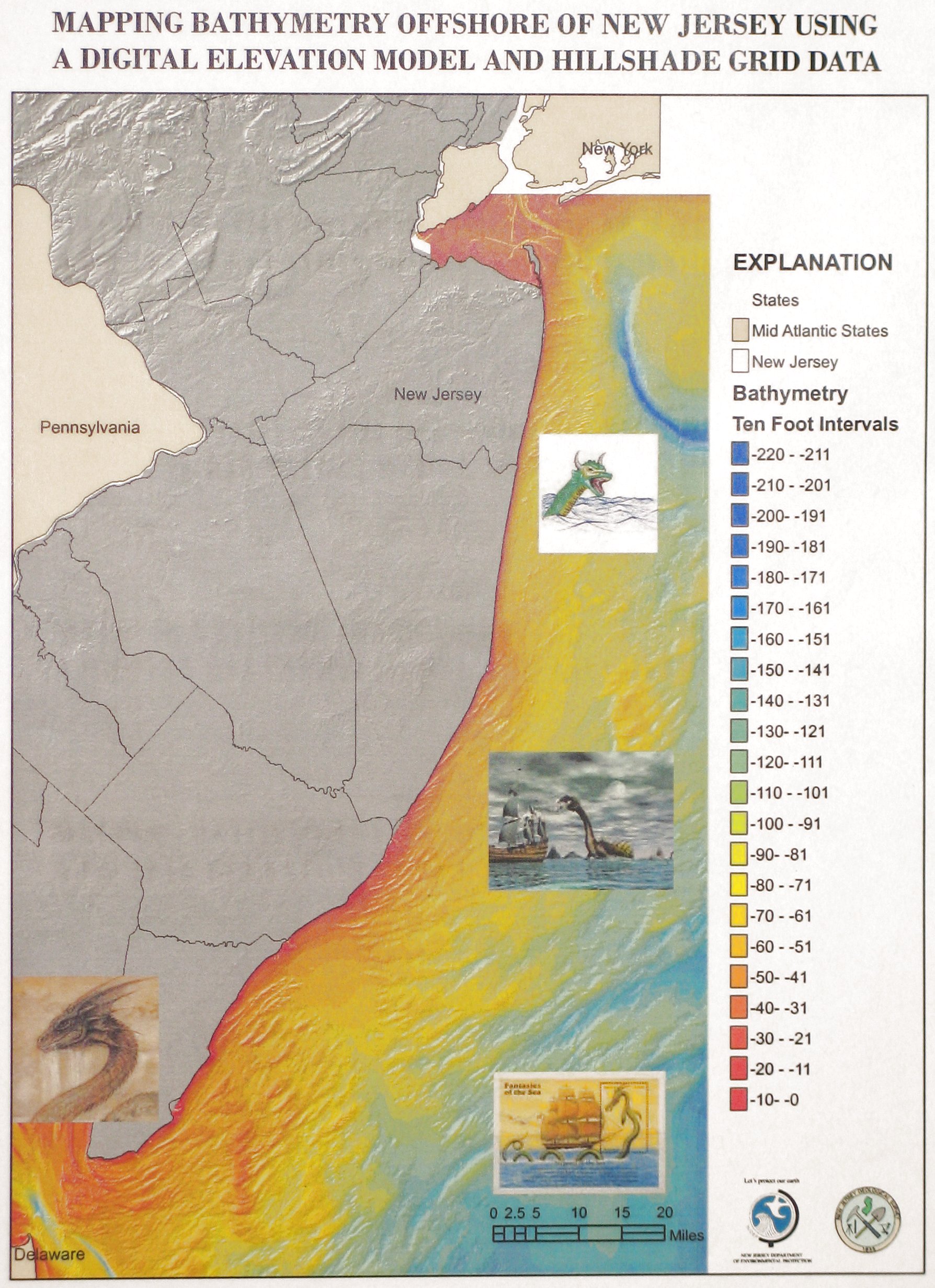 I had previously mentioned the success of our GIS students at the 20th Annual NJ DEP Mapping Contest. Now you can check out all of the winners at: http://www.nj.gov/dep/gis/mapcon20.htm
07 May 2007
3-d printing
 The Times looks at 3-d printing and describes it as ready for home uses. You can download a cog and then have your 3-d printer make it. Think about ways to explore three-dimensional representations of landscapes and alternative grading plans. Desktop Factory hopes to deliver a desktop unit at under $5k later this year.
Only in Mumbai
 With no warning, someone left their 737 in the middle of a busy street in Mumbai for days. Then, just as suddenly, it disappeared.
The ultimate excuse for video games
Efforts to maintain and improve brain fitness have now reached your Xbox (or Wii or whatever is next) and given people the ultimate excuse for playing computer games. The games will let you keep an eye on your Brain Age while do exercises to improve your flexibility and strength. Seed reports on this potential growth industry:
Merzenich has big plans for PositScience. He wants to launch programs that target the visual cortex, working memory, and executive control. With those goals in mind, he has partnered with the Mayo Clinic to conduct an expansive trial study. Moreover, Merzenich has begun studying the positive effects of PositScience on schizophrenic patients. The results so far have been "extremely encouraging": "If we got these same improvements with a pill," Merzenich says, "we'd be counting the money already. We'd have billions in sales. But this isn't a pill—it's much better than that."Still, a sudden death overtime in Madden NFL '07 is not an excused absence.
06 May 2007
Tribal GIS ban
The headline at Pruned sums it up pretty well: No GIS For You!
No sooner do the tribes in the Phillipines figure out how to use GIS to stake land claims than the government bans them from using it. Go figure.
No sooner do the tribes in the Phillipines figure out how to use GIS to stake land claims than the government bans them from using it. Go figure.
The Hindenburg
 70 years ago today the Hidenburg went down in flames here in New Jersey. It still remains a bit of a mystery how it happened. But a classic lesson to learn from it is that most of the deaths were people who jumped. Most passengers who remained on board, landed safely.
NPR has an audio clip of a news broadcast of the incident. It sounds like it might not have been live.
05 May 2007
Watch that water
Happy Derby Day!
Hargreaves design for the Waterfront Park in Lousiville included some major water features that invite barefooted visitors in the summer to wade in and splash around. But James Brugger of the C-J writes about how there have been bacterial problems in some of the water.
If you aren' familiar with the park, you might check out some slideshows of photos online.
Here's the photo that blew me away.
But the water problem raises an interesting question about what to do. You can already see in the photos from the C-J that putting up signs detracts from the appearance of the original design. But fencing off these areas becomes a much larger distraction and it might still be hard to keep people out. After all, the whole point of these areas was to integrate the movement of park visitors and the movement of water while highlighting places where they intersect.
Hargreaves design for the Waterfront Park in Lousiville included some major water features that invite barefooted visitors in the summer to wade in and splash around. But James Brugger of the C-J writes about how there have been bacterial problems in some of the water.
If you aren' familiar with the park, you might check out some slideshows of photos online.
Here's the photo that blew me away.
But the water problem raises an interesting question about what to do. You can already see in the photos from the C-J that putting up signs detracts from the appearance of the original design. But fencing off these areas becomes a much larger distraction and it might still be hard to keep people out. After all, the whole point of these areas was to integrate the movement of park visitors and the movement of water while highlighting places where they intersect.
04 May 2007
Beverly Pepper
 Last year when we went to Barcelona, one of the pleasant surprises
was Parc de Nord. The park was designed by America sculptress Beverly Pepper who brought the spaces of the park to life with large tiled earthworks. Our photos of the park came out nice, in part, because the colors and the forms made it easy to photograph.
But I was also impressed with Pepper's web site about the park.
Pepper, however, did not want to simply place a sculpture outdoors; she wanted to create a total environment, which would have a practical public use. She considered her park commission a great challenge that would permit her to integrate many of the elements she had studied and worked on separately. She knew it would be difficult, time-consuming, and elaborately complex. In the end, she invested five years, from 1987 to 1992, in collaborating with Catalan landscape architects, Andreu Arriola and Carmine Fiol, and artisans to create the huge, 325,000 square-meter park near the abandoned railroad station.Closer to home you might have seen her work at Grounds for Sculpture or the more difficult to access Amphisculpture.
Young Circle Art Park
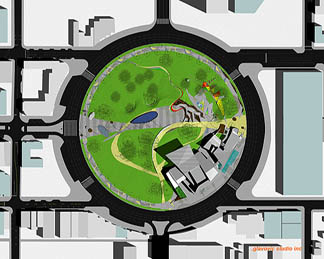 I stumbled onto at least 2 different portayals of this park in the last 2 or 3 days. It is designed by Glovovic Studio and sits right in the middle of Route 1 (a long ways down the street from here) in Hollywood, FL. I don't see how LAM will hold off from including this in an issue in the next year or so - it is dynamic, will be home to some exciting activities, and photographs very well.
When I went to drop it on the map I realized that the Google Map photo is older than the park (which just opened in March).
03 May 2007
LFUCG
OK, so maybe LFUCG doesn't sound so elegant. But the Lexington Fayette Urban County Government is an elegant solution to a variety of problems. It is a merged city-county government which means the entire county is treated as a single place for most purposes, including land use planning.
The merged city-county allows for the use of an Urban Service Boundary, which is what they call their urban containment boundary, as a way of drawing a crisp line between Lexington and the horse farms that wrap around it. If you look at the Comprehensive Plan map (PDF) you can't miss it. Inside the line, they endeavor to provide urban services like water and sewer, outside the boundary they use zoning and other tools to keep the rural areas rural.
Zoning isn't always enough. They are also using an active PDR program to work with farmers to ensure that Lexington has a permanent greenbelt wrapped most of the way around it.
I would encourage procastinating students to poke around the LFUCG websites a bit. They've posted plenty of informative materials.
The merged city-county allows for the use of an Urban Service Boundary, which is what they call their urban containment boundary, as a way of drawing a crisp line between Lexington and the horse farms that wrap around it. If you look at the Comprehensive Plan map (PDF) you can't miss it. Inside the line, they endeavor to provide urban services like water and sewer, outside the boundary they use zoning and other tools to keep the rural areas rural.
Zoning isn't always enough. They are also using an active PDR program to work with farmers to ensure that Lexington has a permanent greenbelt wrapped most of the way around it.
I would encourage procastinating students to poke around the LFUCG websites a bit. They've posted plenty of informative materials.
FAQ: Summer Readings 2
Even as I was posting the longer message about summer readings, one of my colleagues was sending me a shorter list of web links:
Here are three reading lists that focus on books recommended for students of landscape architecture - classics, must read, advanced.
http://www.caup.washington.edu/larch/Programs/reading/reading.php
http://laep.ced.berkeley.edu/admissions/booklist
http://www.library.unlv.edu/arch/titlesforlandscape.html
This is more of a primer on how to get started on reading about landscape architecture and include booklists.
http://www.library.uiuc.edu/cpx/links/laguide.html
http://www.lib.vt.edu/help/handouts/landarch-rg.pdf
Here are three reading lists that focus on books recommended for students of landscape architecture - classics, must read, advanced.
http://www.caup.washington.edu/larch/Programs/reading/reading.php
http://laep.ced.berkeley.edu/admissions/booklist
http://www.library.unlv.edu/arch/titlesforlandscape.html
This is more of a primer on how to get started on reading about landscape architecture and include booklists.
http://www.library.uiuc.edu/cpx/links/laguide.html
http://www.lib.vt.edu/help/handouts/landarch-rg.pdf
Why the Celebration?
A few have asked why there would be critics of a place like Celebration, Florida. I can't find all of the critics online, so my representation of their comments will be a little indirect and undercited, but...
Witold Rybczynski writes a mostly positve commentary for one of his Slate slideshows, but he can't help but tack on a social commentary:
And some authors are focusing mroe on the toal impact of Disney on the landscape in the Orlando area. One example would be Foglesong's Married to the Mouse. One couple moved to Celebration and wrote about it in Celebration, U.S.A: Living in Disney's Brave New Town. Probably the most serious examination of the social side of things comes from Andrew Ross who is an NYU professor of American Studies. In, The Celebration Chronicles, Ross describes his observations after moving to Celebration. According to Amazon the first sentence of the book is, " I live in a country that never runs out of promises." That sums up the chase after utopian dreams pretty well.
Some really object more to the artificially clean environment or the significant manipulation of nature. But most write about the experiment in terms that make it clear that Celebration has acheived something new and something worth watching and talking about.
Witold Rybczynski writes a mostly positve commentary for one of his Slate slideshows, but he can't help but tack on a social commentary:
A four-bedroom house on a small lot—like the relatively modest Craftsman-style Bungalow pictured here, hardly a McMansion—now sells for $450,000. This is more than three times the average selling price of houses in metropolitan areas nationwide, which is currently $140,000, making Celebration the residential equivalent of a Lexus. The truth is that despite its best efforts, the populist Disney Co. has produced an elitist product.One of the simple problems is that Walt had a vision for a community of the future, so unless this really is the most cutting edge social experiment ever, it hasn't live up to his dreams.
And some authors are focusing mroe on the toal impact of Disney on the landscape in the Orlando area. One example would be Foglesong's Married to the Mouse. One couple moved to Celebration and wrote about it in Celebration, U.S.A: Living in Disney's Brave New Town. Probably the most serious examination of the social side of things comes from Andrew Ross who is an NYU professor of American Studies. In, The Celebration Chronicles, Ross describes his observations after moving to Celebration. According to Amazon the first sentence of the book is, " I live in a country that never runs out of promises." That sums up the chase after utopian dreams pretty well.
Some really object more to the artificially clean environment or the significant manipulation of nature. But most write about the experiment in terms that make it clear that Celebration has acheived something new and something worth watching and talking about.
02 May 2007
Can design spark development?
 Oh man, can it ever! Long before it becomes a reality, the High Line in New York is sparking all sorts of exciting new developments. Popular magazine, New York, details some of the rapid changes happening in West Chelsea. Pretty soon there might not be so many good galleries there.
(H/T to Archinect)
TDR at issue
One of the central issues in the debate over New Jersey's Highlands plan is that it is employing a TDR system to encourage the movement of growth away from critical features and towards regional centers or other sorts of receiving zones. The municipality of Ringwood has issued a 10-page recommendation to change the plan because they think the current proposal is going to have a negative impact on the very water quality and rural landscape issues that the highlands Act is supposed to protect.
FAQ: Summer Reading
Q. I have some extra time this summer/semester/winter and would like to read an extra book or two. Can you suggest anything good?
It depends on your interest.
A) For trying to get a sense for Landscape Architecture as a profession:
An interesting book to read and explore (that is often used at universities in the landscape discovery classes) is John O. Simmonds' Landscape Architecture. It is fairly easy to read, can often be acquired as a used book (especially online) and is intersting for folks in and out of the profession.
Another avenue to consider would be to get some recent issues of Landscape Architecture Magazine which is published by the American Society of Landscape Architecture and is meant as their semi-official portrayal of the state of the profession.
B) For environmental planning students I frequently recommend the following (although some are recommended as examples of trends that I may or may not fully endorse):
Ian McHarg's Design With Nature and A Quest for Life.
Anything written by Wendell Berry. My favorite was Home Economics, but that was a while ago.
Duany, PLater-Zyberk, and Speck's Suburban Nation: The Rise of Sprawl and the Decline of the American Dream.
James Howard Kunstler's Geography of Nowhere: The Rise and Decline of America's Man-Made Landscape.
Oh, what the heck. Maybe you should just pick from Planetizen's Top 20 Planning Books list for this stuff.
C) For those who are trying to move up from entry level students to serious students of landscape architecture, Dr. Shearer has prepared this for his design students:
A few people have asked me for a list of books that might be of use to a landscape architecture education. Below is a starter-list which, I think, should offer something to everyone. I have not looked which of these are on the shelf of RU libraries, but all could be borrowed by way of interlibrary loan services. Similarly, I am not sure how many of these will be for sale at Borders or Barnes and Noble's, but everything should be available through Amazon or Alibris (a great site for used books).
There are several books by John R. Stilgoe that are well worth reading. He is an historian, not a designer, and holds a joint appointment between the Department of Landscape Architecture at the Harvard Graduate School of Design and the Visual & Environmental Studies Department of the Faculty of Arts and Sciences. Before mentioning the books, I should give a couple disclaimers: First, he will be speaking here next spring, so you might want to take the opportunity to get a sense of who he is, what interests him, etc. The topic has not been set, but he might very well ask you if you see the arrow in the FedEx sign. Second, JRS was my dissertation advisor (and J.B. Jackson, author of The Necessity for Ruins, was his). And no, I am not required to be a shill for his books. Also worth mentioning, he writes a bi-monthly column in the Sunday Boston Globe--South Shore Edition. You can find these by searching his name on Google News.
John Stilgoe, Common Landscapes of North America. His first major work, this book examines how North America has been intentionally shaped from the colonial era through the early nineteenth century by non-designers. Topics include measures taken by government--such as the Ordering of Towns which was penned before the Puritans stepped off the Arabella, the Spanish Law of the Indies, and the Jefferson-era Northwest Ordinance; by farmers--how northerners made fences to keep things in vs. how southerners made fences to keep things out and why barns are red; and by what might be considered visionary industrialists--such as the people who funded the Pennsylvania Turnpike and the Erie Canal. As one might expect, this book is chock full of historical facts, but its real strength is that demonstrates how "traditional" practices for shaping the landscape are not conventions to be followed uncritically. Instead, they are based on a complex combination of ideals and practicalities. At a minimum, this book would complement your landscape history class in that it describes the "non-art" shaping of the environment. But separate from that potential, I think this book would be of interest to everyone, regardless of whether you are in the landscape architecture, landscape industry, or environmental planning & management programs.
John Stilgoe, Outside Lies Magic. Relatively short and very approachable, this book was written for a broad audience and intended to get everyone to go outside, look around, and think about the implications of what they see. For example, how does the US Post Office organize space and how, in turn, do we--in part--live by that organization?
John Stilgoe, Landscape and Images. This book is a compilation of some of JRS' articles and essays. Topics include the role of photography in shaping our understanding of the landscape (for better and worse), the specter of hobgoblins in suburbia, and bikinis. This book came out last year through the University of Virginia Press and I do not know if it is available as a paperback yet.
Simon Schama, Landscape and Memory. Schama is another historian, but unlike Stilgoe does not focus on the environment. (For example, a previous book was on Dutch painting and he has recently been compiling a multivolume history of the Britain.) As a result of his range, he is not as insightful on particular points about landscape change, but his breadth makes connections that a more specialized mind might miss. Some of the places described in Landscape and Memory will be familiar to you from your landscape history class; others--like Mount Rushmore--you will know from elsewhere. What I think is useful about this book is its organization: Rather than go through a discussion of these sites by time or by location, it is arranged in three parts by material: wood, water, and rock. This perspective can help you re-think not only what you learned in your history class, but how you might apply design themes based on materials in studio.
William Cronan, Natures Metropolis. If you are looking for patterns in this list, Cronan is also an historian. If he has a fault, it would be that he occasionally sentimentalizes some activities associated with shaping the environment. That particular problem is not so evident in this history of Chicago in which he describes how the idea (the promise?) of "progress," natural resources, and technology combined to create a new kind of urban condition. I recommend this book not because I think everyone should know about America's second city, but because it lays out, in clear language, how possibilities can be combined to create something bigger than most people can imagine. Whether or not such things should be built is another question, but it is happening at a rapid clip in China as you read. Admittedly, this book will be of more obvious interest to those in the environmental planning & management program, but it could help everyone think about the built environment.
J. Nicholas Entrikin, The Betweenness of Place: Towards a Geography of Modernity. This book is not an easy read: most graduate students need to keep a very good dictionary at hand, and you will want to (or need to) pause and think about what is expressed after each and every page. In essence, Entrikin tries to synthesize two opposing ways we understand the creation of regions. On the one side, there is the German "science of space" view which holds that law-like forces of change operate universally over time. On the other side is the French, "description of place" view which holds that regions emerge from entirely idiosyncratic opportunities and decisions. If you can get through it, it will help you to understand arguments of geographic limitation-determinism.
Gaston Bachelard, The Poetics of Space. If you pick up Kevin Lynch and Gary Hack's Site Planning, you will be able to start applying what you read very quickly; It's just that kind of book. The Poetics of Space is the opposite in term of easy application, but it is arguably as important. You do not "use" this book. Instead, you live with it, and as you do it infuses your own ideas and makes them richer. Most of the points are made in terms of architecture—and indeed, this book is read by just about every architect at some point in his or her education—but do not let that get in the way of you reading it. (Stilgoe thought it important enough that he wrote an introduction to one of the more recent editions.)
Edward T. Hall, The Hidden Dimension. Hall is an anthropologist who writes on a variety of issues that frequently go unnoticed in daily life because they are so ingrained in a culture. In this book he examines what might be considered the dynamics of personal space and indirectly, what designers might do to influence how social places are designed.
Niall Kirkwood, The Art of Landscape Detail and Weathering and Durability in Landscape Architecture. Kirkwood now deals with bioremediation and other technologies for brown field sites, but his first book and follow-up were careful studies of construction details. On the surface, they are about what combinations of material and forms work, what do not work, and why. However, their underlying premise is that for site scale design to be successful, the ideas of the larger scheme should be expressed in the thoughtful execution of the smallest elements. Admittedly, most books on building details are hopelessly dull and this text might suffer a certain lack of glamour. But if you want to further explore how a curb or a flight of steps might matter and, moreover, how thinking about these things might contribute to a richer design process, then these books are worth a look. Also of note, when I last looked, they were quite expensive.
James Corner [Editor], Recovering Landscape: Essays in Contemporary Landscape Architecture. Corner is the Chair of the Landscape Architecture Department at the University of Pennsylvania. Some of the essays in this collection are difficult to read, but if you are interested in wrestling with big ideas, it is a good place to start.
Giuliana Bruno, Atlas of Emotion: Journeys in Art, Architecture, and Film. Another disclaimer: I was GB's teaching fellow for several years. There is "smart," there is "really smart," and there is "scary smart"—so smart that you are glad the person uses their mind for good and not to rule the planet for their own enrichment. Giuliana Bruno is scary smart. This book is about the relationship between seeing and traveling, about the "motion" in emotion. That topic alone makes it engaging, but what I think is even more important about this book is the way it brings together different arts.
Malcolm McCullough, Abstracting Craft: The Practiced Digital Hand. During pin-ups and reviews we have talked about how the making of drawings and models is a matter of craft—of knowing about the qualities of materials and how they can be shaped for a certain effect. Very soon you will be making representations with a computer in addition to with a lead holder and chipboard and you might be wondering, is there such a thing as "digital craft"? After all, most AutoCad plots look as if they could have been made by anyone any time. McCullough, who was trained as an architect and urban planner, thinks that digital craft does exist, even if the ideas of craft are not discussed or taught in a computer lab. This book places digital media within a larger context of visual arts. It will not teach you how to make the most of the Photoshop magic wand tool, but it will introduce you to a way of thinking about your efforts with keyboard and mouse that will lead to better works.
Douglas Cooper, Drawings and Perceiving: Life Drawings for Students of Architecture and Design. Cooper teaches at Carnegie Mellon and this book might be considered a translation or adaptation of the well known The Natural Way to Draw by Kimon Nicholaides for designers. The instructions and exercises are quite good.
Robert W. Gill, Basic Rendering. This book is all about black and white rendering. Its strength is its discussion of how light behaves on the objects around us. It will help you to become a master of stippling.
01 May 2007
GIS job at the Brownfields Center
Henry Mayer, Executive Director of the National Center for Neighborhood and Brownfields Redevelopment, is looking for a full-time person who has strong GIS skills along with good environmental background (and maybe writing skills). If you know anyone that might be interested in a position, they should email him at
hmayer@rci.rutgers.edu.
Edward J. Bloustein School of Planning and Public Policy
Rutgers, The State University of New Jersey
33 Livingston Avenue, Suite 100
New Brunswick, New Jersey 08901
Phone: (732) 932-0387, x653
Fax number: (732) 932-0934
Email: hmayer@rci.rutgers.edu
hmayer@rci.rutgers.edu.
Edward J. Bloustein School of Planning and Public Policy
Rutgers, The State University of New Jersey
33 Livingston Avenue, Suite 100
New Brunswick, New Jersey 08901
Phone: (732) 932-0387, x653
Fax number: (732) 932-0934
Email: hmayer@rci.rutgers.edu
DPZ's new medieval village
Today's DIRT had details on one of the latest New Urban communities that DPZ is planning for the Florida Panhandle. The difference here is that Sky would be based on the principles of medieval village design rather than the usual old New England village.
Life list: Woodland Cemetery
Birders keep life lists of birds they've seen. And I saw a great list of places that every geology fan should visit.
So I thought maybe I should start a personal list of great places I have left that I still want to go. Over the summer I hope to very occassionally post places I think are outstanding, but haven't yet verified on the ground.
The first one I'll list is Woodland Cemetery by Erik Gunnar Asplund. Unfortunately, Stockholm is just far enough out of the way that I doubt I'll be stopping by real soon. Still, the entire site looks so compelling that maybe we should rethink our plans. Woodland is on our 3 landscapes list and I've added it to the map.
So I thought maybe I should start a personal list of great places I have left that I still want to go. Over the summer I hope to very occassionally post places I think are outstanding, but haven't yet verified on the ground.
The first one I'll list is Woodland Cemetery by Erik Gunnar Asplund. Unfortunately, Stockholm is just far enough out of the way that I doubt I'll be stopping by real soon. Still, the entire site looks so compelling that maybe we should rethink our plans. Woodland is on our 3 landscapes list and I've added it to the map.
Unassisted Triple Play
Baseball is filled with unique plays and rarely seen acheivements, like no-hitters (I've seen one) and 4 consecutive batters hitting 4 consecutive home runs. But one of the rarest of all plays is one you can't plan for, the unassisted triple play. Sunday afternoon a rookie shortstop for Colorado pulled off the 13th unassisted triple play i the history of major league baseball. It happened so fast that his own coach was confused.
If you have any interest in sports, you'll want to watch the video from MLB."Once he made the play and I thought we had four outs, I wondered how that worked for the next inning," Rockies manager Clint Hurdle said. "But I think we had it figured out. Those aren't things you work on or plan for, so when they happen, it kind of catches everybody for a second."
30 April 2007
One of our own in the paper
Advanced Geomatics student, Angela Gorczyca, was in today's newspaper. She was part of a study that found that Middlesex County has nearly as many bird species (308) as Yellowstone National Park (318).
Sad day in DC
Washington DC has lost (or at least suffered serious damage to) one of its great old buidings. The Eastern Market suffered from a major fire today. I found a nice old gallery of photos taken at Eastern Market.
FAQ: Changing final grades
Q. I am unhappy with my FINAL grade and would like to see it changed. What can I do?
A. Unfortunately, you may have waited too long for most remedies. Now that the grades are final I will NOT:
* Offer additional extra credit opportunities;
* Change the break point between letter grades;
* Reconsider subjective grades (like a paper or a studio project) unless they were returned so late that you did not have the opportunity to review the paper until after the end of classes; or
* Accept late assignments or offer make-up exams without excused absences (as approved by Martin Hall).
You should understand that these are not fair to the students who worked so hard to come to class on time, take good notes, get their work in on time, complete the extra credit, and take advantage of office hours and test review sessions.
However, there are some appropriate reasons for which I would consider a grade change. If you are requesting that I reconsider your grade, you should suggest which of the following reasons applies:
a) there seems to be a computational error in calculating your grade;
b) there seems to be a reporting error in calculating your grade;
c) you believe there was a scoring error on one of your exams;
d) you believe that you showed significant consistent improvement over the course of the semester (65%->75%->85%) and should receive special consideration; or
e) you want to submit late work under an excused absence.
If you are going to argue your case on a subjective grade, you certainly should focus on the SPECIFIC element of the grade (like "Test #2", or "the graphics grade on the final studio project") that you think should be reconsidered, not the overall final grade.
If you are close to the next grade and don't see any justifiable reason to request a change, you should at least try to get a copy of your final (by the first week of classes of the next semester) and check that there was no scoring error.
You certainly should EXPLAIN why a change of grades would be appropriate. I won't even respond to vague general requests to reconsider.
GENERAL TIPS AND REQUESTS:
Ask yourself this simple question, is there some strong evidence that clearly demonstrates that your ability and knowledge are superior to your performance on the measures used in class? Is there a specific and appropriate reason that your test scores were not as high as they should have been considering your level of knowledge and ability?
Your grade is YOUR grade. Please do not ask me to change it because of someone else's (e.g., "I worked harder than him but didn't get as good a grade". If I erred and gave him a higher grade than he deserved, it doesn't mean that you deserve it too.) Instead, show me how your grade would be wrong even if you were the only person in the class.
Try not to insult me in your requests. Telling me that I am not FAIR is a really good way to make me feel less like helping. Plus, if I am really unfair, you should probably be discussing the matter directly with the department chair.
Try to avoid obvious lies. Students shouldn't tell me that they never missed a class when they know that I called on them 6 times and they answered twice. Don't tell me that you are a good student when you know that a quick check of your GPA will reveal otherwise.
I am more than willing to discuss these matters further, but would encourage you to contact me with specific questions or concerns at dtulloch@crssa.rutgers.edu
29 April 2007
New Urbanism

After our recent lecture on New Urbanism, I did want to mention some online resources.
Another notable project within a few hours drive is the Storrs Center near UConn's compus. They have an official site up for this planned community.
Washington Town Center, here in NJ, has been written about plenty including this older piece saying it was a smart idea and this newer one pointing out that it has been too successful.
I also recently saw this piece on the new Dardenne Prairie, which is a little more from DPZ.
You could look at the firms like Rutgers-related A. Nelessen Associates or the (in)famous DPZ.
The Congress for the New Urbanism maintains an official presence online that includes projects and images.
What I don't have handy is any written critique of New Urbanism. Maybe next time...
Takings cases
While we talked about a number of takings cases in class, we didn't have a reading to supplement those lectures. To help I've rushed to slap together some links, altough I can't claim to have read them. Which also means that I cannot vouch for their quality or usefulness other than in the most indirect ways.
From Wikipedia:
Cornell Law School has pulled up some of the SCOTUS texts:
http://www.planning.org/amicusbriefs/kelo.htm
From Wikipedia:
- http://en.wikipedia.org/wiki/Kelo_v._City_of_New_London
- http://en.wikipedia.org/wiki/Dolan_v._City_of_Tigard
- http://en.wikipedia.org/wiki/Penn_Central_Transportation_Co._v._New_York_City
- http://en.wikipedia.org/wiki/Euclid_v._Ambler
Cornell Law School has pulled up some of the SCOTUS texts:
- Penn Central - http://www.law.cornell.edu/supct/html/historics/USSC_CR_0438_0104_ZS.html
- Dolan - http://www.law.cornell.edu/supct/html/93-518.ZD.html
- Nollan - http://www.law.cornell.edu/supct/html/historics/USSC_CR_0483_0825_ZS.html
- Kelo - http://www.law.cornell.edu/supct/html/04-108.ZO.html
http://www.planning.org/amicusbriefs/kelo.htm
How do you resolve this?
It turns out that even the wealthiest communities have problems worth people building homes that are too large. It has been added to our map.
Great Orange Graphics
 The Great Park of Orange County is moving ahead with new details being revealed regulalry. This week, the OCRegister has detailed graphics showing how the Orange balloons would work. The ballons are designed to give up to 30 people a ride at a time.
28 April 2007
Great Falls State Park
I meant to link this a while ago, but since it happened before I started the blog, I was always going to be a little late.
Last year the NJ DEP ran a design competition to develop a masterplan for Paterson's Great Falls. The competition entires have been posted online by NJIT, with entries from notable landscape architecture firms including WRT, Field Operations, and EDAW. The jury included Lance Neckar, a landscape architecture professor from Minnesota.
The final outcome was announced late in the year:
Last year the NJ DEP ran a design competition to develop a masterplan for Paterson's Great Falls. The competition entires have been posted online by NJIT, with entries from notable landscape architecture firms including WRT, Field Operations, and EDAW. The jury included Lance Neckar, a landscape architecture professor from Minnesota.
The final outcome was announced late in the year:
The competition winner, Field Operations of New York City, proposed a plan called "Paterson's New Outdoor Living Room," allowing residents to walk along the river, under the shade of its cliffs and up to the foot of the falls. The $10 million vision for the project's first phase centers on using a loop path to tie the park's various elements together -- linking the falls and Overlook Park to the ATP site, which would be restored as a landscaped path, the Valley of the Rocks and Mary Ellen Kramer Park.
27 April 2007
Battle of Bound Brook
After spending a chunck of the spring talking about the American revolution, I was looking forward to seeing the re-enactment on the 230th Anniversary of the Battle of Bound Brook this weekend. Sadly, it has been cancelled due to the flooding earlier this month.
Instead, I can spend some time this weekend reading up on the recently found George Washington letter.
Instead, I can spend some time this weekend reading up on the recently found George Washington letter.
The World Series is coming
The World Series of Birding is just 14 days away and things are getting pretty exciting. Since the playing field is the entire state of New Jersey, we get a pretty good view of the action. I am sure that some teams are making a final review of the more unusual rules (it is, afterall, a sport of honor) and cleaning their lens. As a non-competitor, one way to prepare is just reviewing old entries. You can see how a team of 1-5 graders identified over 100 species last year. La Puma et al. competed in digiscoping, which involes taking digital photos of birds through scopes (my favorite is their Black Skimmer photo).
Ouch!
The Yankees brought up their 20-year old phenom pitching prospect, Phil Hughes, last night. How did he describe the experience? “Hopefully, I won’t remember it too much."
26 April 2007
Ag Field Day
 Just a quick reminder that this Saturday is the 89th Annual Ag Field Day. It is a great chance to catch up with other alums, the faculty, and our current students. The School has a website up with a full list of activities (http://agfieldday.rutgers.edu/events.asp) but I thought a few were worth mentioning.
1) Our highlight every year is, of course, the daylong open house at Blake Hall. We'll have up new student work with both students and faculty around to give tours to prospective students and interested parties. Make sure you check out the giant model of Paterson, NJ in the upstairs back studio. We'll have our list of alums who we've lost touch with, hoping that other alums can help us find them again. And we'll have lots of stories and news to share.
2) My second home on campus, the Center for Remote Sensing and Spatial Analysis, is holding an open house from 10 to noon. We'll be giving away posters and showing off high-tech mapping toys.
3) The Marine Science program is showing their highly acclaimed IMAX film on the somewhat smaller screen in the Alampi Room at IMCS. "Volcanoes of the Deep" is showing at 10am with the lead researcher there to introduce it and answer questions. It is a fascinating film and yet another RU product to be proud of.
It'll be a great day that we look forward to sharing with you.
Map Contest
 We are excited to announce that the Advanced Environmental Geomatics class has returned from the NJDEP Map Contest in Trenton with three map awards. The team had ten members: Vanessa Beuschel, Philip Bosco, Angela Gorczyca, Peter Hugger, Maura McShane, Emmanuel Ndiema, Dennis Quinlan, Matthew Vitullo, Kaitlyn Walsh, and Michael Yaffe. Their map of the Spatial Dimensions of the Revoloutionary War in New Jersey captured hundreds of events and places that are an important part of New Jersey's history. You might want to note that the above map is a draft and not final. We'll try to update it and give it a more permanent web home in the coming days.
The awards they brought home were:
- 1st Place Best Newbie
- 2nd Place Most Unique
- 2nd Place Best Overall (Non-NJDEP)
What makes the birds sing?
Is it love? Is it spring? Is it streetlights??? According to a new study, urban birds are singing at night because the noise during the day drowns them out.
24 April 2007
St. Guadi?
The Belfast Telegraph reports that there is a possibility that Gaudi will add still another credential to his resume: saint. Some already call him God's Architect, but that could make the title really stick.
Jose Manuel Almuzara, an architect and president of the Association for the Beatification of Gaudí, said: "We do not see any serious obstacles to him becom-ing canonised. His greatest creation has made faith accessible to the average person and inspired thousands who were not Catholics before they visited. We do not know how long this may take but we are confident.
What is a tree worth?
Someone wrote to ask me about the valuation of landscape architecture, and I had to admit that I know very little about the process of assigning value to designed landscapes and elements.
But I do know that there is a fairly well established process for estimating the value of existing trees in the landscape, either as a fixed value to the owner (what you you owe them if you killed their tree) or as an annually accruing value (what are the benefits of this tree to the community). Researchers have just conducted a street tree survey of all 5 boroughs of NYC and found that after you factor in costs for planting and maintenance, the city is benefitting $122 million per year from its street trees. According to the NYTimes, these benefits aren't evenly distributed...
But I do know that there is a fairly well established process for estimating the value of existing trees in the landscape, either as a fixed value to the owner (what you you owe them if you killed their tree) or as an annually accruing value (what are the benefits of this tree to the community). Researchers have just conducted a street tree survey of all 5 boroughs of NYC and found that after you factor in costs for planting and maintenance, the city is benefitting $122 million per year from its street trees. According to the NYTimes, these benefits aren't evenly distributed...
The tree census found that Queens has about 40 percent of the city’s street trees, followed by Brooklyn, with about 25 percent; Staten Island, with about 16 percent; the Bronx, with about 10 percent; and Manhattan, with roughly 8 percent.
23 April 2007
From cornfields to backyards
In yet another Slate slideshow, Witold Rybczynski explains the details of how a farms turns into houses. These slides are in support of Slate's publication of excerpts (1, 2, 3) from his new book, Last Harvest: How a Cornfield Became New Daleville. The development he looks at, New Daleville, isn't that from us, but instead of driving there you could just visit the website. Or look at it on the EPD map.
If you read the details you'll find that his ideas on sprawl and architecture are probably not as simple as you might first have suspected.
If you read the details you'll find that his ideas on sprawl and architecture are probably not as simple as you might first have suspected.
21 April 2007
Weekend Eye Candy

 Last Summer I finally made it to Peter Walker's classic project, the Weyerhaeuser Headquarters. As you can see from the photos, it was extremely hot and dry (98 degrees), but it still felt lush. A sign of the timlessness of the project is that the Walker firm posts their photos of the 1972 Weyerhaeuser Headquarters in the same project list as the very recent Novartis campus in Basel. After those, look at the other 100+ PWP projects that are online.
A long drive
If you have always wanted to drive from New Jersey to Portugal, you may still get your chance. The Russians are proposing to build a tunnel across the Bering Strait. Ah, but will there be enough gas for Americans to take in such a long trip? The tunnel is part of a larger proposal to connect Siberia's gas and oil with America's cars and wallets.
20 April 2007
Green: The New Red, White and Blue?
Since I haven't seen it, I don't know how seriously I can recommend this, but it does sound intriguing...
"Green: The New Red, White and Blue," a documentary featuring Tom Friedman¹s reporting on green technology, premiers on the Discovery Channel on Saturday, April 21 at 9 p.m. EDT.
"Green: The New Red, White and Blue," a documentary featuring Tom Friedman¹s reporting on green technology, premiers on the Discovery Channel on Saturday, April 21 at 9 p.m. EDT.
Land Steward
New Jersey Conservation Foundation (NJCF), one of the nation’s premier land conservation non-profits, seeks a Land Steward to manage preserved land primarily in the northern half of the state.
Responsibilities include basic land maintenance, habitat restoration, creation of hiking trails, monitoring of preserved lands and working with partner organizations, in addition to various physical tasks. Significant in-state travel required.
Candidate must possess passion for the environment and a willingness to work hard. Qualifications to be considered include: knowledge of native ecology, practical skills including carpentry and operating heavy machinery, excellent interpersonal skills, and a college degree in biology, ecology or a related field.
Please send resume & salary requirements to Maria Hauser, 170 Longview Road, Far Hills, NJ 07931 or e-mail maria@njconservation.org. EOE M/F/V/D
Responsibilities include basic land maintenance, habitat restoration, creation of hiking trails, monitoring of preserved lands and working with partner organizations, in addition to various physical tasks. Significant in-state travel required.
Candidate must possess passion for the environment and a willingness to work hard. Qualifications to be considered include: knowledge of native ecology, practical skills including carpentry and operating heavy machinery, excellent interpersonal skills, and a college degree in biology, ecology or a related field.
Please send resume & salary requirements to Maria Hauser, 170 Longview Road, Far Hills, NJ 07931 or e-mail maria@njconservation.org. EOE M/F/V/D
19 April 2007
The most popular poem in America?
Robert Pinsky's Samurai Song
When I had no roof I made
Audacity my roof. When I had
No supper my eyes dined.
When I had no eyes I listened.
When I had no ears I thought.
When I had no thought I waited.
When I had no father I made
Care my father. When I had
No mother I embraced order.
When I had no friend I made
Quiet my friend. When I had no
Enemy I opposed my body.
When I had no temple I made
My voice my temple. I have
No priest, my tongue is my choir.
When I have no means fortune
Is my means. When I have
Nothing, death will be my fortune.
Is my strategy. When I had
No lover I courted my sleep.
18 April 2007
3 Landscapes: Thomas Rinaldi
 Ah, the final list of the season. Surprisingly, none of his examples of landscape architecture were from the Hudson valley.
Naples - The living ruin pictured above (photo from Wikipedia)
Hazmberk Castle
Namesti Miru (Peace Square) in Prague
For background, go here: http://hahawall.rutgers.edu/tulloch/Candidates.html
Subscribe to:
Posts (Atom)


