21 January 2011

Arcosanti

A couple years ago I finally got to visit the formerly futuristic commune-like Arcosanti.  This is Paolo Soleri's dream of how we could build future cities, although it was also a living experiment in how to incrementally advance the forms and ideas of a such a place as a self-sustaining community.  And since it was in the desert of Arizona, sustainability is especially difficult.  My visit was limited to an hour or two, so I was interested in reading someone else's account of a recent visit in PlaNetizen. 


20 January 2011

Talk on Changing Land Use Rules

Wednesday morning (the 23rd) the Hunterdon County Planning Board is hosting an early morning talk on the changes in the timing rules in New Jersey's Municipal Land Use Law.  This "coffee with the County" event should have some pretty serious discussion of a topic that may sound minor but has the potential to alter day-to-day planning in New Jersey.

Quote of the Day

"Nature abhors a straight line"

- Capability Brown

A new memorial

The new Rosie the Riveter Memorial has opened in Richmond, CA.

18 January 2011

Great project site

The web site is up for Holly Nelson's Senior Studio investigating the Salt River Bay on the island St. Croix, VI.  The representations of the site include creative studies of both the land and people:


But it also includes more spatially explicit studies of the site.

And soon it will include the final design the students presented to the National Park Service and partner institutions.

17 January 2011

Another great MLK Day link

The City Fix talks today about Public Transportation as a Civil Right.

Rev Martin Luther King Jr Day

This video of the I Have a Dream speech includes not only one of the great American speeches, but some compelling shots of the areas around the Lincoln Memorial.


The work at the MLK Memorial site continues, so you might want to check out this virtual tour:

12 January 2011

A different sense of scale

Ogle Earth has a link to a news article that reports that Google Earth has had over 800 million activations.  That is pretty amazing.

11 January 2011

Jack Dangermond at TED

Since there aren't many Landscape Architects talking at TED, we are extra excited to see GIS and LA represented in Jack Dangermond's TED Talk on GeoDesign. Go team!

10 January 2011

Job in upstate New York

Introduction
ORI – Organic Recycling Inc was established in 1985. Its business can divided into 2 aspects 1) Compost project management and 2) One stop horticultural supply centers that offer bulk mulch, compost, topsoil and other landscape needs, a wholesale stone and pavers center and wholesale nursery. ORI is an MBE.
In the east coast we have 2 Supply Center – 1) Orangeburg NY (30 Acres) and 2) Goshen,NY which is 85 Acres.

POSITION AVAILABLE: BUSINESS DEVELOPMENT MANAGER- ORGANIC RECYCLING INC

1) DESIRED QUALIFICATIONS
a) Qualified Landscape Architect or Agronomist
b) One to three years work experience within the horticulture/plants industry. Some knowledge of plants and landscape construction preferred.
c) Trainable Person:
i) Capable and motivated to learn the ORI business approach and products
ii) Self motivated and confident type of personality
iii) Capable of undertaking a project on his own with reference and parameters provided.
iv) Capable of professional presentation
d) Experience in marketing in the NY Metropolitan Area
2) GOAL
• Increase customer base (increase ORI’s off-site business development/sales effort and increase ORI’s geographical territory)
• Implement and maintain a consistent customer service program
• Support sales effort of Division Managers.
3) RESPONSIBILITY AND TASK
Increasing ORI Customer Base - Landscape Architects, Property Developers and Property Development Contractors State authorities (e.g. NYSDOT, NYC Agencies, NJSDOT) and Municipal Departments (e.g. DPW, Parks Dept etc.) by

• Develop awareness of ORI Products and Services targeting
• Determining contact person(s) for these target customers
• Contacting these target customers:
a) via post-card/email for initial awareness
b) via telephone requesting for personal appointment to presentation and to drop-off ORI “Products & Service Manual”. Develop “Power-point” presentation
c) Presentation booths at appropriate trade shows e.g. Landscape Architect Association Annual Conference ADPW Trade Show

* Acquire knowledge of ORI’s existing customers
* To get ORI Products and Services specified in plans
* General Marketing activities
* Develop market intelligence e.g. competitors, new projects, customer feedback, new products, price changes, changes in market conditions etc. Monitor specific competitors/vendors for business development purposes
* Monitor listing of projects etc. from permit listing Service Company.
* Business Development via Web-Site. Organize and maintain internet and usps mailing list for the above described category of customers.
* Participate in Trade Shows. Develop a list if target trade shows.
* Assist with Advertisement and Promotions Program(s)
* Assist with ongoing Monthly Product Sales Program
* Assist with customer loyalty program
* Special Sales Events at the ORI Sales Centers.
* Customer Service Program:
o To develop a customer service program in coordination/consultation with Division Managers.
o Customer Service Program provides for scheduled and consistent business contacts (telephone calls/visits) with existing and potential customers
o Customer Service Program commences after the Training Period and the initial launch of the program to increase ORI’s customer base.
* Assist Division Managers with sales closings (once initial business development task have been implemented).

Please fax resume to Organic Recycling Inc at 845-398-1017 or email to hr@organicrecycling.com

06 January 2011

Blue Ridge Parkway documentary

For those in the NY area, you'll want to set your DVRs to record this weekend's showing The Blue Ridge Parkway: A Long and Winding Road.  It looks like it might really probe more into the land owners who lost their land so the road could be built.  It will show at 9pm on Saturday (Jan 8th) on WLIW.  Just another example of ow TV can help you learn.  (h/t Puk)

04 January 2011

NPS LA Office

 Shenandoah National Park has a visitors center exhibit showing a typical Landscape Architect's Office from back in the earlier days of the park.  It includes a plan of a stopover along the beautifully designed Skyline Drive.

Not only does the exhibit include some drawings, but it also includes this mark up of a photograph.  It really shows how seriously the landscape architects were thinking about the impacts and aesthetics of what turned out to be one of America's great scenic drives.
Of course, details matter too...

 And the tools of the trade have changed a bit since then.

Accurate to the period?  Maybe.  But necessary?  Not really.


Best post-industrial proposal of the year?

Not really a year-end wrap-up, but Charles Jenks' artistic use of a slag heap is one of the more unique post-industrial projects that has been proposed in recent memory.

29 December 2010

Snow daze

If you are still struggling to fill your time with the current snow, you might consider what some other designers have tried. Last year our students made the most of snowballs and coloring.


A Buffalo professor is trying to use snow to resculpt visitor experiences to an Olmsted park. The video below shows you more.

25 December 2010

Home Alone house

A streetview of Kevin McCallister's house from Home Alone. (This year is the 20th anniversary of the movie's release.)


View Larger Map

21 December 2010

We're down a man!

While it isn't much of a surprise, the Star-Ledger has an interactive map showing how New Jersey is losing a congressional seat.  It isn't that we got smaller, just that we are getting bigger slower than some other states.  Between 2000 and 2010, we still grew grew 4.5 percent to 8.8 million.

Air photos of sprawl

Does sprawl look better on the ground or from the air? (h/t Pete K)

20 December 2010

Cape May pits environment against aesthetics

Some Cape May residents are finding the Historic Preservation Commission's strict opposition to environmental improvements - solar panels that can be seen from the street and any windmills - that they are referring to them as the "gingerbread police".

More and more rural

The LA Times has a powerful map last week showing the rapid depopulation of rural America.

17 December 2010

IGERT RAs at Iowa

The University of Iowa's Geoinformatics for Environmental and Energy Modeling and Prediction IGERT Program is looking for Research Assistants. If you are looking at grad programs, you might add this to your list.

Gaudi in NatGeo

National Geographic covers the breaking story of an architect whose work is inspired by nature itself, Antonio Gaudi.  Sustainable Cities Collective has a copy of the big fold out poster that looks great.

Then and now

Wired helps you see landscapes in a different way.  Considering how I go to the same places on Fall Field Trips every three years, I probably should take this more seriously.

Hanbury Evans 2011 Summer Scholars Design Competition Opens

Hanbury Evans Wright Vlattas + Company is accepting applications for its class of 2011 Summer Design Scholars. This is a juried selection, open to upper-level undergraduates and graduate students in architecture, urban design, landscape architecture, and interior design.

15 December 2010

Dangermond Fellowship deadline is Feb 15th

The Dangermond Fellowship


Award: Up to three (3) $10,000 fellowships awarded each year to graduate students in the United States. Recipients are also awarded ESRI software, technical training access, and travel costs to conferences.
Deadline: February 15

The Landscape Architecture Foundation, Environmental Systems Research Institute (ESRI), and the American Society of Landscape Architects jointly sponsor the Dangermond Fellowship, a national fellowship for graduate students of landscape architecture. The purpose of the fellowship is to promote and facilitate the integration of art, science, method, and technology in the study and profession of landscape architecture, and encourage the use of geographic information systems (GIS) as a framework for exploring integrated approaches to landscape assessment and intervention.

Students wishing to apply for a fellowship can apply as individuals or as members of interdisciplinary project teams. Individual applicants are required to be graduate students studying landscape architecture. All members of a project team are required to be graduate students with at least one member majoring in landscape architecture. The applicants are to be supported by one or more faculty advisors. The principal advisor should be a faculty member in the department of landscape architecture. Employees of ESRI and their relatives are not eligible for the fellowship.

Selection criteria will include the creative use of geographic information systems (GIS) as a framework for exploring integrated approaches to landscape assessment (analysis) and intervention (planning, design and management).

In addition to the General Submission Guidelines this fellowship requires the following:

Requirements:
1. A written proposal for the work to be undertaken (limit 3 pages) containing the following:
• an objective, outcome and method
• transferability of the proposed work
• deliverables
• level of institutional support (faculty, facilities, etc.)
2. A cover letter from the principal faculty advisor indicating his/her faculty position and confirming department approval and adherence to the overall goals of the fellowship
3. A specific delineation of the roles of each team member and faculty advisor(s)
4.

A one-page biographical sketch of the faculty advisor(s)
5. Two letters of recommendation for individual or team efforts from faculty members not involved in project.

More wildlife corridors

Complete with color images, the Wall Street Journal ran a feature on landscape architects designing wildlife corridors including Olin's design of a $12 Million overpass.

(h/t Puk)

12 December 2010

10 December 2010

Dream 'hood?

Claiming that "For Gen Y, it's not about the dream house, but the dream 'hood," doesn't change the fact that Gen Y is smaller than either the generation before it or after it.  Niche markets are big, but Generation Me is the one that'll change the real estate market.

09 December 2010

Reminder: New Jersey Geospatial Forum

The New Jersey Geospatial Forum is pleased to announce that Jack Dangermond, founder and CEO of ESRI, will be the guest speaker at the Forum's December meeting. The meeting will be held at the New Jersey State Museum, 205 West State Street, Trenton, NJ 08608 at 10 a.m., in the auditorium.

Please allow sufficient time for parking, which is available either on street at metered spaces or in the following parking garages:

There is limited free parking in the Statehouse Garage:
Enter from Memorial Drive or West State Street

There are some pay parking facilities in the area:
*State Street Square Garage
Enter from Chancery lane above East State Street

*Trenton Marriott Garage
The hotel is at the intersection of W. Lafayette Street and S Warren Street
Enter the garage from South Warren Street

Or you could just take the train and walk 10 minutes.

08 December 2010

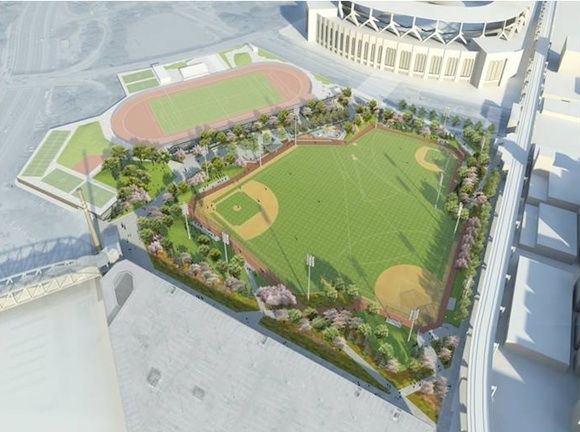
LiveBlog: Yankee Stadium Upland Park Redevelopment

 Yankee Stadium Upland Park Redevelopment

Gary Sorge, FASLA, Stantec
Frank McCue, NYC Parks

Last LiveBlog of the semester.

While one is the client and one is the design firm, they really work as a team.  The project had over 450 submittals to review. 

Mill Pond Park was built on the site of the old Bronx River Market from the 1920s-1970s.  The old Powerhouse has been retrofit with a green roof, hoping to get LEED Gold.

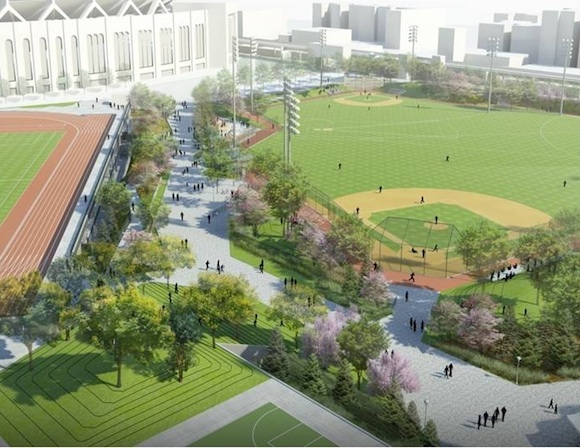
The new park has been built just as it was shown to the community in early renderings. Macomb Dam Park was also overhauled with Heritage Field and Ruppert Plaza.  There are River Avenue Pocket Parks, including small play areas and a $3 million skateboard park.

MetroNorth built a new train station which had to be integrated into these design, too.

Stantec's approach emphasized the park as more than just a collection of ballfields, but a highly accessible park for the broadest possible audiences.  Some pieces of the old frieze (the white arched fencing that is part of the Stadium iconography) were saved for the new Heritage Field.  Layout and grading requirements prevented them from being able to save the location of home plate as the new home plate, where Lou Gehrig gave his famous address. (now it is at 2nd base)  But they did preserve the giant bat.  They are also installing 7 Viewmasters so you can see slides of the old Stadium.  They did preserve the footings of much of the Stadium, burying them under the berms.


Ruppert Plaza is the wide walk you see below.  The mound is above the roof of a parking deck.

The park will also have Yankee quotes and even a Bull Durham quote scattered around on the walls. 

  Work began this past summer.

Wildlife corridors

Kelly Brenner has a detailed post on Sustainable Cities Collective that looks into Wildlife Corridors.  It pointed out that planners aren't yet making these as effective as they could be: "A study from 2008 found that planners and designers need to think more naturally because corridors that were too symmetrical were not as effective as corridors with some asymmetry and irregularities."

06 December 2010

Turning the House that Ruth Built into Heritage Field, a New Community Park

LA Fall Lecture Series presents Gary T. Sorge, FASLA, AICP

Wednesday, 12/08 at 4:00 pm,
Cook/Douglas Lecture Hall;
3 College Farm Road
New Brunswick, NJ

Turning the House that Ruth Built into Heritage Field, a New Community Park

Sports enthusiasts and fans greatly anticipated the opening of the new Yankee Stadium in 2008.  The nearby Bronx community greatly anticipates the opening in 2011 of the final piec e of an extensive park redevelopment program.  The new Stadium was constructed on existing parkland, perhaps some of the most intensely used ballfields in the City.  As part of its commitment to the Bronx community, the City of New York needed to construct new park facilities to replace what was displaced by the new stadium and associated parking structures as soon as possible.  Of course to do so, the City and the design team needed to recapture the land beneath the old Stadium for development of a significant portion of the park plan.  A new park on the roof of a parking garage, a waterfront park, two off-site ballfields, a major building renovation, two additional community parks, pedestrian bridges and local roadway improvements are now complete.  The final piece is the construction of Heritage Field and Ruppert Plaza on the grounds of the former Stadium, arguably the most prominent venue in the history of sports.

Our presentation will focus on three major elements in the sites transformation:  dismantling the Stadium; designing, gaining approvals for and constructing the new park as quickly as possible; and appropriately commemorating the events that occurred at the Stadium over its 86-year history.  Each element presented its own unique challenges and our presenter will provide a first-hand account of how a  landscape architecture led design team influenced the results.
 
Gary T. Sorge is Senior Principal at Stantec and alumnus of the Rutgers Landscape Architecture program.
For more information see Stantec.com

03 December 2010

NPR travels the Passaic

The Great Swamp and the Passaic River made it on NPR last month.  Sally Rubin helped them track down the headwaters in Mendham and then they headed downstream to ponder the effects of industrialization.  Today our students are still exploring the next steps for the Great Swamp Watershed.

Gold-light tress

To call this potential new technology a game breaker is an understatement. (h/t The Texan)

02 December 2010

A sad first for Celebration

Not quite like Mayberry.

Special speaker at New Jersey Geospatial Forum

The New Jersey Geospatial Forum is pleased to announce that Jack Dangermond, founder and CEO of ESRI, will be the guest speaker at the Forum?s December meeting. The meeting will be held at the New Jersey State Museum, 205 West State Street, Trenton, NJ 08608 at 10 a.m., in the auditorium.

Please allow sufficient time for parking, which is available either on street at metered spaces or in the following parking garages:

There is limited free parking in the Statehouse Garage:
Enter from Memorial Drive or West State Street

There are some pay parking facilities in the area:
*State Street Square Garage
Enter from Chancery lane above East State Street

*Trenton Marriott Garage
The hotel is at the intersection of W. Lafayette Street and S Warren Street
Enter the garage from South Warren Street

Or you could just take the train and walk 10 minutes.

01 December 2010

Map of warming

The Economist has a global map showing the likelihood of a place having a new "hottest summer on record" in the next several decades.  For instance, it looks like both Washington DC and Atlanta have a 70-89% chance of having a hotter summer than they've ever had. It is interesting to note that the map comes from a Food Security paper in Science - the implications could be frightening.

Factory Farm Map

Where does your food come from? Unless you shop local, FactoryFarmMap shows you the answer. (h/t Peter M)

Common Lecture canceled

Today's Common Lecture by Ray Mims of the USBG has been canceled. Maybe you could use the hour of found time to read a book.  PlaNetizen has posted their top 10 Books for 2011 and Strong Towns blog has a list of what they consider essential reading.

Quote of the Day

"Boy, if somebody could write a song about [city planning] I'd have to stand up and cheer for them. No. There are some things you just can't write songs about."

30 November 2010

Student project in the news

The Voorhees Sun reports that people are anticipating something special from our students' and CUES' efforts to transform the Buzby Landfill into the the Voorhees Environmental Park.

Laurelwood Arboretum

An open space grant is going to help get Wayne's Laurelwood Arboretum cleaned up and expanded in ways that should help get it back on the map.  Now I just have to remember to put it on the map.

29 November 2010

LA Fall Lecture Series presents Ray Mims
Applying the SITES rating System: Lessons from Pilot Projects


Wednesday, 12/1 at 4:00 pm
Cook/Douglas Lecture Hall
New Brunswick, NJ

Sustainable Sites Initiative (SITES) is in the midst of becoming a functioning rating sy stem and is now receiving feedback from real projects. SITES, an interdisciplinary effort that has created national guidelines and a rating system encourages integrated, systems-based approaches to sustainable landscape” design, construction and maintenance. SITES will work at all landscape scales, with or without buildings. The goal is renew and restore places and move from conservation to regeneration through landscapes that mimic natural systems. SITES should also be used to “restore degraded ecosystem services” found in brownfields and greyfields, creating new economic value in the process.


Ray Mims has been the United States Botanic Garden staff member working on the development of the Sustainable Sites Initiative (SITES) since 2006, participating in both the SITES steering Committee as well as the Vegetat ion Technical Committee. At the United States Botanic Garden, Ray oversees the ongoing development and implementation of sustainability efforts, conservation partnerships, and threatened plant collections at the United States Botanic Garden. Prior to joining USBG, Ray served as the Director of Horticulture at Denver Botanic Gardens, Director of Horticulture and Grounds at the Washington National Cathedral, and Horticulturist at the Atlanta Botanical Garden.


For more information please visit:

http://www.sustainablesites.org
http://www.landscapeforlife.org

28 November 2010

African plants

Rutgers Program in History of Science, Technology, Environment and Health

Judith Carney (Geography, UCLA)
Fri 3 December, 11.30am

"Seeds of Memory: Africa's Botanical Legacy in the Atlantic World"

This talk examines the ways that African food and animal species circulated in the tropical Atlantic world between the sixteenth and eighteenth centuries. Emphasis is on their role in the transatlantic slave trade, the means by which they arrived in the New World, and the sites where they were established in plantation societies. An examination of the African components of the Columbian Exchange draws attention to the significance of subsistence and the agency of enslaved Africans in instigating the cultivation of longstanding dietary preference

Rutgers Center for Historical Analysis
88 College Avenue, New Brunswick

24 November 2010

Bike sharing


WNYC reports that New York is looking to get a bike share program started by 2012.  These seem to work well in places like Barcelona and Minneapolis, so it may be a surprise that it is taking this long for NY to sign on.  Until you read about the opposition to bike lanes in the City.  Then again, maybe NYC got interested only when Boston announced they were doing it too.

You can see from the map below that Minneapolis has lots of stations. That's part of what makes it work.

Wireless and trees

Could wi-fi and wireless phones really be killing the trees?

23 November 2010

Tree vs. train

A 10-story redwood tree (named El Palo Alto)  at Stanford U is blocking a new high-speed rail line.  It is the tree that their mascot emulates.  What will they do?

22 November 2010

Princeton Junction hearing

If you are under the impression that no work gets done, then you'll find West Windsor an instructive lesson tonight. The Princeton Packet reports that the Town Council will be making a big decision about one of the properties on its "Main Street" at Princeton Junction station.  While it will bring in new revenue, some are questioning the current design.

20 November 2010

Don't forget that DIRT's Julie Bargmann is speaking at Princeton Monday night November 29th.  They've also posted an impressive Spring Schedule with Bruno Latour, Elizabeth Diller, Jeff Koons, and Thom Mayne.

19 November 2010

Digital Map of NYC

Government Technology has a feature on NYC's digital map.  While the tool has been around a while, I hadn't realized how many different features had been added., especially the historic aerial photographs.

18 November 2010

Cool class for everyone: Architectural Design

In the past our architectural design class/studio has only been open to juniors and seniors in the Landscape Architecture program. but this year we are opening it up with no pre-reqs.


Architectural Design Spring 2011 (3) Credits

Instructors:
Joseph M Hyland daedalten@aol.com
Timothy G Weiler tgweiler@embarqmail.com

Description:

The course is an introduction to the fundamentals of architectural design and its practice. The course is both a lecture and a studio and lecture topics will coincide with studio projects. The student will learn a working methodology: an understanding of designing built space, an awareness of how to read/interpret architecture through analysis: an understanding of architectural elements, site, history, materials (wood, concrete, glass, steel) and building programs: an understanding of the language of architecture, plan, section and elevation: a knowledge of architects; and the student will be introduced to the LEED process for building.

Studio projects will be both abstract and pragmatic and will last in duration from one to four weeks. Project assignments will increase in complexity over the course of the semester. The projects will be presented in models and drawings; you will design with pens and pencils as well as the computer. The final project will be the design of a building based on the student’s own design methodology.

There will be two or three field trips during class time to visit projects or exhibits. Architectural juries will be brought in to evaluate and critique some of the assigned studio projects.

There are suggested text but none are required and there will be the occasional assigned readings.

The course is open to all students, there are no required prerequisites.

The emphasis will be to have each student formulate a rational design approach to architecture. The course is both a lecture and a studio. Lecture topics will include theories of both the modern and contemporary architectural movements and examples of the buildings. Lectures on sustainability, building technologies, materials and the profession of architecture will also be covered. Studio projects will be both abstract and pragmatic and will last induration from one to four weeks. Format will be models and drawings; you will draw with pens and pencils as well as the computer.

Did you know...

Wikipedia appears to have an entry on Impervious Surface but not Pervious Surface.

Race and transit in Chicago

The Next American City has a somewhat provocative look at the differences between racial patterns on transit vs. in Chicago neighborhoods by Yonah Freemark.  Make sure you read a few of the comments.

17 November 2010

Live Blog: Seiko Goto

Designing Gardens for the Healing Mind
Seiko Goto


This post-sabbatical report comes in three acts.  As usual, liveblogging is sloppy, incomplete and inaccurate.
1) Historic research
 (will be in a film with NHK for Japanese next August and then translated into English and brought to US)

WWII Japanese Interment camps
These controversial facilities were located in inaccessible locations with poor living conditions. 
Photos by Ansel Adams only tell part of the story.
The camp was so large that it had 24 dining halls.
Today it is a NPS National Historic Site.

Gardens were one of the key tools for helping the interred make the experience less painful.

David recommends Kenny Helphand's Defiant Gardens

2) Garden Projects
What if the residents of a senior community had an indoor garden in the winter?
Differnet courtyards were identified (some designed by professionals, some note so much), and then residents were asked to visit each - once in the winter and once in the summer - and review their preferences.
Associations with plants from their childhood were important.
The Japanese garden was the most preferred and the herb garden (professionaly designed) was least preferred.  Comments about the herb garden suggested a problem with the ephemeral nature of herbaceous plants.
At a nearby school, she found that primary school kids also preferred Japanese garden designs.

As an alternative to prefernece surveys, she used synthetic and para-synthetic EKG to monitor patient responses to gardens.  Japanese gardens were found to e better, but the lack of trees in herb gardens might have just made them too hot.
Finally, Alzheimer's patients were studied.  EKG, heart rate, medical report and video tape were used to document responses.  Patients started inside and then moved outside.  They heard crickets, and when they went away, noticed that they were missing.  Since these patients' memories aren't supposed to endure that long, it was a notable finding.  Something is linking memory and gardens.

3) Japanese Garden Workshop
Mark R reported on a small group trip to Kyoto where the students got to do hands-on maintenance with a master japanese gardener.
"If a carp can become a dragon, what can you do?"

One more for EDA

New Brunswick, NJ

Clickers are growing in use

The NY Times takes a brief look at the growth of hand-held student response devices.  While I don't use them in my classes, I have to admit that I enjoy seeing the responses when used during my guest lectures in EDA.  Alas, as a quick tech piece, the author doesn't get to dig in very deep into the effectiveness of these tools. 

What do think? Big brother?  Big pain?  Or Classroom 2.0?

16 November 2010

EDA notes

Some random notes from today's EDA lecture:

Hope you enjoyed it.

Designing Gardens for Healing the Mind

LA Fall Lecture Series presents Seiko Goto

Wednesday, 11/17 at 4:00 pm,
Cook/Douglas Lecture Hall;
3 College Farm Road
New Brunswick, NJ


Designing Gardens for Healing the Mind

Dr. Seiko Goto is Assistant Professor at our department. This presentation is a summary of studies conducted during her sabbatical leave in 2009.

1. Study of Japanese gardens in North America

2. Study of healing effects of Japanese gardens.

In the first part, she will introduce her recent study on Japanese gardens in Manzanar internment camp built by internees during WWII. In the second part, Dr. Goto will introduce four pilot studies on healing effects of Japanese garden. Although each study was a short term in duration and small in sample size, the results showed strong tendencies to say that population suffering from Alzheimer disease could get positive effects from viewing a Japanese garden. Horticulture therapy was developed in the rehabilitative care of hospitalized war veterans because the therapeutic benefits of the gardening have been valued in the US. The main purpose of such a program is to encourage patients to get involved in hands on gardening activities. However, benefits of gardens come not only from gardening but also from viewing. This presentation will give a glimpse that Japanese gardens could help emotional and cognitive improvement of viewers.

15 November 2010

Rutgers water movie/s

This week there is a screening of a wonderful older film starring one of Rutgers' more notbale faculty, Michael Rockland from American Studies:

___
Members of the Rutgers community and the general public are invited to a screening and discussion of "Three Days on Big City Waters" on Thursday November 18th. The film chronicles a canoe trip from Princeton, New Jersey to New York City taken in fall 1973 by Michael Rockland and Charles Woolfolk of Rutgers University. The film starts at 8:00 pm in the Teleconference Lecture Hall, on the 4th floor of Alexander Library in New Brunswick. A discussion of the film will be led by Professor Michael Rockland.


Michael Aaron Rockland is professor of American Studies at Rutgers University. He is the author of twelve books, three of which have received special recognition. His first book, Sarmiento's Travels in the United States in 1847 (Princeton), was chosen by The Washington Post's Book World as one of the "Fifty Best Books of the Year." His latest books are Stones, a novel (Hansen Publishing Group) and The George Washington Bridge: Poetry in Steel (Rutgers). Rockland has won five major teaching/lecturing awards, including the National Teaching Award in American Studies. He has lectured in some twenty-one countries around the world. A regular contributor to New Jersey Monthly magazine, he has also worked in television and film production, mostly for P.B.S. He is regularly interviewed on N.P.R.

This event is cosponsored by the Rutgers University Libraries, the Byrne First-Year Seminars, and the Ecologies in the Balance? The Way Forward program series, as part of their Water, River, Raritan Film Series. Other film screenings/discussions planned in this series are:

* Thursday March 24, 2011 - "Rivers of Destiny"
Discussion led by Geography Department Professor Trevor Birkenholtz
in the Teleconference Lecture Hall, 4th floor, Alexander Library
* Wednesday April 13, 2011 - "Atlantic Crossing"
Discussion led by Rick Ludescher, Dean, Cook Campus
in the Cook Campus Center

Both films start at 8:00 pm.

For more information on the November 18th film screening/discussion of "Three Days on Big City Waters" or on the Water, River, Raritan film series, please contact Kayo Denda at kdenda@rci.rutgers.edu.

Eating up the Pinelands

The southern pine beetle has chewed its way through 14,000 acres of the Pinelands this year.  The Star-Ledger reports that this is easily the worst year ever. (While this link will go stale fast, you can see that it was front page news).

12 November 2010

Cool Class: Writing about Architecture, Design and Public Space

Rutgers' writing program offers a class called 355:201 Research in the Disciplines.  Doesn't sound entirely compelling?  Each section studies a different topic.  The section of interest to many of our student readers this spring will be Section B2 -  Architecture, Design, and Public Space.   (MW 1:10-2:30PM)  It gives you a chance to explore the field while enhancing your design vocabulary and improving your ability to communicate design processes and products.

The class counts towards the SEBS Oral and Written requirement.

11 November 2010

Veterans Day

At the 11th hour of the 11th day of the 11th month we remember those who've served. These photos are from the recent Fall Field Trip to DC in which we studied the WWI, Vietnam and Korean Memorials.


A massive vision for Manhattan

Paul Rudolph's plan for a Manhattan Megastructure would have destroyed so much of what is New York today. So it will be fascinating to visit the current exhibit at Cooper Union until Nov 20 to see whether you look past the Moses-style destruction of Lower Manhattan and still find value in the somewhat playful vision of Rudolph. Or maybe you think this is as brutal as his brutalist architecture.

10 November 2010

Videos

While watching videos can be easier than digging through a dense text, they do take time. Sometimes they accumulate past their time of usefulness. So, here are some videos I hope to watch soon.

Ellen Dunham-Jones gave a TedTalk (in Atlanta of all places) in which she talk about the challenge of the next 50 years: retrofitting suburbia.


Another is Duany's address to CNU 18 in which he argues that New Urbanists need to learn from landscape urbanism.

Blogging the dark side of the Garden State

Wolfram Hoefer, this afternoon's speaker, has co-authored part of a recent blog post on the Dodge Foundation's Blog. 

09 November 2010

Another GIS Day announcement

From our friends at BCC:

TOMORROW: GIS Day at Burlington County College in Mount Laurel, NJ
Wednesday, November 10th 9-4:30
The event is FREE (including Breakfast and Lunch)
Registration is requested but walk-ins will be accepted.
Register at www.co.burlington.nj.us\dit

Didn't register? You can still attend!
Registration closes at 2 PM, today, November 9th, but walk-ins will also be accepted.

This event should have something for everyone; from applications for GPS, crime mapping, transportation and climate change to advanced topics such as the Cloud and how it relates to GIS, plus interactive GPS and GIS workshops.

9-12 Speakers
12-1 Lunch
1-2:15 GPS Activity
2:30-4:30 GIS Lab
Please see the attached flyers for a detailed agenda and directions.

Be a part of GIS Day! --

*** Display your map in the map gallery! ***
In addition to the speakers and workshops, a map gallery will be on display all day. All entries will be accepted from beginner to advanced.

It's easy to enter - Just send your map to Merrilee Torres either as hardcopy (to the mailing address below) or as a PDF or JPEG (to the email address below). Please include your name, organization and a brief abstract about your map (optional). This is a chance to show your work - Maps that show how GIS or GPS was used to answer a question, make a decision or make someone's work easier are especially of interest!

Please send your map by the morning of Tuesday, November 9th or bring it with you on the 10th. All maps submitted for GIS Day will also be included in the Burlington County Map Gallery and Contest the following week (see attachments for details).

Moving maps

GIS isn't always static. Since we are interested in dynamic processes, our maps have to keep up. A great example is David La Puma's Woodcreeper blog which often includes animated radar maps showing overnight bird migrations (see below). It is a busy time of year right now for this former CRSSA inhabitant.


08 November 2010

Designing Across Opportunities for Transdisciplinary Design in a Post-Industrial Situation

LA Fall Lecture Series presents Wolfram Hoefer

Wednesday, 11/10 at 4:00 pm,
Cook/Douglas Lecture Hall;
3 College Farm Road
New Brunswick, NJ

Designing Across Opportunities for Transdisciplinary Design in a Post-Industrial Situation
 
The discipline of landscape architecture can be a potentially leading force in successfully re-integrating brownfields into the urban pattern, both functionally and aesthetically.  In order for landscape architecture to play this pivotal role in brownfield remediation, it is important to recognize the need for two levels of interdisciplinarity.  On a first level, the field integrates broad aspects of arts, humanities, and sciences.  On a second, site-specific level, landscape architects need to collaborate with professional ecologists, engineers, planners and architects. 
Using the example of the on-going research project Hackensack Water Works at Oradell Cultural Landscape Study, Park Design and Public Outreach Proposal, the presentation will examine how this “double interdisciplinarity” provides an opportunity to take leadership in brownfield remediation if the profession develops appropriate ways to address the difficulties that accompany such a situation.

Dr. Wolfram Hoefer joined  the Department of Landscape Architecture at Rutgers, the State Universiy of New Jersey as an Assistant Professor in 2006. In 1992 he earned a Diploma in Landscape Architecture from the Technische Universität Berlin and received a doctoral degree from Technische Universtät München in 2000. He is a licensed landscape architect in the State of Bavaria, Germany.
His research and teaching focus is the cultural interpretation of brownfields as potential elements of the public realm. Further he is investigating the different cultural interpretations of landscapes by the general public in North America and Europe and how they have an effect on professional approaches towards planning and design solutions for adaptive re-use of brownfields.

05 November 2010

Cool class: Material Tectonics

MATERIAL TECTONICS
550:438
Spring 2011
3 Credits
Brian Osborn

This course is an investigation into methods of construction and craft within the environmental design fields and leading to the design and build of a full scale intervention. Weekly readings will outline a contemporary theory of tectonics from the modern 1 to the digital 2. Regular seminar lectures and discussions will provide a foundation for the development of a group design project. Designs will be tested at real scale through iterative prototyping and material testing. Students will address the real consequences of material selection, in terms of their sustainability, through a term research project.


What will they build?

04 November 2010

Haiti

10 months after the earthquake, many have forgotten Haiti.  To help us be more mindful of that The Big Picture has some amazing photographs of what life is like there now.  But as you see the cities of tents, read today's news that they are bracing for what might be Hurricane Tomas by the time it gets to them.  There is lots that designers could be doing to improve situations in places like these and we've been hearing more and more about it this semester from people like Werthmann and Jelacic.  Add in a current hurricane-prone project in St Croix and a recent look at the coastal zones in Cape May, and it is increasingly clear that there is a call to answer.

03 November 2010

Cool class: Restorative and Empowering Gardens

Restorative and Empowering Gardens
LA 11:550:438(sec 1) “Special Problems in Landscape Architecture”
Spring 2011
Professors Seiko Goto and Laura Lawson
Location: TBD
Wednesday and Friday 10:55 – 12:15

Course Description
This course engages students to explore the complex relationships between people and the environment by focusing on two affective responses: restoration and empowerment. Through readings, discussion, lectures, and student work, seminar participants will examine different places that evoke these responses either intentionally or unintentionally. Students will be encouraged to explore new opportunities to enhance this role of nature in urban spaces, as well as challenged to consider other affective responses and/or places such responses would be inhibited.

The course is divided into two sections. The first section will focus on historic and contemporary examples of gardens that are used for restoration of minds and study their cultural and historical backgrounds that determined their design. The second half of the course will focus on landscapes that have played a role in empowering people toward greater self-actualization in themselves, their communities, and society. The two sections will be taught independently.

The class is open to students of all majors.

01 November 2010

Fall 2010 Environmental Geomatics Lecture

Erle Ellis, Director of the Anthropogenic Landscape Ecology Lab at the
University of Maryland, will be speaking on Wednesday, November 3 at 4pm at
Trayes Hall, 100 George Street in the Douglass Campus Center.

Dr. Ellis maps the human footprint,  a global map of human activity --human
systems with natural systems embedded into them.  Anthromes are biomes that
include this human activity, including farming, forestry, villages, and
cities.

Mount Holly's Gardens

Mount Holly has been demolishing a 1950s housing area called The Gardens. There have been plenty of news stories about it over the years, but they've generally been small and ignored.  Places and Spaces wrote about it 2 years ago.

Last week Bill Potter posted an opinion column describing how egregious he considered the latest chapter. Bill Wolfe responded with a comment on Places and Spaces as well as his own recent photos of the Gardens, which he pointed out looked a little like some parts of post-Katrina NOLA.

When we talk about policy solutions to planning problems through tools like eminent domain and COAH, the conversations (whether for or against) are often fairly abstract using numbers and zones and units to describe the policy instead of focusing on the lives of the individuals.  Last year a video was made showing the toll that the process is having on the residents.  It is touching and very personal:


29 October 2010

Where's that little Devil?

Ready for Halloween?  Someone has mapped out the sightings of the Jersey Devil. 

As a bonus, ESRI has a nationwide map of where children are wearing costumes this year.

28 October 2010

GIS Day down south

Novemeber 17th is GIS Day, easily one of the biggest days on the spatial calendar.  Our readers in South Jersey might enjoy celebrating GIS Day at Atlantic Cape Community College at their May's Landing campus:
Atlantic Cape’s GIS Day event will include exhibits by GIS professionals, student project displays, interactive games and activities, and our popular geocaching sessions. Geocaching is a modern-day, high-tech treasure hunting game played throughout the world by adventure-seekers equipped with GPS devices. 
Readers in other parts of the country can use the GIS Day locator to find a celebration near them.

27 October 2010

LIve Blog: Jerome Barth on Bryant Park

Vice President of Business Affairs
Why Bryant Park Works


Since public funding for parks and green infrastructure has become increasingly scarce, an increasing number of parks are looking for alternative models of funding.  If annual rents around Bryant Park are $13 million higher (Say, at the Grace Building), and the property is worth an extra $217 million, how much is it worth for them to help fund the maintenance of the park? 

Making the park one of the most popular in the world requires lots of work, but at the core it has come from some basic improvements: Simple design, friendly but visible security, trash collection during the day, tons of lighting, flowers (send a message that someone is in charge), and movable seating.

Attention to design concerns can refocus attention on details that impact the park's usage: Stairs are an enemy of usage.  If you want people to come into your park, you might want to avoid them.  They make access harder for disadvantaged populations and make many people think twice about using them. 

Barth also talked about the park bathrooms as a detail that matters.  (Design for women)

But maybe the Park's greatest strength is programming.  Piano at lunchtime.  Chess events.  Outdoor reading room.  Wi-fi (technology is your friend).  Movie nights.  Skating rink.  Ping-pong.  Fencing.

The #1 pleasure outdoors, no matter who you are, is people watching.

References include:
Malcolm Gladwell's Blink
Kelling and Cole's Fixing Broken Windows

Bryant Park video


Photojojo's Time Lapse Video of Bryant Park from a collection called Photojojo loves you on Vimeo.

 Remember, today's Landscape Industry Lecture is Jerome Barth from Bryant Park.

25 October 2010

The Fall 2010 Landscape Industry Lecture

The Fall 2010 Landscape Industry Lecture
Jerome Barth


Wednesday, 10/27 at 4:00 pm,

Cook/Douglas Lecture Hall

Why Bryant Park Works

Bryant Park, a once desolate place and symbol of urban decay, is now a vibrant space that is the town square of midtown Manhattan. The park creates massive value for its neighbors without using public money and through a very deliberate management style. Discover how Bryant Park is managed and why, with plenty of opportunity for questions and answers.

Jerome Barth is Vice President of Business Affairs of Bryant Park Corporation, the 34th Street Partnership and the Chelsea Improvement Company. He is directly involved in the evolution of Bryant Park as a brand and the management of innovative public space of world quality throughout all 3 business districts, ensuring that they meet the expectations of every patron who visits them.

The Bryant Park Restoration Corporation is one of the largest efforts in the nation to apply private management backed by private funding to a public park. The park reopened in 1991 with a budget six times the level under prior city management, and has been a huge success with the public, press, and nearby institutions. Today's Bryant Park is favorably compared with th e great parks of London and Paris, and was the winner of the Urban Land Institute Excellence Award for public projects, as well as many other awards from design, real estate, and redevelopment groups.

For more information please visit:

http://www.bryantpark.org

22 October 2010

2010 Top 10 Shapers of the American Landscape

Here is the list of Top 10 Shapers that I am presenting in EDA listed in alphabetic order. For comparison purposes I have linked each one to its entry in Wikipedia, but these are not definitive descriptions. And the Top 10 Shapers tag at the end will find you a few other interesting links...


The big mover this year is William J. Levitt.  Among other things, there have been 2 notable Levittown books in the last 18 months, one a collection of essays on the Bucks County Levittown while the other is linked to a notable moment in race relations. A Levittown ad was also featured this year in Lapham's Quarterly.

21 October 2010

Open space evaluation

After last week's lecture on the Evaluation of Open Space in Vienna, you might enjoy reading the more local evaluation of a piece of open space at Baldpate Mountain by Bill Wolfe.

19 October 2010

GIS job near campus

The NRCS is looking for a Natural Resource Specialist (GIS) to work in their Somerset office.

Christian Werthman lecture

We had an outstanding lecture yesterday by  Harvard GSD's Christian Werthman.  He spoke about the rapid growth and critical importance of informal cities around the world.  Called by many names, favelas, barrios and slums are all a neglected part of the urban landscape, treated as illegal and given little or no support by most governments even though they represent more than 50% of the population in some cities.  Werthman challenged the audience to step up to something new and described the landscape architectural response to it as a moral imperative.

Three different citations stood out:
  • Konstantinos Apostolos Doxiadis, whose Ekistics proposed a more focused effort of studying Human Settlement, but proposed it in a more top-down approach that isn't very well accepted today in places like the barrios in this talk
  • John Turner whose Housing by People argued for acknowledging the positive aspects of slums, which are really a locally-driven grass roots design
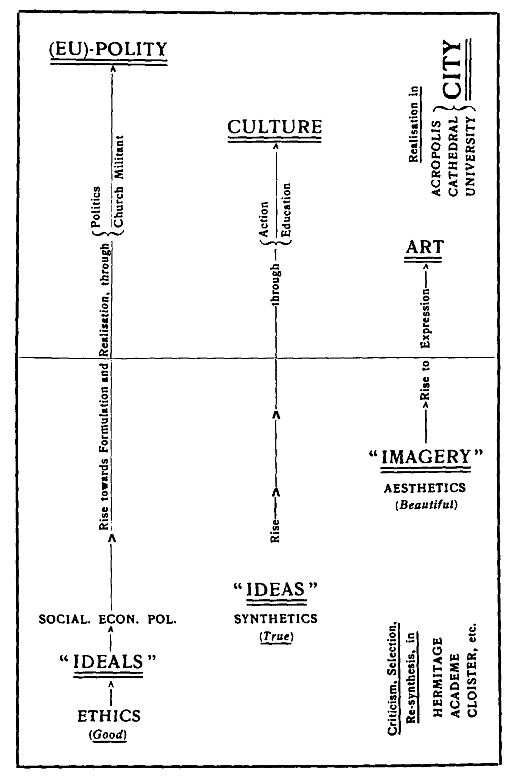
  • Patrick Geddes, particularly as described in Patrick Geddes in India, recognized the importance of green infrastructure as a tool for transforming these areas into less dangerous habitats (see also Civics: as Applied Sociology)
(This Geddes image is from Project Gutenberg's copy of Civics.)

While the examples like the Kolkata Sewage Fish Ponds from informal cities may be new to many of us, it is interesting to see how old some of the solutions are. 

18 October 2010

Frank Gallagher lecture

Ecology & Evolution Graduate Program Seminar
Dr. Frank Gallagher

Administrator NJ Division of Parks and Forestry
Visiting Scholar, Urban Forestry Program
Rutgers University
http://www.gallaghergreen.com/

"The Ecological Risk of Urban Brownfields, Lessons from Liberty Park"

Thursday, Oct 21, 2010

4:00 p.m.
Alampi Room, Marine and Coastal Sciences
Host: Dr. Peter Morin
Refreshments at 3:30

15 October 2010

Steve Strom Memorial Lecture

Next week we have our featured talk of the Fall, the Steve Strom Memorial Lecture.  This year our guest is Darrel Morrison, FASLA, presenting current works from NYC and beyond.  As a fellow of both ASLA and CELA, Darrel is widely recognized as both a designer and educator.  He was one of the founding editors of the Landscape Journal and has served as LA Chair at Wisconsin and Dean at Georgia, taught at the Conway School, and is now leading Columbia's Landscape Design program.  His ecologically-oriented design approach has been featured in any number of magazines and high-profile venues, but maybe his most prominent design work has been at the Storm King Art Center where more and more mowed lawns have been converted to tall grasses (as seen in the poster below).

Darrel was also a friend and mentor of Steve's, so it is particularly touching that he is able to participate in the series. The talk will be at 7pm on Wednesday evening October 20th at Trayes Hall in the Douglass Campus Center.  Mark your calendars now.

Another language found

Since place matters, it seemed worth noting the language, Koro, has been "discovered" in a small part of the rather large country in India.  But what makes it blog worthy is the guy recording Koro is wearing a Cincinnati  cap.  "And this one belongs to the Reds"

14 October 2010

13 October 2010

LIve Blog: Dagmar Grimm-Pretner

Dr. Dagmar Grimm-Pretner
Institute of Landscape Architecture
University of Natural Resources and Life Sciences Vienna

The areas around Vienna have a variety of landscape types as it is the meeting places of the Alps and the lowlands and is divided by the Danube.

Traditionally it has several different types of open spaces including:

Vienna has worked to preserve its Forest and Meadow

Evaluation can emphasize spatial and functional structure, comfort, and activities, with specific groups in mind.  One example was an evaluation of Bruno Kreisky Park.  Another case study looked at Fritz Imhoff Park. The same principles can be applied to something like the forecourt to Schönbrunn or a biotechcology center at Robert Hochner Park.  The Rudolf Bednar Park used orange vertical elements (sticks?) which change the personal experience of the park.

Turning towards Sustainability and Park Design we need to operationalize the concept with the intent of building a basis of for future parks effort.  As a holistic, normative concept, sustainability builds on three columns of ecology, economy and society.  A series of 9 goals were developed to assess how well proposed designs satisfied these sustainability measures.

Conext matters

As I have been saying I studio, context matters.  At all scales.

12 October 2010

COAH change

The NJ Appellate Court has found that the current Third Round COAH Rules didn't satisfy the constitutional obligation for affordable housing.  The Record had a column today.  Blue Jersey offers their perspective.  And the League of Municipalities has a letter to mayors about the situation.  And here is a response from the builders community.

Location-based U apps

Since college students are more likely, demographically, to use social media and mobile phone apps than investment bankers and sanitation workers, it only makes sense that Universities would engage them at the level.  The Chronicle reports on how schools are starting to use location-based apps, like FourSquare, to tap their energy.  (h/t PeterM)

11 October 2010

Common Lecture: Dagmar Grimm-Pretner

LA Fall Lecture Series presents Dagmar Grimm-Pretner

Wednesday, 10/13 at 4:00 pm,
Cook/Douglas Lecture Hall
3 College Farm Road
New Brunswick, NJ


Landscapes of Vienna - Qualities in Public Open Space

The presentation discusses various aspects of quality in open space. It gives an overview of c ontemporary landscape architectural work in Vienna and it presents results of research work dealing with open space design and the concept of critical sustainability.


Dr. Grimm-Pretner is an associate professor teaching and researching at the Institute of Landscape Architecture, University of Natural Resources and Life Sciences Vienna, since 1993. Her research focuses on contemporary landscape architecture in urban settings. Important topics within the research are public open spaces in densely populated urban areas and the interaction of usage and design of open space. Landscape architectural quality, as well as evaluation strategies of designs and sites, are fields of interest.

(My contemporary photos from Vienna aren't very contemporary, it turns out)